Surface mobility — from Apollo's LRV to pressurised rovers for Moon and Mars
Crewed surface stays live and die by how far the crew can travel. Apollo's LRV pushed traverse range from 1 km to 35.7 km. The next generation — pressurised rovers — pushes it to multi-week, multi-hundred-km expeditions.
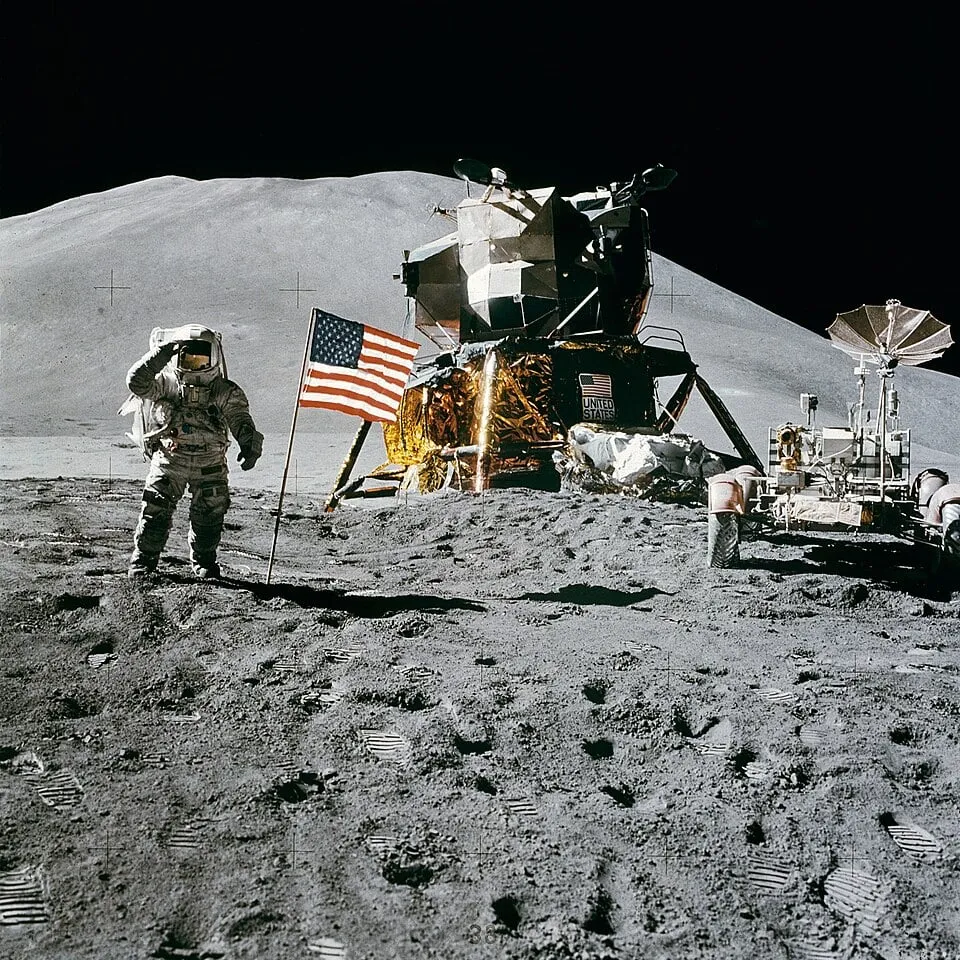
Apollo's Lunar Roving Vehicle (LRV) flew on the last three Apollo missions (15, 16, 17, 1971-72). Before the LRV, surface traverses were limited by suit consumables to about 1 km radius from the LM — and EVA fatigue from walking in 1/6-g while carrying a pressurised suit made even that distance limit a stretch. The LRV was deliberately scoped to fit folded into the LM Quad-1 storage bay (a 0.7 × 0.7 m envelope), weighed only 210 kg unloaded, and ran on two 36-V silver-zinc batteries (no recharge — the LRV was a single-mission asset). Top speed: 18 km/h. Total range on those batteries: ~92 km (57 mi), with a hard walk-back limit of half the consumables remaining (so practical traverses were 5-10 km out + 5-10 km back). Apollo 17 logged 35.7 km total over three EVAs, the all-time human surface-driving record. The LRV's design template — open-frame, unpressurised, suit-only, single-mission disposable — is what Artemis is rebuilding now as the LTV.
Artemis Lunar Terrain Vehicle (LTV) is the direct LRV descendant: open-frame, unpressurised, designed for two suited crew, ~20 km traverse radius. Three contracts were issued by NASA in April 2024 — Intuitive Machines, Lunar Outpost, and Astrolab — for design + delivery, with a single down-select expected for the production order. Differences from LRV: rechargeable batteries with solar trickle-charge (the LTV stays at the site between Artemis missions, supporting subsequent crews and operating as a tele-driven rover during the lunar nights and intervals when no crew is present), partial autonomy for self-positioning and obstacle avoidance, designed for ~10-year deployed lifetime instead of single-use. Target IOC: Artemis V (currently scheduled mid-2030).
Pressurised rovers are the qualitatively different next step. The Toyota / JAXA Lunar Cruiser concept (the project name for what JAXA calls the Manned Pressurised Rover) is a 6-tonne, 6 × 5 × 4 m vehicle with internal pressurised volume of ~13 m³ — about the size of a small bus or a Winnebago RV. Two crew live inside in shirtsleeves for up to 30 days at a time, exiting in suits through suitlock airlocks. The fuel cell + regenerative cycle gives 1000-km range. The Chinese ILRS programme has a similar pressurised rover under development. Practical implications: a pair of pressurised rovers can support multi-month expeditions far from the base camp, transforming surface ops from 'a few days outdoor activity from home' to 'expedition-style traverses of hundreds of km' — closer to Antarctic field-camp logistics than to Apollo. NASA's plan uses the Toyota Lunar Cruiser as the agency-baseline pressurised rover starting around Artemis VII.
Mars rover heritage is purely robotic so far — Sojourner (1997), Spirit + Opportunity (2004-2010 and 2004-2018), Curiosity (2012-present), Perseverance (2021-present), Zhurong (2021-2022), Pragyan (2023). All four-wheel or six-wheel, all unpressurised, all autonomous-with-Earth-supervision. Crewed Mars architectures lean heavily on this heritage: Perseverance's autonomous-navigation software (AutoNav 2.0, which can drive 200+ m per Sol without intervention) is being matured into the navigation stack for crewed pressurised rovers. The pressurised rover for Mars is qualitatively the same machine as the lunar one, but with two extra demands: it has to handle dust storms (typhoon-class scenarios that can last weeks), and it has to handle the perchlorate / dust contamination problem on every airlock cycle. Both are unsolved at the engineering level today; both are the kind of problem that gets solved by 5-10 years of lunar pressurised-rover field-testing before Mars.
SEE IN THE APP
- /moon Apollo 15/16/17 LRV traverses (Hadley, Descartes, Taurus-Littrow); Yutu-1, Yutu-2, Pragyan, Rashid robotic rovers; Artemis LTV + pressurised-rover landing zones
- /mars Sojourner, Spirit, Opportunity, Curiosity, Perseverance, Zhurong — robotic rover heritage informing crewed pressurised-rover architectures