Lunar surface operations — 1/6 g, regolith, day/night
Apollo gave humanity 12 lunar walkers, 22 EVAs, ~80 surface-hours, 382 kg of samples. Every crew came back wishing for different things. Artemis is rebuilding the lunar EVA playbook against what those 12 learned.
Locomotion in 1/6 g is the first surprise. Apollo crews trained at the Langley 9.5° simulator + KC-135 parabolas, and everyone still landed expecting a clumsy walk. Reality was the opposite: walking at 1/6 g is *over*-stable in some axes (the body's mass-times-1/6g restoring force is small, so you settle slowly), and *under*-stable in others (forward momentum from a step persists much longer than on Earth, and there's no atmosphere to slow you). The Apollo crews converged on three locomotion modes: walking (good for slow + careful), the loping-jog (good for medium-distance, both feet off the ground for an extended period), and the kangaroo-hop (Aldrin's discovery on Apollo 11 — push off with both feet, glide). The Apollo 17 EVA-3 transcript has Cernan and Schmitt openly negotiating which mode to use for each segment of the traverse; the answer is mostly loping.
Lunar dust is the second surprise and the worst-engineered problem of every Apollo mission. Apollo regolith is razor-sharp on the micron scale (no atmospheric weathering, no liquid water to round the grain edges; the grains are essentially shattered volcanic glass), electrostatically charged from solar-UV photoionisation (the dust *flies* toward charged surfaces), and pervasive — by the end of Apollo 17, EVA suits, cabin interiors, sample bags, and even the crew's bodies (after un-suiting) were uniformly grey-brown. Schmitt, the only geologist who walked on the Moon, developed 'lunar hay fever' inside the LM after Apollo 17's third EVA — measurable respiratory irritation from inhaled regolith. The medical analog on Earth is silicosis. Modern projections of long-duration lunar habitation place dust mitigation at #1 in the engineering problem list above radiation, thermal, ISRU, or psychological factors; the Artemis-era response is electrostatic dust mitigation (active charge-neutralisation surfaces), redesigned suit gaskets, and inside-the-airlock dust-removal systems (the Apollo crews could only brush).
Day/night thermal cycles are the third constraint. The lunar day is 14 Earth-days of continuous sunlight; the lunar night is 14 Earth-days of darkness. Surface temperatures swing from ~+120 °C in daytime to -180 °C in the unlit areas — wider than any environment humans operate in. Apollo missions all landed within ±5° of the morning terminator, where the sun was low enough that thermal stress on the suits was tolerable for the planned ~3-day stay (Apollo 11 was 22 h, Apollo 17 was 75 h). Artemis III's planned ~6.5-day stay near the south pole avoids this problem differently — the South Pole has near-permanent illumination at the rim of certain craters (Shackleton, Cabeus) plus near-permanent shadow in the crater floors (where the water-ice ISRU targets are). The new EVA architecture is fundamentally cold-shadow + warm-rim + repeated airlock cycling, which has no Apollo analog.
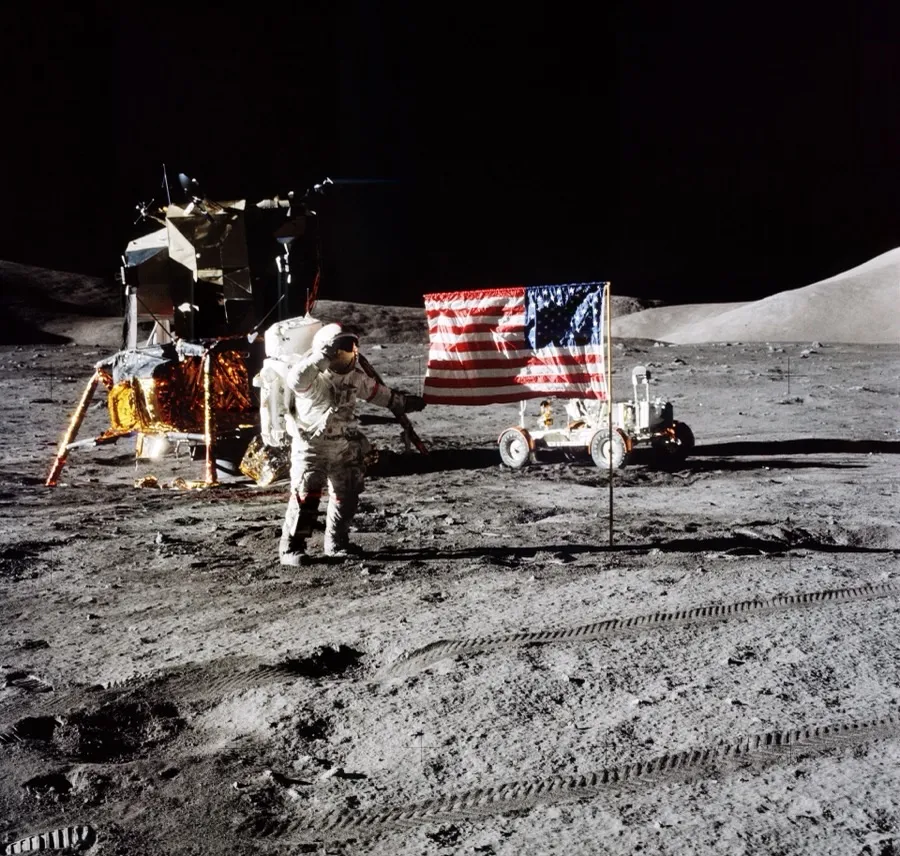
The Apollo Lunar Roving Vehicle (Apollo 15-17) was the single most-cited improvement requested by every Apollo crew that didn't have one. The LRV had 4 in-wheel motors (each 0.25 hp), a design top speed of ~13 km/h (Cernan hit ~18 km/h on Apollo 17, the downhill speed record), and a walk-back radius of roughly 5–7.6 km from the LM depending on mission and consumables (the EVA-walkback constraint — if the rover failed, the crew had to be able to walk back inside their consumables budget). The Artemis programme's analog is the LTV (Lunar Terrain Vehicle, three commercial designs under contract from 2024). A pressurised lunar rover ('lunar Winnebago' was the early NASA branding) is planned for later Artemis flights — Toyota + JAXA have a joint design called Lunar Cruiser; China's CMSA is building Tansuo, an unpressurised two-seat rover, for its first crewed landing, targeted for 2030. Pressurised mobility extends the operational range to ~200 km from the lander, transforming what 'surface operations' means.
ISRU — In-Situ Resource Utilisation — is the architecture-defining problem for any lunar stay beyond about a week. Apollo brought everything from Earth; the LM had ~12 hours of consumables margin past the planned EVAs. Artemis III plans a similar Earth-only architecture for the first surface mission, but Artemis IV+ and any future Moon-permanence design has to use lunar resources. The two big ones are water-ice (in the south polar permanently shadowed craters — Chang'e 5 sampled regolith with detectable water; the planned NASA VIPER rover would have prospected directly; Polaris Dawn-class commercial missions may carry their own prospectors) and lunar regolith for shielding (radiation + thermal — the same regolith that's a respiratory hazard inside is a useful shield outside). Tiangong-derived Chinese lunar plans, ESA's Moon Village concept, and NASA's Artemis Base Camp all assume ISRU water + ISRU shielding as enablers — without them, lunar permanence is unaffordable.
SEE IN THE APP
- /missions Apollo 11–17 (crewed), Artemis II–III (planned), Chang'e 5/6 sample-return as comparison robotic analogs — every lunar surface mission has different physiological + operational profiles
- /moon Apollo 11–17 + Artemis III landing sites — each carries duration + sample-mass + traverse-distance fields that lunar-surface ops directly constrain
- /fleet A7L, A7LB (Apollo lunar suits), AxEMU (Artemis lunar suit, Axiom Space build) — surface-rated suits are a distinct class from station EVA suits