Pre-flight training — the years before launch
Modern astronauts train 18-24 months basic + 2-3 years mission-specific before flying. Apollo crews trained 5 years for a 10-day mission. Ground-to-flight ratio is the highest of any operational profession.
Basic training is roughly the same across NASA, Roscosmos, ESA, JAXA, CSA, and China’s CMSA: scuba certification (for the neutral-buoyancy pool work that will later teach EVA), aircraft flight time (T-38 jets at JSC, L-39s at Star City), parabolic flight (~30s zero-g exposure in a converted aircraft — the 'vomit comet' name is accurate the first 10 flights), centrifuge to 8g (off-nominal Soyuz ballistic re-entry; nominal is ~4g), altitude chamber to 30,000 ft, sea + desert + arctic survival training (in case of off-nominal landing). NASA's basic-training cohort runs Houston-Cologne-Tsukuba-Tsukuba for 18-24 months; Roscosmos's GCTC programme is similar but longer (24-30 months) and includes more centrifuge time. The basic phase isn't about specific missions — it's about producing a body of qualified astronauts who could be assigned to any future flight.
Mission-specific training begins ~2.5 years before launch for an ISS expedition and ~5 years before launch for an Apollo-class deep-space mission. The crew is assigned, the science programme is locked, and training shifts from 'what is space' to 'what specifically will I be doing on this mission'. ISS expedition training cycles through Houston (US-segment operations, Crew Dragon / Soyuz), Star City (Soyuz, Russian-segment operations), Cologne (Columbus module + EVA Lab), and Tsukuba (Kibo). A crew member touching every module on station has roughly 12,000 hours of mission-specific training by launch — the equivalent of six years of full-time work on top of the basic-training pipeline.
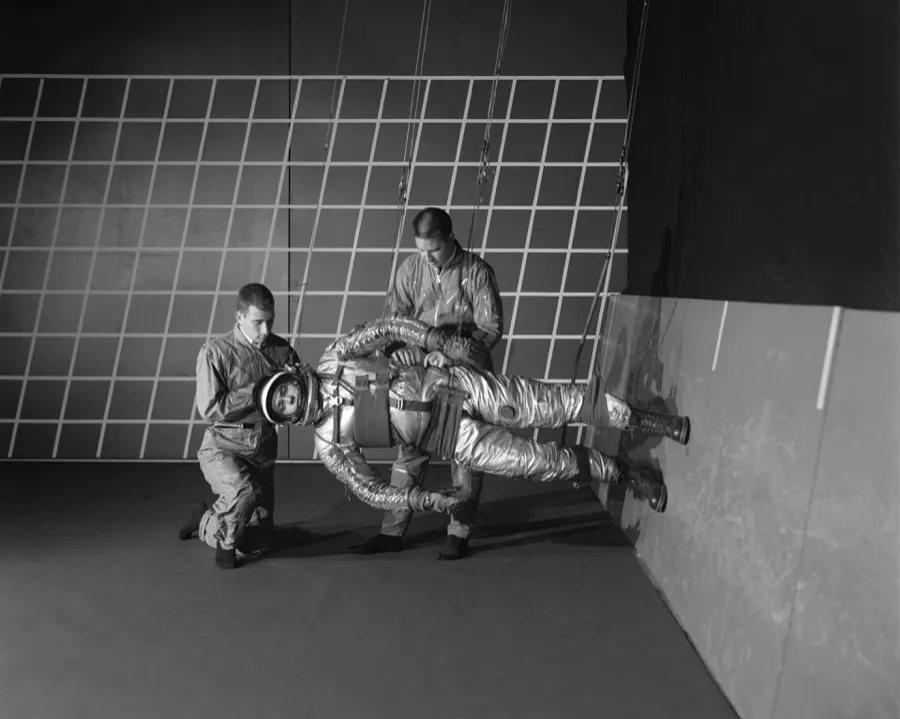
EVA training happens in the Neutral Buoyancy Laboratory (NBL) in Houston — a 40m × 25m × 12m pool with a full-scale ISS mockup at the bottom. The astronaut wears a pressurised suit (the EMU, modified for water) and is weighted to neutral buoyancy so they can practice the exact tasks they'll do on orbit. The training ratio is severe: roughly 10 hours of NBL training per 1 hour of planned flight EVA. The Russian counterpart is the Hydrolab at Star City, configured for Orlan suits + Russian-segment mockups. China runs an equivalent at the Astronaut Center of China outside Beijing. Apollo lunar EVAs trained at a 9.5° suspension rig (pictured) plus 1/6-g KC-135 parabolic profiles plus rock-collection field trips in lunar-analog terrain — Iceland for Apollo 17, the Grand Canyon for earlier missions.
Vehicle-specific simulator time dominates the final 6 months. Soyuz crews log ~250 hours in the Star City Soyuz simulator, including dozens of off-nominal scenarios (one re-entry engine fails, attitude-control thruster sticks, parachute deploys late). Crew Dragon and Starliner crews use SpaceX's Hawthorne and Boeing's Houston simulators respectively. Shenzhou crews train at ACC's Shenzhou simulator. Every simulator session ends with a debrief covering what went right + what went wrong, and the same scenarios get re-run weeks later to confirm the lessons stuck. The cumulative simulator time across all spacecraft a modern ISS commander has flown — Soyuz + Crew Dragon + perhaps Starliner — runs ~1,500 hours. That's a year of full-time work just on getting the vehicles right.
Quarantine + the final two weeks are the strictest part. Soyuz crews enter pre-launch quarantine 14 days before liftoff at Star City + Baikonur — closed dormitory, controlled diet, daily medical, no outside visitors except family at a glass barrier. Crew Dragon uses a shorter 7-day quarantine at Kennedy Space Center. Shenzhou uses a similar 14-day window in Beijing then transfers to Jiuquan. The purpose is partly infection control (a head cold in microgravity is debilitating + can't be effectively treated) and partly psychological — the quarantine ritual marks the transition from training to operational status. By launch morning the crew has been awake roughly 6 hours, eaten a calibrated low-residue meal, suited up in 3 hours of choreographed pre-egress, and walked the 100m from suit-up to the bus to the launch pad. The Soyuz tradition of urinating on the rear-right tire of the bus (a Gagarin original) and the Shenzhou tradition of three formal handshakes before boarding both date to the same impulse: rituals close the training era and open the flight.
SEE IN THE APP
- /missions Crewed expeditions — the training pipeline that produced each crew is encoded in the mission's pre-launch timeline
- /fleet Crewed spacecraft (Soyuz, Crew Dragon, Starliner, Shenzhou, Orion) — each requires its own vehicle-specific training cycle
- /iss ISS module training — every astronaut on station has trained on every module they'll touch