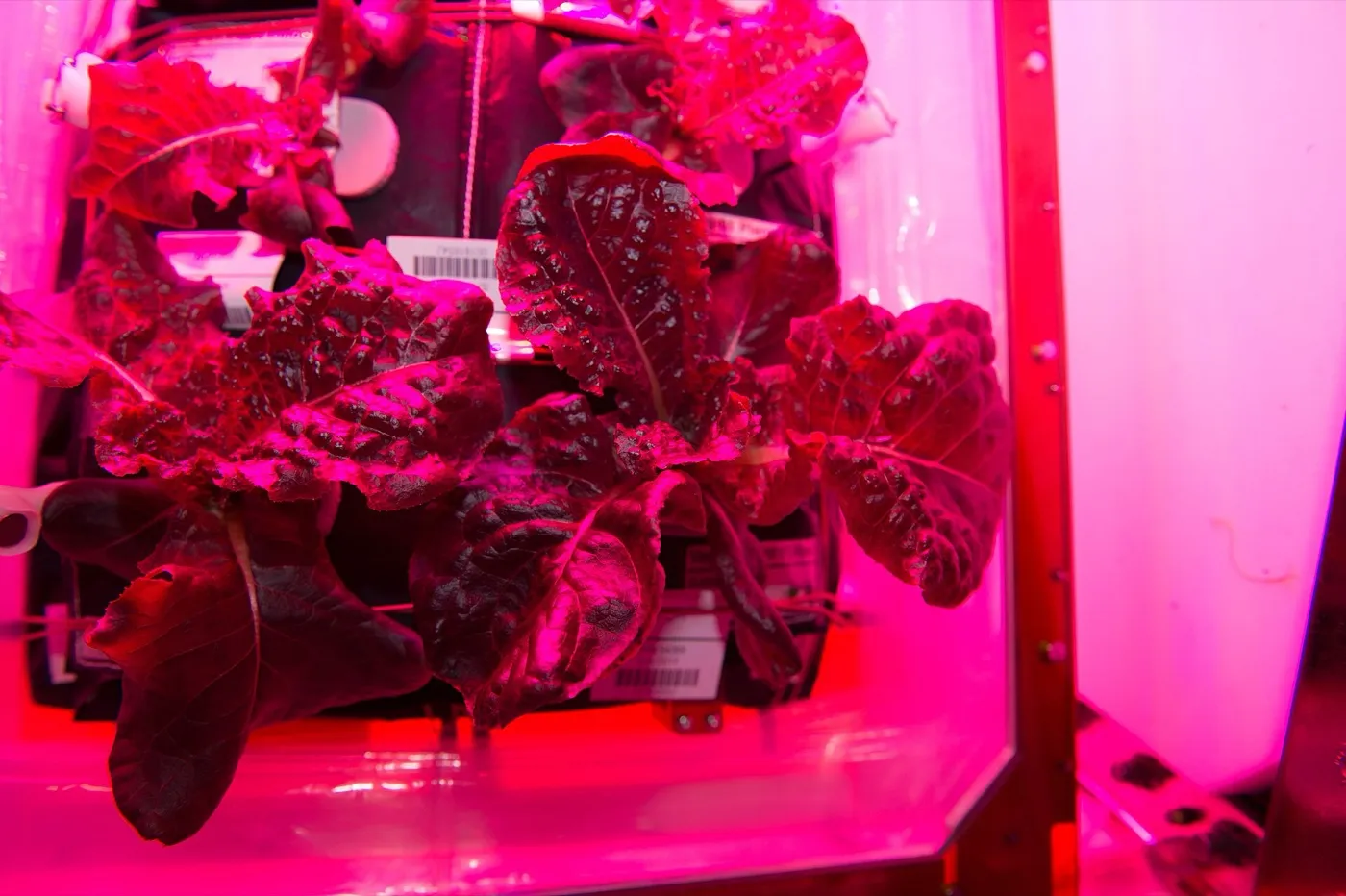
Food production off-world — from Veggie to greenhouses on Mars
ISS crew have been eating food they grew themselves since 2015. The leap from 'salad supplement' to 'closed-loop daily diet' is the open frontier between the ISS today and any Mars settlement worth the name.
ISS started its food-from-orbit programme in 2014 with Veggie, a small chamber bolted into the Destiny lab with red and blue LED lighting and pillow-style root modules. The first crop the crew was cleared to eat was 'Outredgeous' red romaine lettuce, in August 2015 — half the harvest eaten on-orbit, half returned for analysis. Since then Veggie has cycled mizuna, pak choi, mustard greens, tatsoi, kale, peppers, and zinnia flowers (the flowers were a deliberate test for crops with reproductive structures), plus the Advanced Plant Habitat (APH, installed 2017) adding a closed-environment 0.4 m² growing volume with sensor-monitored CO₂, humidity, and light. The contribution to crew nutrition is small — measured in handfuls per crew per month — but the psychological contribution is large, and validated against the recommendations from the Mir 1980s isolation studies which flagged 'connection with growing things' as a core countermeasure against asthenia.
The architecture for a Mars or lunar greenhouse is much bigger. NASA's reference Mars greenhouse module: 50-150 m² growing area, hydroponic or aeroponic, LED-lit (sunlight on Mars is ~43% of Earth's surface insolation, insufficient for high-density agriculture especially during dust storms), running on closed-loop water + nutrient + CO₂ recycling. Target: provide ~50% of crew calories + 100% of fresh produce, with the other 50% shipped from Earth as shelf-stable rations. The 50% threshold is significant — below it the greenhouse is a supplement; above it the crew is committed to it for survival, which changes the redundancy + maintainability + crew-time-cost calculus dramatically. CHAPEA, NASA's year-long Mars-analogue mission running at JSC (first 378-day mission completed July 2024, second mission underway), is actively measuring this trade.
The deeper architecture is bioregenerative life support: instead of physico-chemical ECLSS (Sabatier reactors, CDRA zeolites), use a biological loop where crew CO₂ feeds plants that produce O₂, plant waste feeds composters that produce fertilizer that feeds plants, and so on. ESA's MELiSSA project (Micro-Ecological Life Support System Alternative, started 1989, multiple breadboards operational at Universitat Autònoma de Barcelona) is the canonical research programme — five interlinked bioreactor compartments simulating a closed-loop human + plant + microbe ecosystem. MELiSSA has demonstrated stable closed loops of months in duration at sub-scale; the technology readiness for a flight mission is moderate (~TRL 4-5), with mass and reliability the open issues. Russian Bios-3 (Krasnoyarsk, 1972-1984) demonstrated ground-based closed-loop food + atmosphere for 4 humans for up to 5 months; their data still informs current designs.
Mars adds a regolith problem. Direct planting in Mars soil is ruled out for the same reason direct breathing is — perchlorates. Mars regolith is laced with 0.5-1% ClO₄⁻ which is a thyroid toxin and likely root-system inhibitor. Mitigations under research: perchlorate-reducing bacteria (some Earth species naturally consume perchlorate as electron acceptor), pre-treatment with electrochemical reduction (using ISRU-electrolysed H₂), or simply hydroponics that doesn't touch regolith at all. The simplest path is the third — keep food production decoupled from regolith and use it only for habitat shielding + construction. Lunar regolith doesn't have the perchlorate problem but is metabolically inert and physically abrasive — most plant species fail to thrive in lunar simulant unless heavily amended with composted organics.