Bone density loss
Astronauts lose roughly 1–2% of bone mass per month in microgravity — the same rate as elderly osteoporosis, but compressed and reversible-ish.
Bone is a living tissue that constantly remodels itself: osteoblasts lay new bone down, osteoclasts dissolve old bone away, and on Earth the loading from walking, lifting, and just standing keeps the two roughly balanced. Take that loading away in orbit and the balance tips. Resorption keeps going at its normal rate; new-bone deposition slows. The result is a net loss of about 1–2% per month, concentrated in the weight-bearing structures: lumbar spine, pelvis, femoral neck, calcaneus.
For comparison, post-menopausal osteoporosis on Earth runs at about 1–2% per **year**. A six-month ISS mission compresses about a decade of age-related loss into half a year. Some of it comes back after flight; some doesn't. Studies of long-duration crew suggest measurable bone-mineral-density deficits persist for years post-flight even after dedicated rehabilitation.
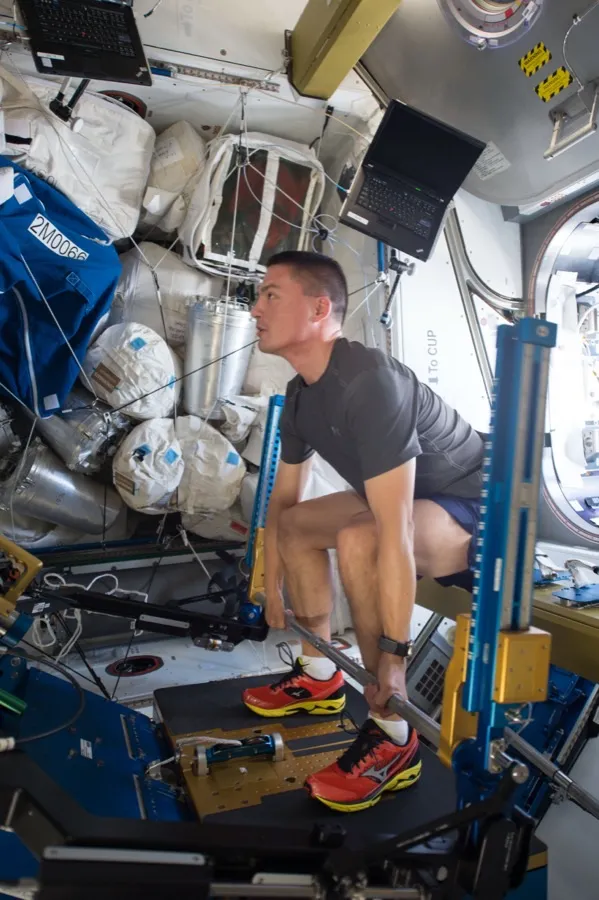
The countermeasure stack on the ISS is ARED (Advanced Resistive Exercise Device — a vacuum-piston-loaded fake squat rack), the T2 treadmill (run while bungeed down), and the cycle ergometer. Modern protocols hit ~1100 N axial loading on ARED — high enough to be osteogenic. With ARED + bisphosphonate drug regimens, six-month crew now return with bone losses around 0.5%/month rather than the pre-ARED 1.5%/month. Better, not solved.
For a Mars-class three-year round trip, even the best current countermeasures imply a fracture-risk landing astronaut. Active research lines include vibration platforms, mechanical loading suits, and exploring whether artificial gravity (a slowly rotating habitat) is the only durable answer.
SEE IN THE APP
- /iss Exercise modules (ARED + treadmill) on the ISS hardware tour