Mars human architecture — what crewed Mars actually requires
Apollo went to the Moon and came home in 8 days. Crewed Mars is a 2-3 year mission with 6-9 month transits each way, conjunction blackouts, and a self-sufficient surface stay. None of the technology is fully ready.
The transit problem dominates the architecture. Earth-Mars transfer windows open every 26 months; the cheapest (lowest-ΔV) Hohmann-class transfers take ~7-9 months one-way, with a forced surface stay of 18-20 months until the next launch window aligns. Faster transits exist but cost much more ΔV — NASA's DRA 5.0 baseline assumes a 6-month transit using nuclear thermal propulsion (NTP) that doesn't yet exist at flight scale. SpaceX's Starship architecture relies on aerocapture + propulsive landing using methane/oxygen propellant (the ISRU portion is provided in-situ from the Mars CO₂ atmosphere); the Starship approach plausibly enables ~3-4 month transits at higher ΔV. The crewed-Mars plan that CALT, China’s main rocket maker, presented in 2021, with first crews from 2033, is in the same conceptual family, with a different ISRU profile. Russia's IKI Mars proposals predate the modern engineering studies. India's ISRO Gaganyaan-derived crewed-Mars studies are conceptual.
Radiation is the unsolved physiological problem. The Earth-Mars transit is outside Earth's magnetosphere; crew radiation dose from Galactic Cosmic Rays (GCRs) accumulates at ~1.8 mSv/day during transit (vs ~0.3–0.5 mSv/day on ISS, per MSL/RAD measurements). A 6-month transit each way + 18-month surface stay (with Mars's thin atmosphere providing partial GCR shielding but no magnetic-field shielding) totals roughly 1 Sv of GCR exposure — which maps to an estimated few-percent increase in lifetime cancer risk for a Mars crew member — a figure with large uncertainty (roughly a factor of 2–4), since the risk models extrapolate from very different radiation types. Solar Particle Events (SPEs) add irregular acute-dose spikes; the Carrington-class SPE of 1859 would have been fatal to unsheltered Mars-transit crew. The countermeasure stack is partly passive (water-based or polyethylene-based radiation shielding around the crew sleeping quarters), partly active (active shielding via electromagnetic deflection — researched but not flight-proven), and partly architectural (Mars regolith berms over the surface habitat, ~3 m of regolith provides equivalent shielding to Earth's atmosphere).
Mars surface ops at 1/3 g add their own set of unknowns. Apollo crews stayed 22-75 hours; ISS crews stay 6 months but at 0 g; nobody has ever stayed at a fractional gravity for 18 months. The bone-density-loss and muscle-atrophy curves at 1/3 g aren't measured — extrapolations suggest they're better than 0 g but worse than Earth, with the unknown being whether the body re-adapts to a steady-state at 1/3 g or continues a slower atrophy curve. Vestibular adaptation is another open question — Earth-Moon-Mars sequencing for a single mission may produce a different end-state than Earth-Mars direct. The ISS Twins Study (Mark + Scott Kelly, 2015-16) provided the first identical-twin Earth-vs-space dataset; Mars-class analog studies (Antarctica winter-over, HI-SEAS, Mars Society MDRS, Roscosmos SIRIUS) provide isolation + psychology data but not the gravitational variable.
ISRU — In-Situ Resource Utilisation — is the architecture enabler. Mars's atmosphere is 95% CO₂ at ~0.6% Earth's pressure; the MOXIE experiment on Perseverance demonstrated electrolysis of atmospheric CO₂ to produce O₂ at ~10 g/hour scale (a flight-rated 200x larger unit could supply a crew). Mars subsurface water-ice exists in mid-to-high-latitude permafrost (verified by Phoenix, Mars Reconnaissance Orbiter, Mars Express); the SHARAD radar found subsurface ice bodies and reachable at depths of ~1 m in some sites. Combined CO₂ + water-ice ISRU produces methane + oxygen, the propellant pair used by Starship — closing the propulsion loop and reducing Earth-launched mass by a factor of ~3 for a chemical-rocket Mars architecture. The deployed ISRU plant has to operate autonomously for ~26 months before the crew arrives (the cargo-pre-deploy architecture). No spacecraft has yet survived 26 months of unattended Mars surface operation; the longest-lived was Opportunity at 14 years, but with continuous Earth oversight.
EDL — Entry, Descent, Landing — is the bottleneck nobody has solved at human scale. The Mars atmosphere is thick enough to require heat-shield protection on entry (~3-5 km/s entry velocity) but too thin to slow a vehicle to landing speeds aerodynamically. Every Mars lander to date — Viking through Perseverance — has been ~1 tonne or less. A crewed Mars lander has to deliver ~20-30 tonnes to the surface. The available techniques are supersonic retropropulsion (SpaceX-pioneered, used at Earth landing, scalable in principle), supersonic inflatable aerodynamic decelerators (NASA HIAD demonstrators are flight-tested), and propulsive descent throughout (Starship architecture). None has been demonstrated at human-class Mars scale. The first uncrewed mass-class Mars EDL demonstration is at the front of every architecture's critical-path list, alongside the ISRU plant and the deep-space life-support stack.
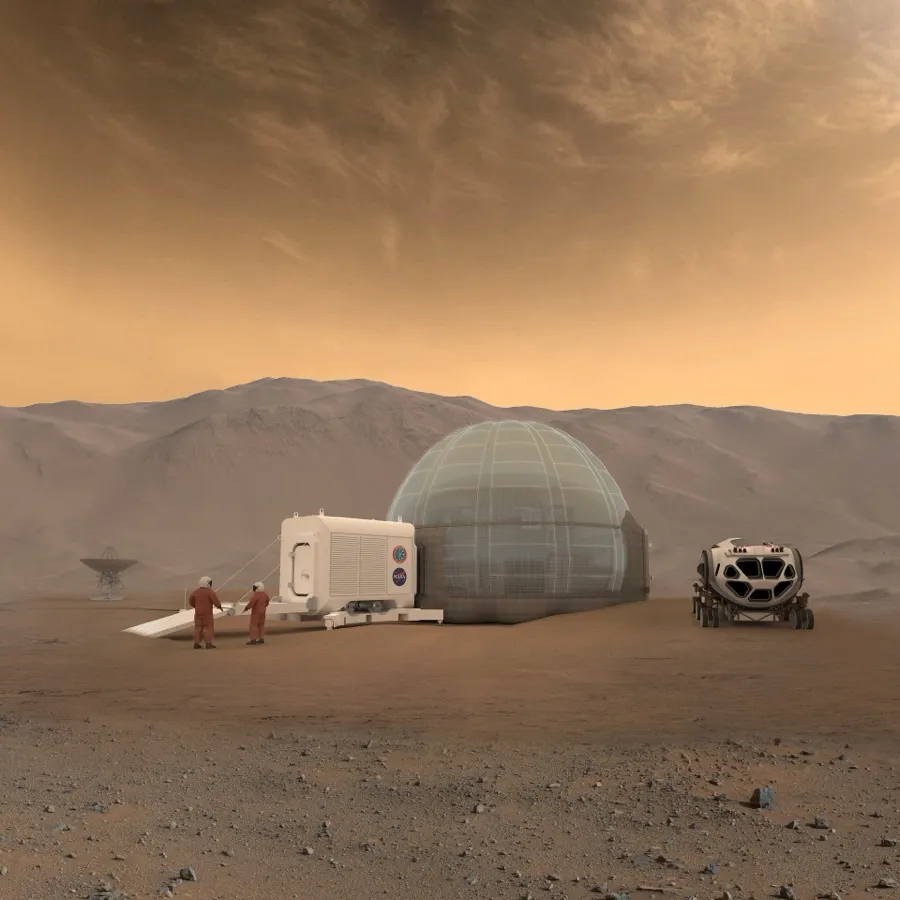
SEE IN THE APP
- /missions Mars sample-return (planned), Artemis-bound architecture studies (long-term), the existing /mars rover catalogue is the closest operational analog
- /mars Hotspots + rovers + their landing zones — every site in the catalogue is a candidate landing ellipse for crewed Mars
- /fleet Crewed-Mars-class spacecraft are largely conceptual today; the Mars transit habitat is the limiting design problem