Lunar habitat design — Artemis Base Camp, ILRS, sustained surface stays
Two parallel architectures are now committed: NASA's Artemis Base Camp + the Chinese-Russian ILRS. Both target the lunar south pole, both stake their water-ice strategy on the same dozen craters.
The site choice is no longer open. Both NASA's Artemis programme and the Chinese-Russian International Lunar Research Station (ILRS) have selected the lunar south pole, specifically the rims and inner walls of permanently-shadowed craters near 89°S: Shackleton, de Gerlache, Haworth, Faustini, Shoemaker. Three things make this region uniquely valuable. First, the permanently-shadowed regions (PSRs) at the crater bottoms hold water-ice deposits — confirmed by LCROSS (2009) impacting Cabeus crater and detecting OH/H₂O in the ejecta plume, and by Chandrayaan-1's M3 instrument seeing the spectral signature directly. Second, peaks-of-eternal-light along the crater rims see the sun for >85% of every year, giving near-continuous solar power without lunar-night batteries. Third, the south pole is the only region where both prerequisites — water and sunlight — coexist within ~10 km of each other, making short surface-traverse logistics possible.
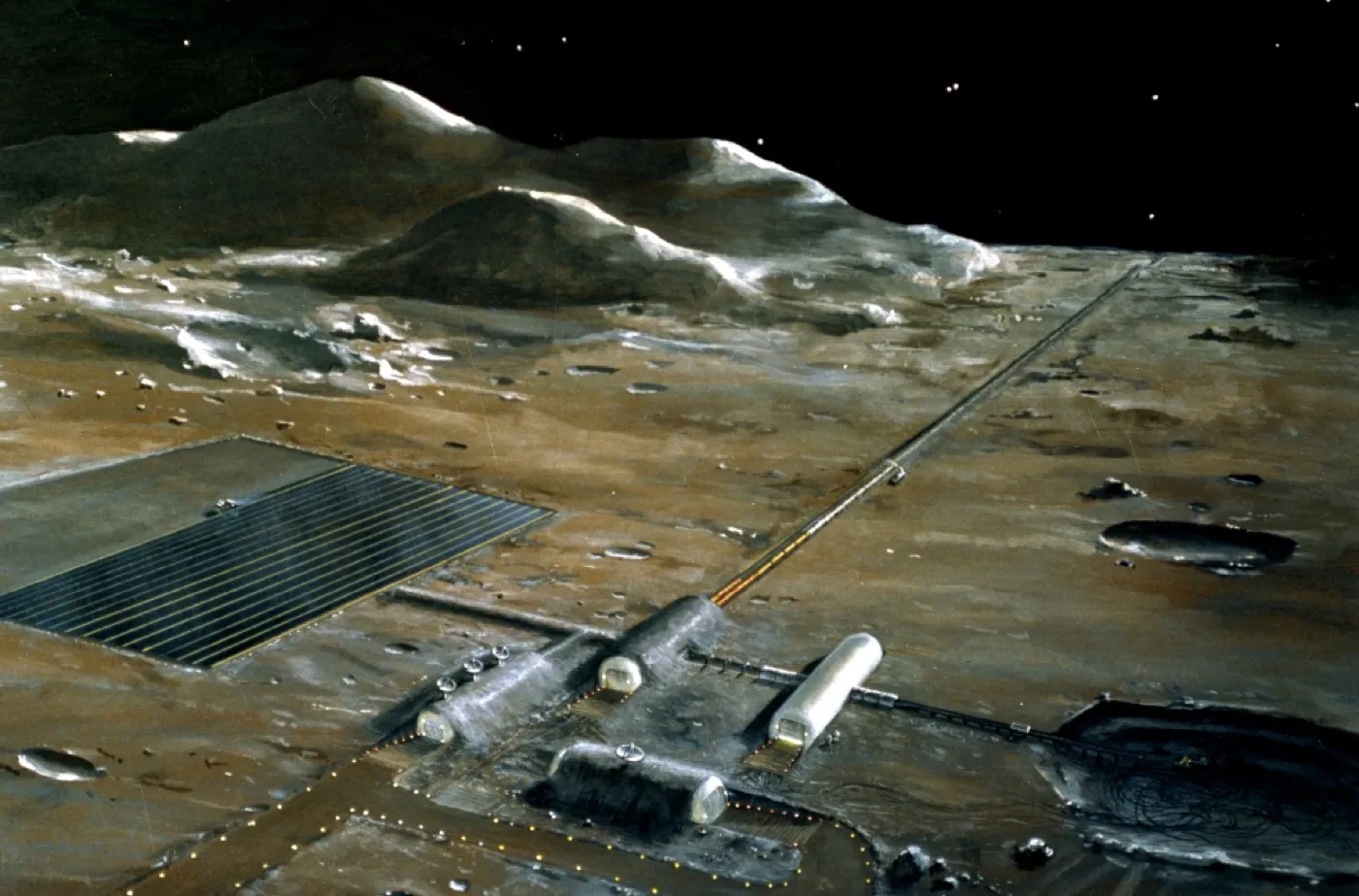
Artemis Base Camp is the consolidated NASA + partner architecture for sustained Moon presence after 2028. Three elements: (1) a Foundational Surface Habitat — a fixed pressurised structure, ~50 m³ habitable volume, supporting two crew for ~30 days; (2) the Lunar Terrain Vehicle (LTV) — unpressurised buggy descended from the Apollo Lunar Roving Vehicle, contracted to Intuitive Machines / Lunar Outpost / Astrolab for 2030 delivery; (3) the Pressurised Rover — a Toyota / JAXA-built tracked vehicle the size of a small bus, with 30-day endurance and on-board ECLSS, allowing multi-week traverses without returning to base. The total mass on the surface at IOC is around 12 tonnes, delivered by Starship-HLS, SpaceX Cargo, and Chinese-equivalent commercial-cargo landers being matured in parallel.
ILRS is the Chinese-Russian counterpart, announced 2021 with a coalition that now includes Pakistan, Belarus, South Africa, Egypt, Thailand, Venezuela, and more. The architecture is similar but the timeline is more aggressive: Chang'e-7 (2026 scheduled) + Chang'e-8 (2028) precursors, robotic outpost build-up 2030-2035, crewed landings before 2030 (mostly aspirational), full base 2035-2045. The base design centres on a Tianhe-derived pressurised module landed via Chang'e Mission Module variants, supplemented by inflatable BEAM-style habitats. The differences from Base Camp are doctrinal: ILRS plans for nuclear-fission surface power (Russian-supplied 10 kWe reactor) where Artemis stays solar; ILRS sites cluster closer to potential mining sites where Artemis spreads more for redundancy.
Two structural problems dominate habitat design — both Moon and Mars share them, but the Moon hits them first. Radiation: galactic cosmic rays + episodic solar particle events deliver about 1.4 mSv/day on the lunar surface (measured by Chang'e-4's LND instrument), vs ~0.5–0.7 mSv/day on the ISS inside Earth's partial magnetospheric shielding — roughly 2–2.5× higher dose. The mitigation strategies under design: regolith berms bulldozed around fixed habitats (1-2 m of regolith blocks ~80% of dose), lava tube interiors (~80-100 m below surface, in tubes detected by Selene / LRO from collapsed skylights — Marius Hills and Mare Tranquillitatis pits are the canonical sites), or pre-positioned water-wall shields. Dust: Apollo crews reported that lunar dust degraded EVA suits within ~10 EVAs, jammed airlocks, abraded seals, smelled like gunpowder, and triggered allergic responses inside the LM. Surface habitat designs all incorporate suitlock dust airlocks (suits stored on the outside, crew climbs in from inside without bringing dust into the pressurised volume) — the same architecture used on Artemis EVA suits and the ILRS plan.