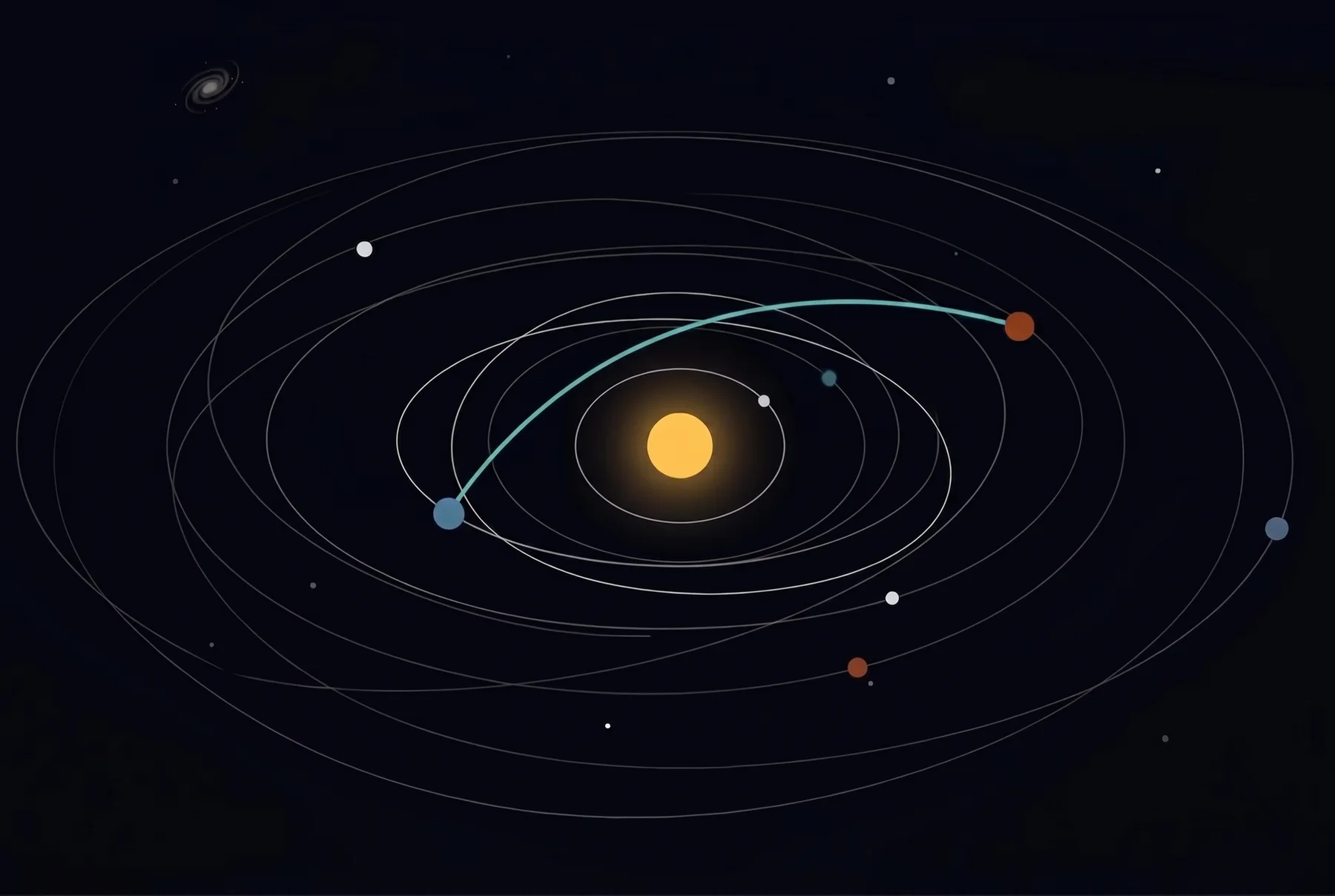
ORRERY
A solar system explorer for the browser.
Real orbital mechanics. Curated mission catalogue. 14 languages.
What is this?
Orrery is a browser-based solar system explorer, mission simulator, and encyclopedia. Real orbital mechanics under the hood — Keplerian two-body propagation, Lambert solvers for transfer trajectories, the same equations real flight teams use. No backend. No accounts. Runs offline once it's loaded.
It's not a flight planner. There's no API to NORAD, no real-time TLE updates, no live launch-window predictions. The numbers are physically correct but stylised; the missions in the catalogue are real but their flight arcs are teaching models, not propagated state vectors.
Designed for everyone — curious lay people, students, space enthusiasts, mission planners who want a sandbox. Built for the browser so it works on any device with a screen. Open source under MIT. The catalogue covers real missions across the inner solar system plus the Moon and four outer-planet destinations, and a fleet inventory of the spacecraft that flew them.
Why this exists
The project started during the lead-up to Artemis II. NASA was about to send four humans around the Moon for the first time since 1972, and the public conversation around it was almost entirely uninformed. People didn't know what 'free-return trajectory' meant. They didn't know why Mars launch windows happen every 26 months. They didn't know the rocket equation.
Orrery is the answer to that. Spaceflight is built on physics that's been understood since Newton. Most of what looks magical is actually visible — you can see the orbits, you can compute the transfer arcs, you can read every formula. The simulator is the front door; the encyclopedia is the textbook; together they're the project.
How to use it
Start at /explore. Spin the solar system. Click any planet to read its orbital elements — semi-major axis, eccentricity, true anomaly. The numbers are live.
Find a mission you care about in /missions — Curiosity, Apollo 11, anything from Sputnik onward. Read its FLIGHT tab to see the actual ∆v budget broken down across the five phases of every spaceflight: launch, trans-X injection, cruise, orbit insertion, EDL.
When something doesn't make sense — when a number on the HUD or a label on a chart confuses you — every term is linked to /science. The encyclopedia is meant to be read in order or hopped through depending on what you need.
/plan and /fly are the deeper end. /plan computes porkchop diagrams for any destination — pick a launch year, see when the windows open. /fly takes a mission and walks you through its trajectory phase by phase. The HUD shows everything in real units.
All 12 destinations
EXPLORE
- Solar System From the Sun to the cosmic web Zoom out through eight nested scales — solar system, galaxy, Local Group, the cosmic web — every one to real distance.
- Stellar Neighborhood The real nearby-star field, in 3D. Fly out past the Sun into the real HYG catalogue — thousands of nearby stars, named and placed in 3D.
- Milky Way Our galaxy, as a labelled schematic. Pull back into the galaxy: the spiral arms, the bulge, and Sagittarius A* at the core.
- Local Group The Milky Way's galaxy neighbourhood. One step further out — Andromeda, Triangulum, the Magellanic Clouds, and dozens of dwarf galaxies.
- Local Sheet The Local Sheet The flat slab of galaxy groups just past the Local Group — the first hint of cosmic structure.
- Virgo Supercluster The Virgo Supercluster Our home supercluster — a hundred galaxy groups drawn toward the Virgo Cluster.
- Laniakea Laniakea The ~160-Mpc basin of galaxy flows our supercluster drains into, toward the Great Attractor.
- Cosmic Web The Cosmic Web The largest scale — superclusters, walls, and voids in a web of filaments (a schematic model).
WORLDS
- /earth Earth orbit explorer Active satellites, GPS, ISS, JWST — everything in our backyard.
- /moon Moon surface map Every Apollo landing site, every Soviet rover, every active orbital asset.
- /mars Mars surface map 27 missions plotted on a real DEM — Curiosity's path, Perseverance's cache, the lot.
- /venus Venus surface map Under the cloud deck — where the Venera and Vega landers touched down and survived the furnace, if only for hours.
PLAN & FLY
- /plan Pick a launch window Porkchop diagrams for any destination — see when nature makes the trip cheap.
- /fly Fly the trajectory Walk a mission's arc phase by phase, with ∆v and timing live in the HUD.
CATALOG
- /programs Programs, nation by nation Vostok to Artemis, Apollo to Tiangong — each national arc, first flight to future.
- /missions Mission catalogue Real journeys to other worlds — Sputnik to Artemis II, with flight data for every one.
- /fleet Spaceflight fleet The spacecraft themselves — most of the historical and current fleet, with crews, payloads, and outcomes.
- /iss ISS module explorer 18 pressurised modules, every visiting vehicle, full station geometry.
- /tiangong Tiangong module explorer China's station — every module, every visiting Shenzhou and Tianzhou.
- /live Live from space The permanent ISS stream and any launches happening now or soon — watched in-app, credited to the official channels.
LEARN
- /essays The long view on spaceflight Generation ships, new propulsion, the body in the dark — where all this is going.
- /science Built-in encyclopedia 73 sections across 10 tabs — orbital mechanics, propulsion, observation, life in space, and more. Every formula, every named law, hand-coded diagrams.