Radiation exposure
Galactic cosmic rays + solar particle events + Earth's trapped belts — the radiation environment outside the magnetosphere is the biggest unsolved problem for a human Mars mission.
Earth's surface gets about 3 mSv (millisieverts) of background radiation per year — radon, rocks, food, cosmic rays attenuated by 100 km of atmosphere. The ISS, in low Earth orbit and still partially shielded by the magnetosphere, gets about **150 mSv per year**. Deep space, outside the magnetosphere, gets about **600 mSv per year** — and that's with no solar storms.
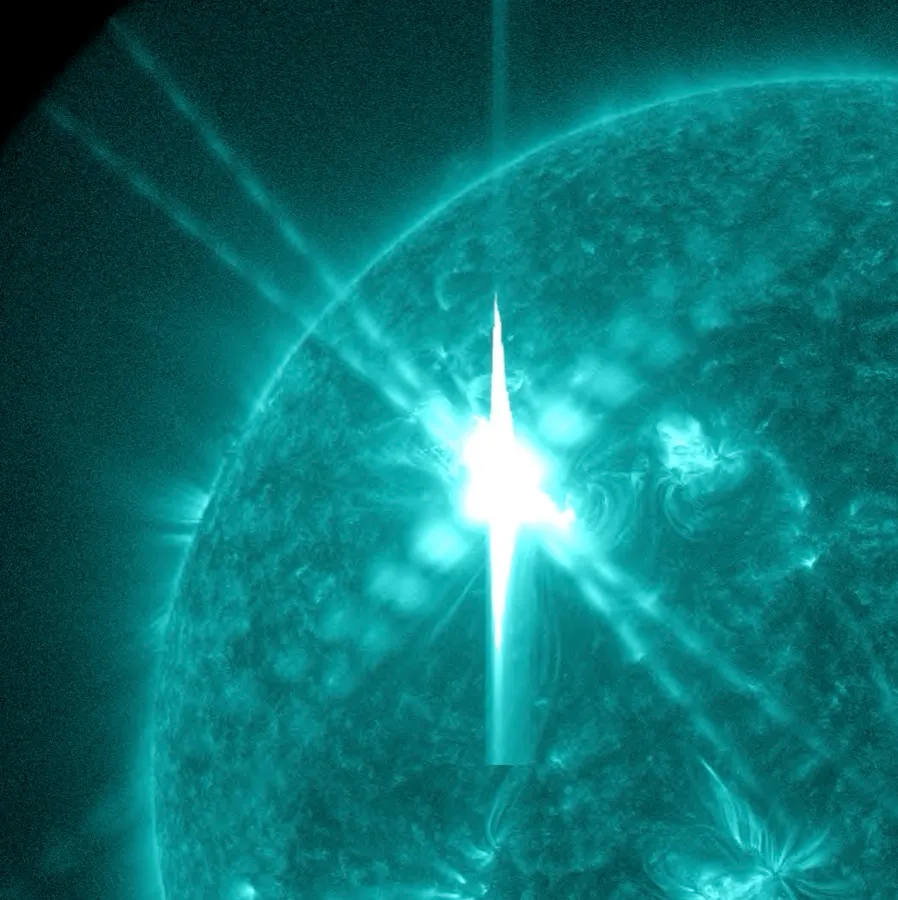
Three sources matter. **Galactic cosmic rays (GCR)** are high-energy nuclei from outside the solar system, mostly hydrogen and helium but with a small tail of heavy ions (iron, mostly) that punch through aluminium hulls and shred DNA along the way. They're the steady background. **Solar particle events (SPE)** are bursts of mostly-proton radiation from coronal mass ejections; one bad one in deep space could deliver a lethal dose in hours. **Trapped radiation** (Van Allen belts) is a Low Earth Orbit problem — ISS is below the inner belt, but transiting through it (e.g. Apollo translunar injection) builds up dose quickly.
Shielding is hard. Aluminium (the natural hull material) is actually worse against GCR than nothing in some regimes — high-Z secondary particles from spallation can be more biologically damaging than the primaries. Hydrogen-rich materials (polyethylene, water) are better; some hab designs use water tanks as a passive shadow shield. Active magnetic shielding is theoretical only. The most cost-effective "shielding" is shorter trip time, which is why fast-transit chemical + nuclear-thermal Mars concepts get serious attention.
Career limits at NASA are not absolute mSv numbers but excess-cancer-risk percentages — about 3% added lifetime cancer risk used to be the cap. ESA, JAXA, and Roscosmos use different conventions. A 1000-day Mars mission with current shielding would put a crew member at roughly the career limit in a single trip. This is the single biggest unsolved physiological problem for sending humans beyond low Earth orbit.