Suit lineage — Sokol to Orlan to Feitian, A7L to AxEMU
Every modern spacesuit traces to one of three families: American Apollo-derived, Soviet/Russian Sokol + Orlan, and Chinese Feitian (itself derived from Orlan). Six decades, three lineages, lots of cross-pollination.
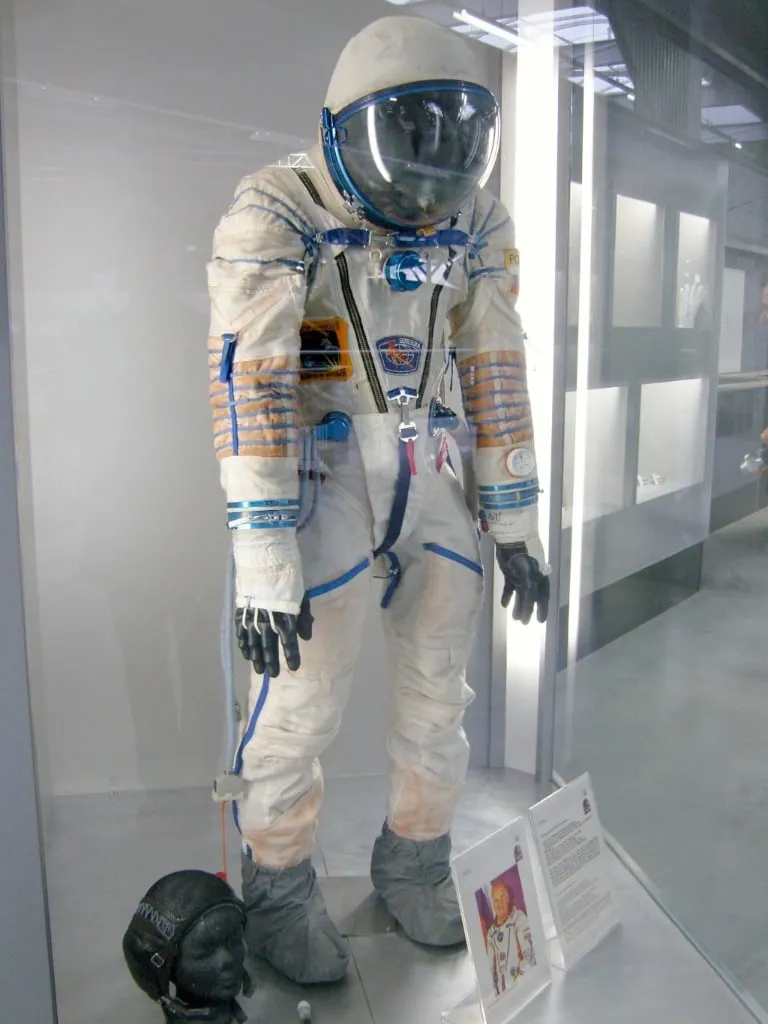
The original IVA suit problem was simple and terrible: keep the crew alive if the spacecraft loses pressure. Vostok and Voskhod cosmonauts wore SK-1 / Berkut suits. Mercury used a modified Navy Mark IV. Gemini used the G3C / G4C. None of these were tested as full-decompression life-savers because no flight had ever lost cabin pressure. Then in June 1971 Soyuz 11 returned with the crew dead from rapid decompression during separation — Dobrovolsky, Volkov, Patsayev were in shirtsleeves because the Soyuz cabin couldn't fit three suited cosmonauts. The Soviet response was the Sokol K-V (1973), a lightweight rubberised-fabric pressure suit designed specifically to fit inside the Soyuz couch and inflate in seconds if the cabin failed. Every Soyuz crew since wears a descendant of Sokol — the current Sokol-M is its latest modernised variant.
The American IVA lineage went through more iterations. Apollo used pressure-tight Block I (which killed Grissom-White-Chaffee in the 1967 fire) then Block II (post-fire redesign). Shuttle used the Launch Entry Suit (orange LES, 1988-94) then the ACES — Advanced Crew Escape Suit (1994-2011). When the Shuttle retired and US-side flights resumed in 2020, both SpaceX and Boeing produced their own clean-sheet IVA suits — the SpaceX Crew Dragon IVA (custom-fitted, single-piece zipper-entry, designed by Jose Fernandez of Hollywood costume background) and the Boeing Starliner IVA (more conventional NASA-design lineage). Neither is rated for EVA. Both inherit the Sokol functional contract — protect against rapid decompression, single-occupant fit, integrated with the seat — but neither shares Sokol's parts list.
The American EVA lineage starts with A7L (Apollo, 1969-72) and A7LB (later Apollo, 1971-72), then the EMU (Extravehicular Mobility Unit, 1981-present), which is the iconic white modular suit used for every US-side EVA on Skylab, Shuttle, and ISS. The EMU is now in its 40+ year of service — newer than most aircraft, older than most operational hardware on station. Its components include the HUT (Hard Upper Torso, the white shell), the LCVG (Liquid Cooling and Ventilation Garment — water tubes against the skin), the LTA (Lower Torso Assembly), the PLSS (Portable Life Support System, the backpack — CO₂ scrubbing + water cooling + oxygen + radio), and the MAG (Maximum Absorbency Garment — astronaut's diaper, a Lockheed-Martin acquisition from the 1980s). EMU production stopped after the Shuttle programme; the suits currently flying are refurbs of the 1980s-1990s build, with parts cannibalised from retired units. The AxEMU (Axiom Space EMU, for Artemis III lunar EVA) is the first new American EVA suit since the original; it inherits the modular philosophy but rebuilds every subsystem.
The Russian EVA lineage is Orlan (Орлан, 'sea eagle'), continuous since 1977. Unlike the American semi-modular EMU, Orlan is a rear-entry one-piece suit — the astronaut climbs in through a hatch in the back, closes the hatch, and is suited. Five-minute prep vs the EMU's 30-minute layered suit-up. Orlan also runs at higher pressure (5.8 psi vs EMU's 4.3 psi) which gives shorter prebreathe windows in exchange for more rigidity. The current Orlan-MKS (introduced 2017) is the seventh generation; flown on every Russian EVA since 2017 and on Tiangong's first crewed EVAs in 2021-22 before China's own Feitian became available.
Feitian (飞天, 'flying sky') is China's EVA suit, debuted on Shenzhou 7 (2008) for the country's first EVA, and now in its second-generation Feitian-2 variant on Tiangong. Feitian is derived from Orlan — rear-entry one-piece, similar internal geometry, similar operating pressure — but built domestically with Chinese-sourced materials and Chinese-developed thermal control. The lineage is admitted openly: ACC (China's Astronaut Centre) had Roscosmos-trained engineers as consultants on the first Feitian, and the second-gen suit further customised the design for Tiangong's Wentian airlock. The geopolitical irony is that Feitian — a Russian-lineage suit — represents the only currently-operational EVA capability outside of the US-Russian ISS partnership. AxEMU (American, lunar-targeted) is in development. Beyond those three, there is no other operational EVA suit in the world today; the IVA market is more diverse (Sokol-M, Crew Dragon IVA, Starliner IVA, Shenzhou IVA, India's planned Gaganyaan IVA), but EVA remains a three-suit world.
SEE IN THE APP
- /fleet Sokol KV-2, Sokol-M, Orlan-MKS, Feitian, A7L, A7LB, AxEMU, EMU, Krechet-94, ACES, SpaceX IVA, Starliner IVA, Shenzhou IVA — every spacesuit in the fleet catalogue traces back to one of three design lineages described in this article
- /missions Apollo 11–17 (A7L / A7LB), all post-1973 Soyuz flights (Sokol family), all Shuttle EVAs (EMU), Shenzhou EVAs (Feitian), Artemis II/III (AxEMU)