Life support — ECLSS, the air and water loop
Six people breathe 6 kg of oxygen a day, drink 18 L of water, and exhale 7 kg of CO₂. None of it is launched from Earth if the station can help it — every gram has to be recovered.
Environmental Control and Life Support System — ECLSS — is the part of a station that nobody sees and everybody depends on. Its job is to keep four numbers inside the green band: oxygen partial pressure (~21 kPa, like sea level), carbon dioxide partial pressure (<0.7 kPa nominal; humans get headaches above 1 kPa), cabin temperature (~22 °C), and relative humidity (40-60%). Get any of those wrong and the crew gets sick within hours. Get oxygen or CO₂ wrong badly enough and the crew dies. The system is engineered with at least one redundant subsystem for every function, and the US segment + Russian segment of ISS each run their own complete ECLSS so a fault on one side doesn't take both.
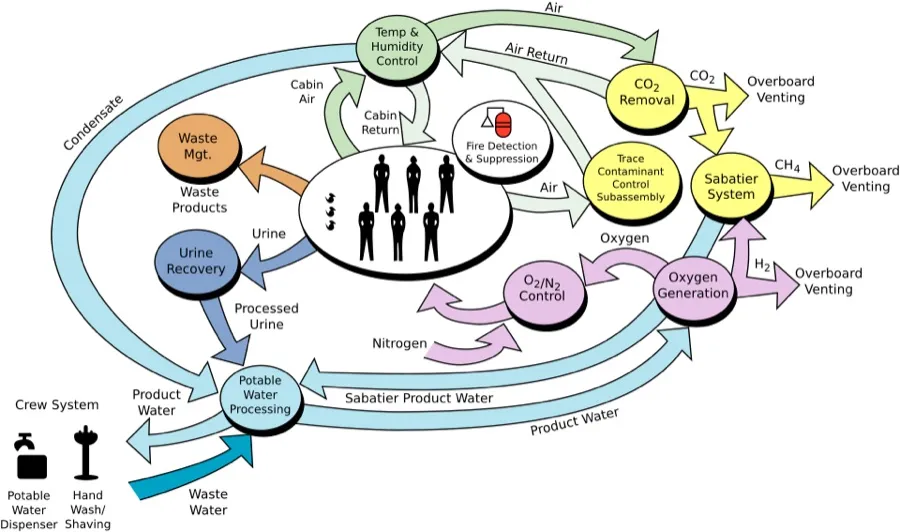
Oxygen comes from electrolysis. The ISS Oxygen Generation System (OGS, in the Tranquility node) electrolyses water — pumped from the Water Recovery System — into O₂ (vented into the cabin) and H₂ (vented to space until 2010, then routed to the Sabatier reactor; see below). At nominal load OGS produces about 9 kg of O₂ per day, which covers 6 crew at 1.5 kg each plus losses. Russian Elektron-VM does the same thing on the other side, plus solid-fuel oxygen candles as a backup (essentially smoke grenades that release O₂ when ignited — used during Mir's 1997 fire-stricken weeks, where they were also the cause of the fire). Tiangong's Tianhe module runs a similar electrolyser; the Chinese architecture explicitly mirrors the ISS Sabatier-electrolysis closed loop.
CO₂ removal evolved more than any other ECLSS function. Apollo and early Shuttle used lithium-hydroxide canisters (LiOH absorbs CO₂ irreversibly; the Apollo 13 'square peg in a round hole' improvisation was a LiOH canister adapter). Modern ISS uses two regenerable systems: the US-side CDRA (Carbon Dioxide Removal Assembly), which uses zeolite molecular sieves that adsorb CO₂ then thermally desorb it for venting, and the Russian Vozdukh, which uses amine swing beds. The Sabatier reactor (Hamilton Sundstrand, installed on ISS in 2010) takes that vented CO₂ and combines it with the electrolysis-generated H₂ to make methane and water — closing the loop. The methane is currently vented; future Mars-bound architectures (Moxie on Perseverance is a related demo) intend to use it as propellant.
Water recovery is the most engineered subsystem. The ISS Water Recovery System (WRS, also in Tranquility) takes urine, humidity condensate from the air conditioning, EVA suit water (which is small), and waste from hygiene, and runs them through a urine processor (vacuum distillation to remove water from brine) and a water processor (multi-filtration, catalytic oxidation, ion exchange). The output is potable water cleaner than most municipal supplies. US-segment recovery was ~93–94% before the Brine Processor Assembly (added 2021); with the BPA, NASA demonstrated ~98% in 2023. The remaining losses are launched up from Earth as resupply water in disposable bags, mostly because the brine that comes out of urine processing still contains 15–20% water that can't be economically recovered — the BPA closes most but not all of that gap. The target for Mars-class missions is >98% continuously.
Thermal control is the last and largest subsystem — the ISS dumps about 75 kW of waste heat through external ammonia loops feeding 14 deployable radiators. The internal heat-transport loop uses water (non-toxic); the external loop uses ammonia (excellent thermal properties, but a leak inside the station would kill the crew, hence the two-loop design with heat exchangers at the segment boundary). The Russian segment uses an ethylene-glycol-based internal loop and a different external arrangement. Every ammonia leak on ISS (there have been several over 25 years) becomes a major operational event because of the cross-contamination risk; the suit-side EVA procedure for handling an ammonia leak is one of the longer training units in the astronaut curriculum.
SEE IN THE APP
- /iss Destiny (US lab — Atmosphere Revitalisation rack), Tranquility (Node 3 — Water Recovery + Oxygen Generation), Nauka (Russian segment lab + redundant ECLSS), Columbus (ESA lab — air-quality experiments)
- /tiangong Tianhe core module — life-support stack for the Chinese segment, including the Sabatier-derived water recovery
- /missions Long-duration missions where ECLSS performance is mission-critical: ISS expeditions, Mars-class transit studies, lunar surface stays
LEARN MORE
- intro NASA · International Space Station Environmental Control and Life Support
- core NASA Technical Reports · Water Recovery System Status (ECLSS overview)
- core Wikipedia · Environmental control and life-support system
- deep ESA · ACLS — Advanced Closed-Loop System (Sabatier reactor)
- deep NASA Technical Reports · Sabatier Reactor Integration on ISS