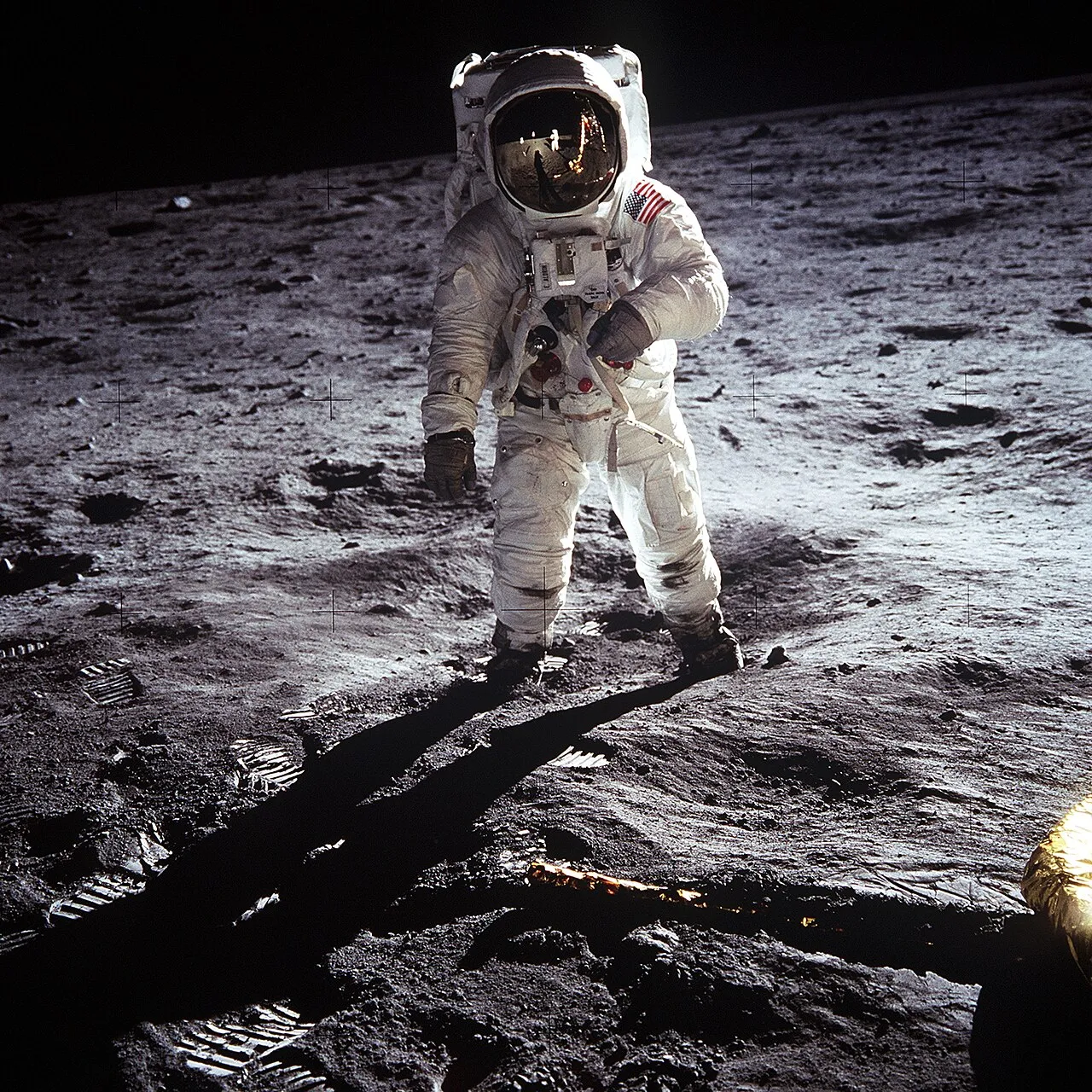
Lunar surface suits
A lunar suit has to do everything an orbital EVA suit does, plus walk for 7 hours on a dusty regolith floor at temperatures that swing from −170 °C in shadow to +120 °C in sunlight — and survive the dust.
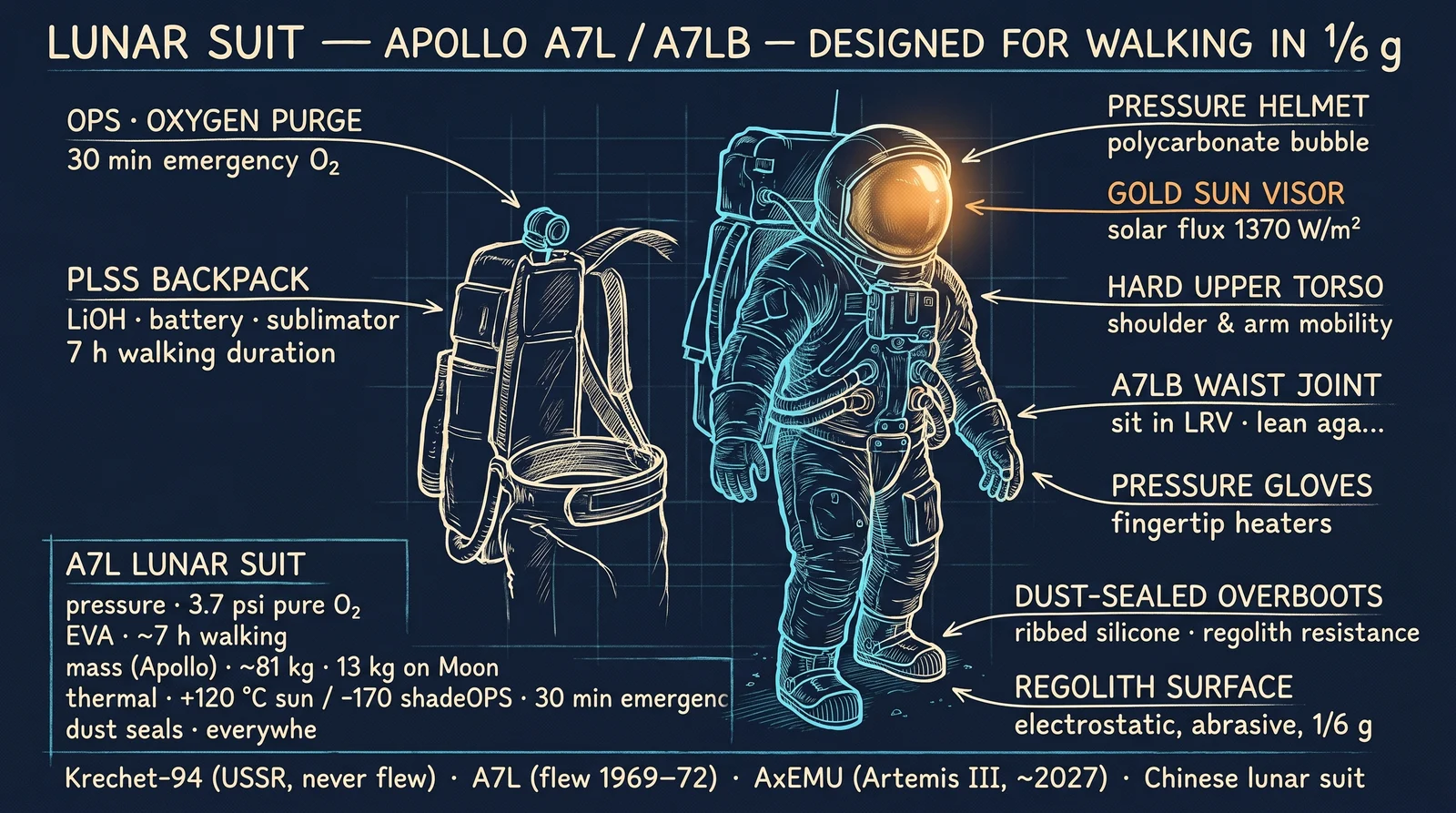
Twelve people have walked on the Moon, and they did it in eight suits of the same family: the **Apollo A7L** (Apollo 11, 12, 14) and its successor the **A7LB** (Apollo 15, 16, 17). A7L was a one-piece pressure garment with a Hard Upper Torso, soft fabric arms and legs, integrated lunar-overboots, an over-the-shoulder PLSS backpack, and an Oxygen Purge System (OPS) as emergency reserve mounted above the PLSS. Operating pressure was 3.7 psi (0.26 atm) of pure oxygen — the lowest of any flown spacesuit, traded against maximum mobility for walking. The A7LB added a waist-joint convolution that let astronauts sit in the Lunar Roving Vehicle without fighting the suit; without that joint the J-mission EVAs would not have been possible.
The lunar environment imposes constraints that orbital suits don't face. **Regolith dust** is abrasive, electrostatically clingy, and gets into everything: Apollo crews returned with lunar dust in their teeth, their hair, their lungs, and worst — in their suit bearings. The PLSS bearings on Apollo 17 were so degraded by the end of the mission that engineers later concluded another EVA would have risked seizure. Modern lunar suits put dust-rejecting bayonet seals on every joint and a dust-tolerant rear-entry system to keep abrasive grains out of pressurised volumes. **Thermal extremes** are wider than LEO: the unfiltered solar flux on the day side is ~1370 W/m², and the night-side surface in shadow can drop below 100 K. The A7L's silver outer layer was an aluminised mylar IR reflector; the inner garments were roughly 25 layers of aluminized Mylar/Kapton, Dacron, neoprene-coated nylon, and reinforced Beta cloth.
**One detail that matters.** A lunar suit's biggest difference from an orbital suit isn't pressure or thermal load — it's **walking**. The boots have to articulate enough for natural gait; the knee joints have to flex with low torque; the soft-suit waist joint has to support a forward lean against the PLSS mass. The Apollo lessons-learned are still the design baseline: Aldrin and Armstrong reported the soft-fabric Apollo 11 suit was "easy to walk in" because the joints were sized for 1/6 g, not 1 g. Test on Earth in the suit and it feels heavy and stiff; on the Moon the mass is the same but the weight is 1/6, and the geometry works. Designing for 1/6 g instead of 1 g is one of the quiet reasons every operational lunar suit has been built fresh rather than carried over from orbital EVA service.
See /fleet for the operational and developmental lunar-suit catalog: Apollo A7L (1968–1971, the suit on Apollo 11 through 14), Apollo A7LB (1971–1972, the J-mission suit with the waist joint), Krechet-94 (Soviet, never flew — but its rear-entry architecture became the DNA of Orlan and Feitian), and the upcoming AxEMU (Axiom, qualifying for Artemis III in the late 2020s).