Crew selection — the funnel from applicant to astronaut
Every space agency runs roughly the same selection funnel — physical, cognitive, psychological, operational — narrowing ~10,000 applicants to ~10 selectees. The bottleneck is crew dynamics under stress.
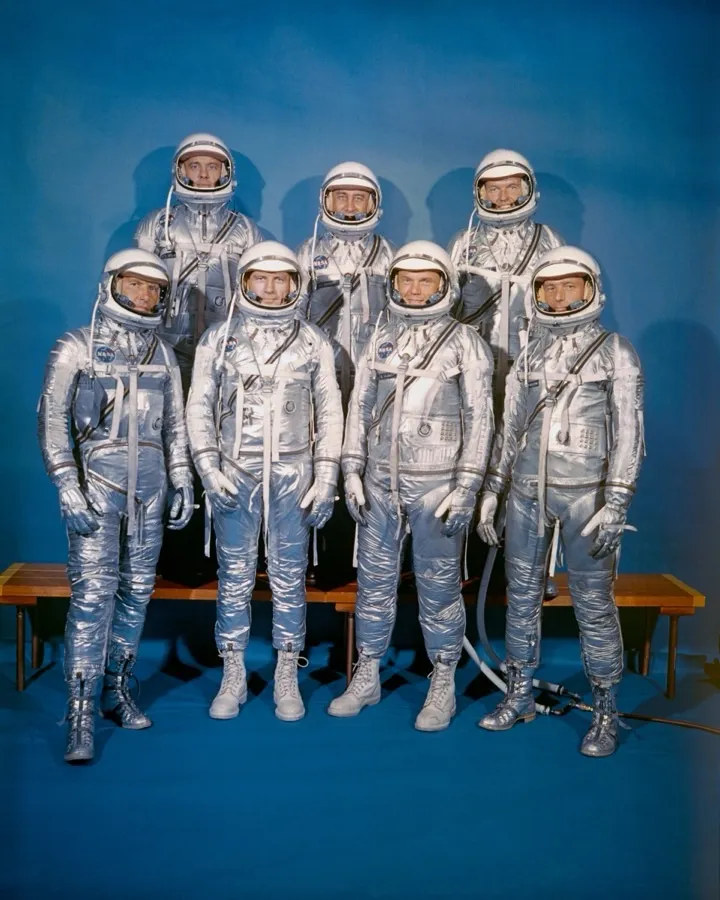
The first generation of selection was driven by hardware constraints. Mercury (NASA, 1959) accepted only military jet test pilots under 5'11" (180 cm — the Mercury capsule cabin limit), under 40 years old, with engineering degrees, and parachute-jump experience. The Soviet Vostok program (1959-60) accepted only fighter pilots under 5'7" (170 cm — the Vostok hatch), under 30, under 70 kg. The reasoning was that the vehicle didn't have enough margin to fly someone larger or older, and a test pilot already had the airmanship + stress-tolerance the program needed. Of the original 20-person Soviet cosmonaut group (1960), only 12 ever flew; of the Mercury Seven, all seven flew. Both numbers tell you the selection bar was set very high relative to mission availability.
Modern selection looks for different things. NASA's 2017 class accepted 12 from 18,300 applicants (0.07% acceptance — significantly lower than Harvard). Education requirement: STEM master's degree or equivalent operational experience (test pilot, MD, PhD). Height window: 4'9"–6'4" (149-193 cm — Crew Dragon and Soyuz both accommodate this range). No vision restriction beyond correctable. No upper age limit. Two years of related professional experience minimum, but actual selectees average 13 years. The fitness bar has shifted from 'jet-pilot G tolerance' to 'will not develop a serious illness on a 6-month ISS expedition' — different problem, different test.
The medical phase is the single largest filter. Lovelace Clinic (Mercury, 1959) ran ~30 separate tests over a week, including the iconic ice-water-in-the-ear vestibular shock and the 'how long can you sit in a dark sensory-deprivation tank' isolation screen. Modern medicals still run isolation chambers (NASA uses a 12-hour confined-space evaluation; Roscosmos uses a longer 5-day Звезда isolation chamber session) but the medical workup is more sophisticated: comprehensive metabolic profile, full cardiology with stress echo, neurological imaging, dental clearance (a tooth abscess on orbit is a mission-loss event), and a psychiatric screen done by panel interview. Soyuz qualification adds centrifuge tolerance to 8g and 14-day quarantine to confirm the immune profile.
Psychological screening is the part that's hardest to evaluate but disqualifies the most candidates relative to its visibility. The selection psychologists are looking for what JSC calls 'expedition behaviour' — the ability to work productively in a confined multinational team for 6+ months with no escape. Disqualifiers include rigid thinking, conflict-avoidance, score-keeping, perfectionism (counterintuitively — the trait is associated with crew-friction in long missions), and the specific cluster called 'right-stuff syndrome' that the early astronaut corps prized. The Apollo psychologist Patricia Santy's 1994 book *Choosing the Right Stuff* documents how the personality profile that wins selection in the test-pilot era is partially the profile that fails in long-duration missions; modern selection has shifted toward the temperament profile that succeeds in Antarctic-winter scientific bases and submarine deployments — calmer, more collaborative, less individually-aggressive.
Non-NASA programs follow parallel logic with national variation. Roscosmos cosmonaut selection inherits the Soviet preference for engineering-heavy backgrounds and longer quarantine windows; the typical Soyuz commander has flown two or three previous missions before the assignment. CSA, ESA, and JAXA each select small cohorts (typically 1-2 per generation) through agency-specific medical + psychological standards but increasingly use shared training infrastructure — every modern ISS crew member trains in Houston, Star City, and either Tsukuba or Cologne. China's astronaut selection, run by the China Manned Space Agency (CMSA), took only PLAAF pilots for its first two groups (1998, 2010); the third group, selected in 2020, added flight engineers and payload specialists, mirroring NASA's 1965 expansion beyond test pilots. India's Gaganyaan crew (4 selected, 2022) all came from the IAF test-pilot pool — the program is following Mercury's 1959 playbook because, like Mercury, this is India's first crewed effort.
SEE IN THE APP
- /missions Every crewed mission carries the crew that selection produced — Mercury through Artemis, Vostok through Shenzhou, the selection criteria show up in the demographics
- /fleet Crewed spacecraft (Mercury, Gemini, Apollo CSM/LM, Soyuz, Crew Dragon, Shenzhou, Orion, Gaganyaan) — the rated vehicle determines what the crew has to be able to tolerate