The Body in the Dark
Everything else in this collection is engineering — navigation, propulsion, landing, talking across the void. This is the one problem no engine solves: the traveller is biology that degrades, and the human body is the fragile cargo the whole enterprise exists to protect.
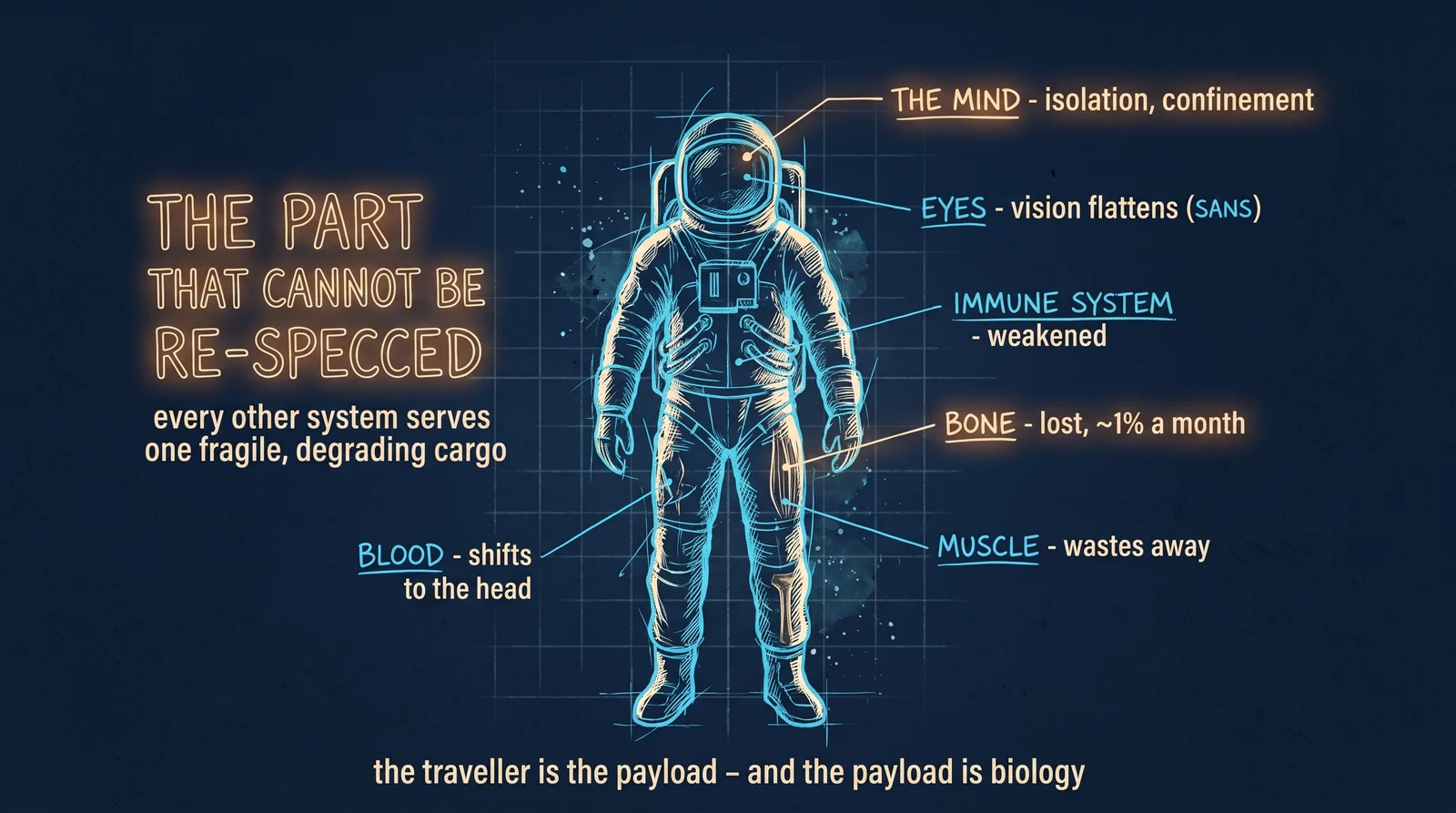
The spacecraft is, in almost every meaningful sense, a marvel. Its navigation system can place it within a hundred kilometres of a target across five billion kilometres of nothing. Its engines can produce thrust for years on a trickle of xenon. Its radios can whisper across the outer solar system and still be heard. Every subsystem is specified, tested, certified against failure, and if something goes wrong mid-journey a team on the ground can send a fix — a software patch across hundreds of millions of kilometres. The spacecraft is engineering at its most refined. It is also, in the one case that matters here, in serious trouble, because the thing it is carrying cannot be patched, cannot be re-specced, and degrades from the moment the hatch closes.
The human body was not designed for space. The temptation — in press releases, in popular accounts, in the visual vocabulary of every mission poster — is to show the astronaut as triumphant, suited, armoured against the void. That image is not wrong. It is, however, incomplete. Remove the suit and you have a primate whose immune responses were shaped by a pathogen-rich African savanna, whose skeleton evolved to hold itself up against one standard Earth gravity, whose cardiovascular system expects a fluid column that fights gravity from the feet up, and whose brain runs on a magnetosphere-shielded radiation budget that has almost nothing to do with what waits beyond low Earth orbit. The suit is an interface. The human is the constraint. Every system aboard the spacecraft, every redundancy in the life-support loops, exists to keep that constraint alive long enough to do useful work and come home.
This is the problem going to Mars asks that no propulsion advance can dissolve. Faster engines shorten the transit and reduce exposure time — but they do not remove it. The body remains what it is: a system under sustained attack from four directions at once. Radiation that penetrates every shield we can afford to carry. The disappearance of the gravity signal the entire musculoskeletal system depends on. An immune system that drifts in ways we are still cataloguing. A mind increasingly alone in a way no evolution prepared it for. None of these is fully solved. Each is a real constraint on how far, and how long, human beings can travel.
The invisible weather
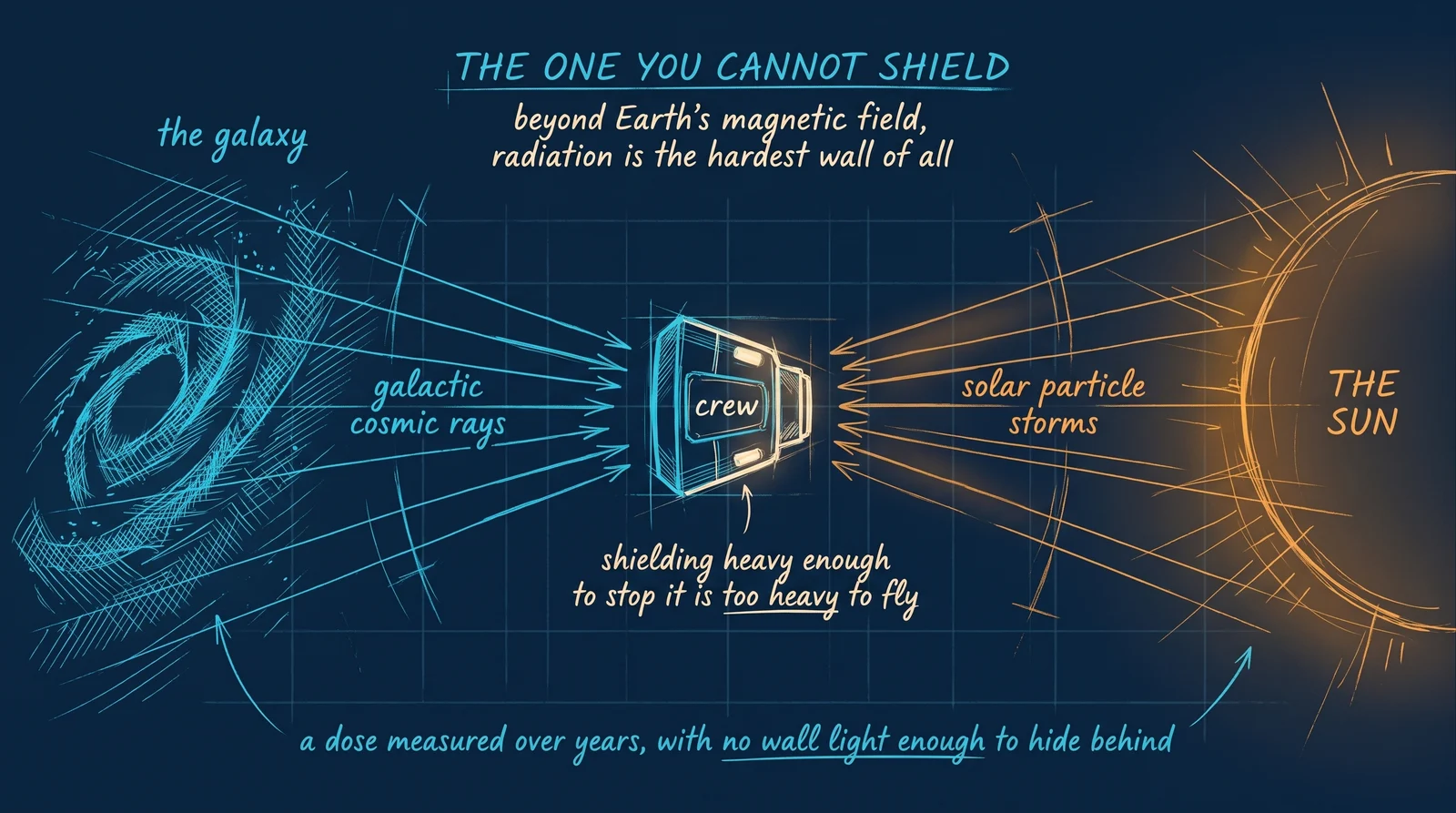
Space is not empty. It is full of radiation — and not the localised, predictable radiation of an X-ray machine, which delivers a known dose in a known geometry and stops. Space radiation comes in two distinct and dangerous flavours. The first is solar particle events: storms of protons accelerated by solar flares and coronal mass ejections, capable of delivering a lethal dose in hours if caught without shielding. The second is galactic cosmic rays: high-energy atomic nuclei that have been accelerating through the galaxy for millions of years and arrive from all directions, continuously, at energies so extreme that the practical amount of metal or water that would stop them is measured in hundreds of tonnes — far beyond what any foreseeable rocket can lift. Earth's magnetic field and atmosphere handle both. Beyond low Earth orbit, neither is there.
Career dose limits for astronauts are set to cap the lifetime excess cancer risk at roughly three percent above the background rate. NASA's limits, expressed in sieverts, vary by age and sex because radiation sensitivity does — a 35-year-old woman faces a stricter ceiling than a 55-year-old man. A six-month stay aboard the ISS — still inside the partial shelter of the magnetosphere — delivers roughly 150 millisieverts. A Mars transit of six to nine months each way, plus a surface stay, would likely deliver 500 to 1,200 millisieverts round-trip depending on solar cycle phase. That figure sits at or beyond what current career limits allow for a single mission.
The cancer risk is the one most discussed in planning documents. The central nervous system risk is the one that unnerves researchers more. High-energy galactic cosmic rays deposit energy in dense, localised tracks through neurons in ways that differ from ordinary radiation injury and may not heal the same way. Animal studies at the NASA Space Radiation Laboratory at Brookhaven have shown measurable cognitive and behavioural changes in rodents exposed to simulated GCR doses equivalent to a Mars mission: degraded spatial memory, impaired executive function, accelerated neurodegeneration. The human data to contradict or confirm this does not yet exist, because no human has ever received a GCR dose that high. We will not know the human CNS answer until the first crew goes. That is a genuine scientific and ethical frontier — treated as such by researchers who study it, even when treated as a background assumption by mission planners who need the trip to happen.
The body forgets gravity
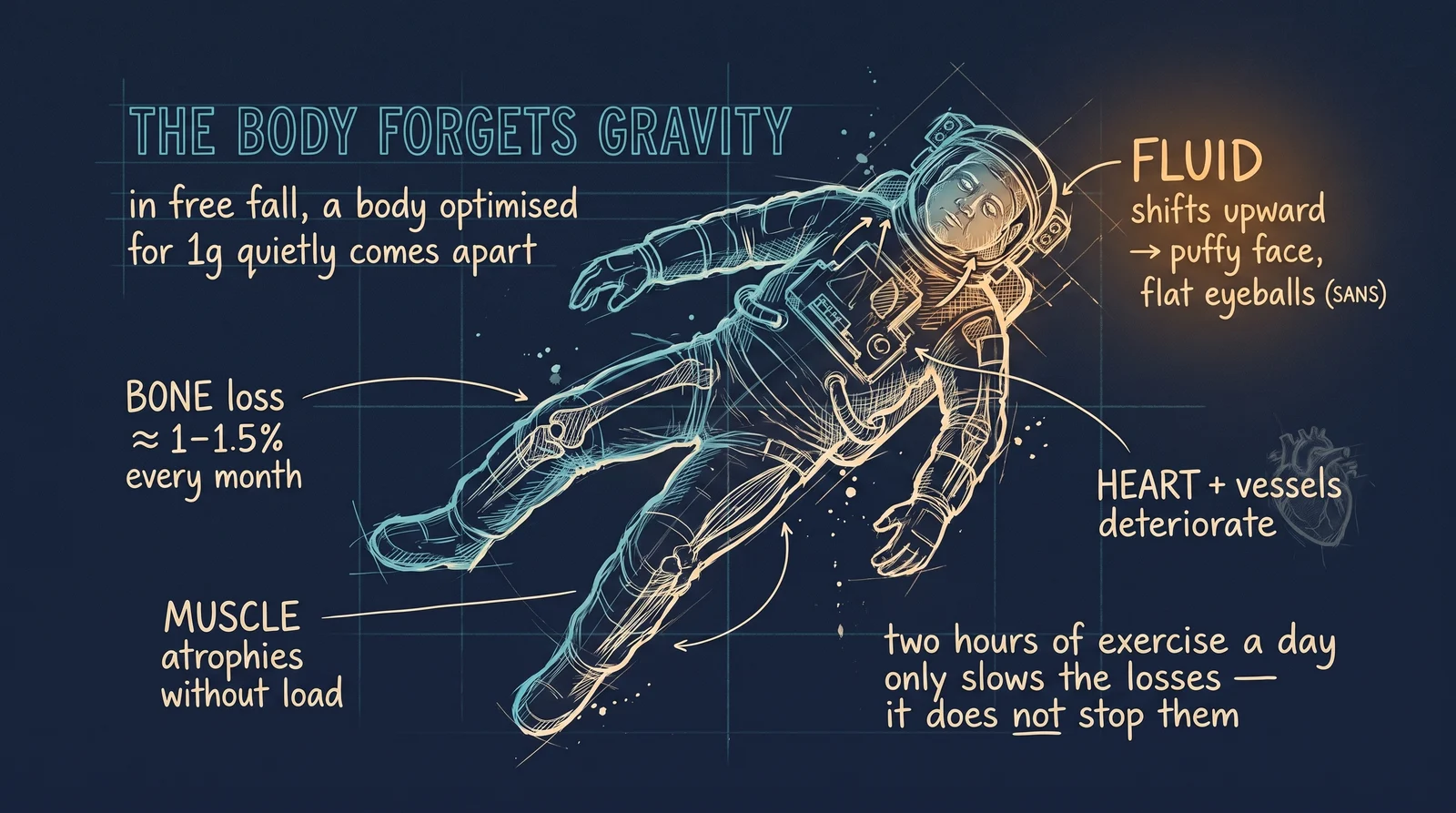
Gravity is not merely an inconvenience the body works against. It is a signal the body reads continuously, and to which nearly every major physiological system is calibrated. Remove it and the calibration fails, progressively, in ways that two hours of daily exercise can slow but not stop. Bone mineral density falls at roughly one to one and a half percent per month in the load-bearing bones — the hip, the spine, the femur — in the absence of the mechanical stimulus that normally triggers bone remodelling. That is a rate comparable to the most severe cases of osteoporosis on Earth, compressed into months rather than decades. After a standard six-month ISS increment, crew members can show bone density losses that take a year or more of recovery to reverse, and the evidence that complete recovery always occurs for all crew members is not airtight.
Muscle mass follows a parallel curve, particularly in the postural muscles — the ones whose primary Earthside function is holding the skeleton upright. Without the constant low-level work of fighting gravity, they atrophy faster than voluntary exercise can fully offset. The vestibular system, which expects a gravity vector to orient itself against, initially misreads the microgravity environment and produces space motion sickness in roughly half of all astronauts during the first few days; adaptation eventually occurs, but the system then has to re-adapt to gravity on return, and the re-adaptation is not always smooth or fast. Cardiovascular deconditioning follows its own arc: with no hydrostatic pressure gradient to work against, the heart atrophies like any underloaded muscle, cardiac output drops, and the plasma volume that normally fills the lower body redistributes upward. Returning crew members who have been in orbit for six months sometimes cannot stand without a blood pressure drop that would floor a healthy adult on the ground.
The most surprising complication to have emerged from long-duration spaceflight in the last decade is one no one anticipated clearly before the ISS programme accumulated enough crew-hours to make it visible: spaceflight-associated neuro-ocular syndrome, or SANS. In microgravity, the fluid shift that drives blood and plasma toward the head also affects intracranial pressure in ways that are still being characterised. The result, in a significant fraction of long-duration crew members — some studies now put it at two-thirds or more of long-duration crew — is a flattening of the back of the eyeball, a change in the shape of the optic nerve head, and measurable degradation of visual acuity. Some astronauts have returned from the ISS needing reading glasses for the first time in their lives. The mechanism is not fully understood. The treatment does not yet exist. SANS is currently one of the three or four problems on the list of showstoppers for a crewed Mars mission, in the assessment of researchers who write those lists.
What we know because someone stayed
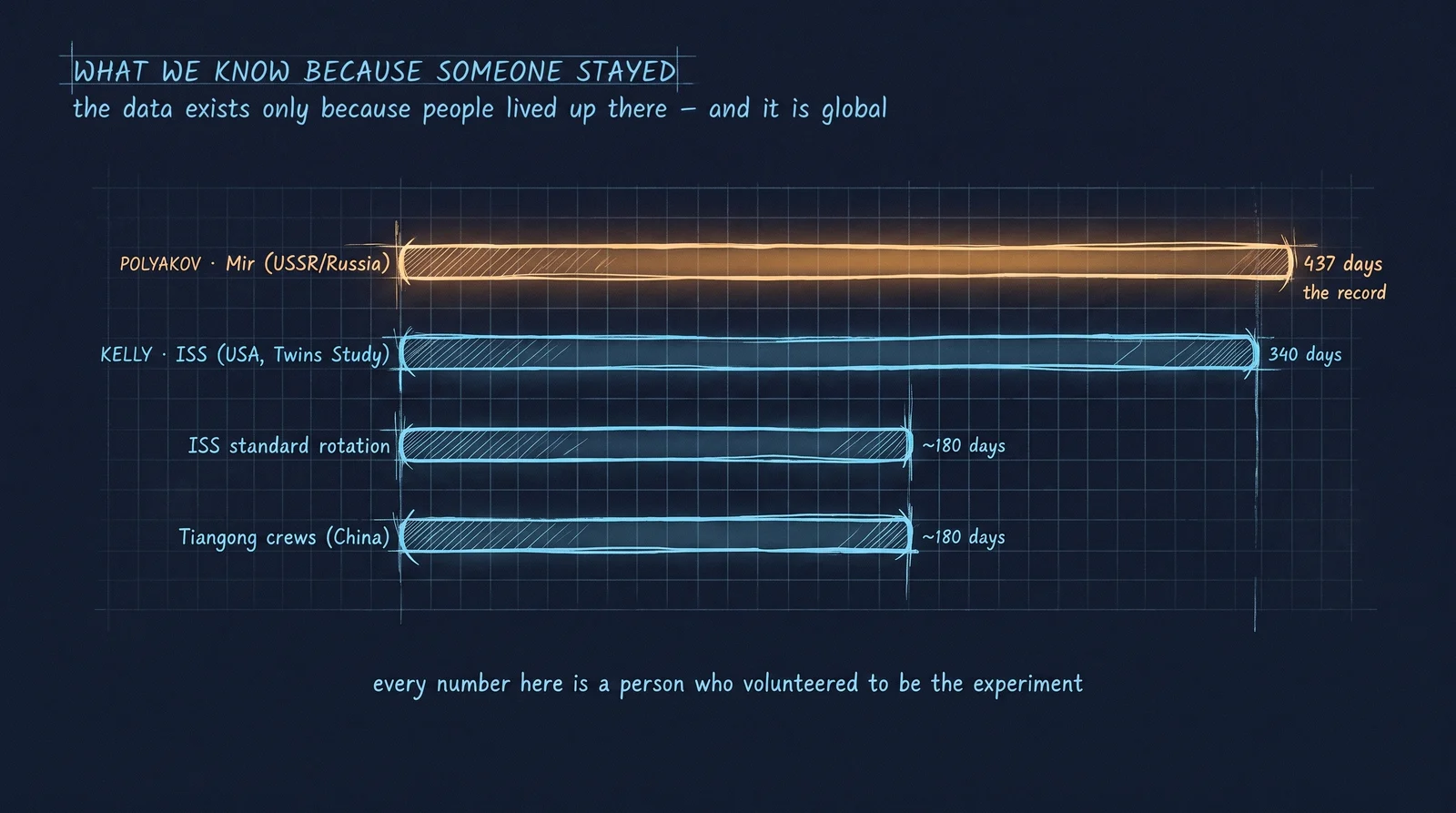
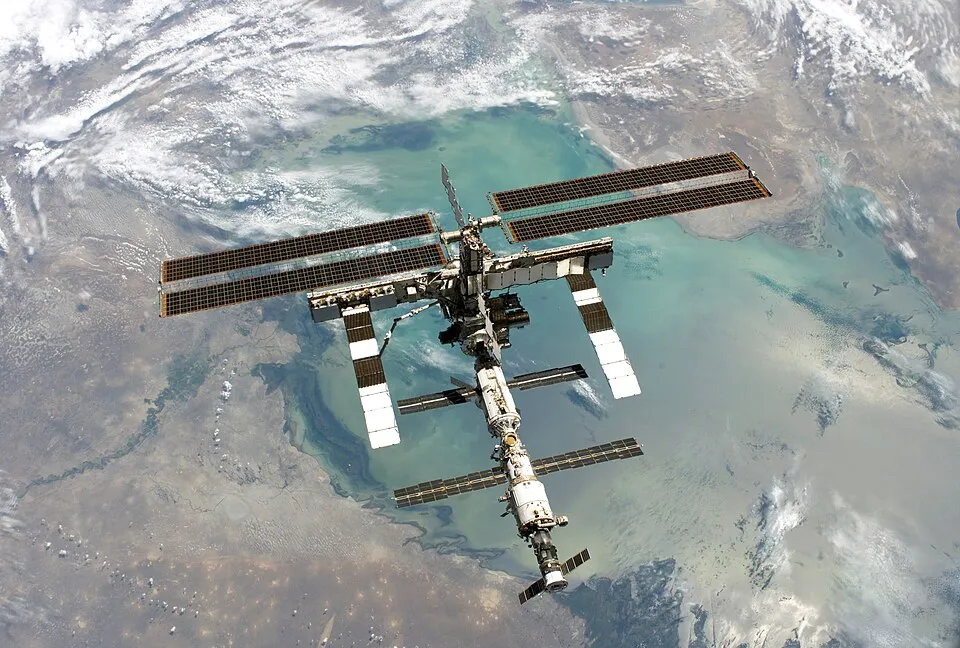
Everything we know about long-duration spaceflight physiology was measured — on real people, who lived in space for real durations, came home, and were studied. The record for a single continuous flight is held by Valeri Polyakov, a Russian physician-cosmonaut who boarded Mir in January 1994 and returned to Earth in March 1995, having spent 437 consecutive days in orbit — still unbroken, three decades later. Polyakov's goal was explicitly medical: to determine whether a human being could survive, functionally, a Mars mission duration. When he landed, he insisted on walking away from the Soyuz capsule under his own power. His bone and muscle recovery took months. He walked. The Salyut and Mir programmes built a Soviet and then Russian body of physiological data that remains irreplaceable — the ISS extended it and globalised it. Peggy Whitson's cumulative 665 days across three missions gave researchers a longitudinal dataset on a single individual impossible to replicate otherwise. The NASA Twin Study — Scott Kelly's 340-day mission compared against his Earthbound identical twin Mark — found measurable changes in gene expression, telomere dynamics, gut microbiome composition, and cognitive performance, most of which reversed on return, but not all. China's Tiangong programme is now adding to the record: crews on 90- and 180-day rotations since 2021, a taikonauts population previously absent from the dataset. Any honest account of what humanity knows about the long-duration human body in space has to include what Russia learned on Mir, what the 15-nation ISS partnership has measured since 2000, and what China is accumulating now.
The mind in a can
The body's physical degradation is measurable and at least partially addressable. The psychological dimension is harder to study, because it depends on variables — personality, crew composition, the texture of confinement, the relationship between crew and ground — that resist controlled experimentation. What the analogue studies suggest is not comforting. Isolation and confinement psychology has been studied most systematically in Antarctic winter-over stations: small groups in genuine darkness and cold, unable to leave. The patterns are consistent across studies — a mid-winter syndrome of degraded mood and cognition, interpersonal friction that compounds in confined spaces, a psychological distancing from the outside world that can persist after return. Antarctic crews can at least breathe outside air and see a landscape. A Mars crew cannot. The Mars-500 experiment in Moscow (2010–2011) simulated a 520-day mission in a sealed habitat; six volunteers completed the full duration without leaving. Sedentary behaviour worsened across the run. One subject spent the majority of the final months asleep. One showed symptoms consistent with clinical depression. As communication delay climbed toward the simulated 20 minutes, the crews reported it felt not just slower but fundamentally lonelier — decisions that would have been delegated to the ground had to be made aboard, and the sense that someone could always be reached slowly eroded. A crew member on the ISS has, at all times, a Soyuz docked to the station. On a Mars transit, the emergency exit does not exist. From the moment of trans-Mars injection, no decision by any controller on Earth can bring the crew home on a useful timescale. The crew knows this. What sustained knowledge of your own unrescuability does to a human mind over 18 months is a question the analogue studies have approached but cannot answer. We will not know until the first crew leaves.

The limit engines do not move
None of what precedes this section is a reason not to go. It is an honest accounting of what going means, and what it will cost the people who go. These are different things, and the difference is worth being precise about.
Better propulsion matters. The new engine technologies under development — nuclear thermal, nuclear electric, solar sails, the further-future concepts — would cut transit time, and cutting transit time cuts cumulative radiation exposure and cumulative physiological degradation. A transit of 90 days instead of 270 is not three times easier on the body; the relationship between dose and effect is more complex than linear, and some systems — the psychological, the bone, the cardiovascular — are sensitive to duration in ways that even a shorter exposure does not fully rescue. But shorter is better. Faster engines are real medicine. They do not, however, change the fundamental nature of the problem. A 90-day transit still crosses interplanetary space with no magnetosphere, no gravity, and no rescue. The body is still the payload. It still degrades. It still returns home diminished in ways that take months or years to reverse, if they reverse at all.
The countermeasures that exist are real but partial. Advanced resistive exercise devices — the kind aboard the ISS, meaningfully better than what flew on early Skylab missions — can slow bone and muscle loss substantially, not eliminate it. Nutritional interventions, pharmacological bone-loss treatments, and sleep management protocols each contribute something. Artificial gravity, achieved by rotating the spacecraft or a module within it, would address the largest single category — microgravity physiology — but no crewed spacecraft with artificial gravity has ever been built or flown, and the engineering cost in mass and launch volume is substantial. The Skylab programme's three crews — 28, 59, and 84 days in 1973 and 1974 — gave the first systematic American evidence that exercise could meaningfully offset deconditioning, a finding that has shaped crew health protocols on every subsequent long-duration programme.
What this reveals is that the challenge of human deep-space travel has two separate categories of difficulty. The first — engineering — is hard but tractable: rockets, navigation, communications, landing, life support all have definable solution spaces where more knowledge and investment move the answer forward. The second is biological, and it is harder in a different way. Not because the biology is incomprehensible — the mechanisms are largely understood, and the countermeasures are improving — but because the biology cannot be negotiated with. You cannot write a software patch for a spine that has lost bone mineral over eight months. You cannot reprogram the immune system's response to isolation with a firmware update. The body has its own constraints, built over millions of years for a single world, and those constraints are the ultimate ceiling on how far any individual can travel. The people aboard a generational starship are not individuals managing their health across a career — they are a lineage, across whom the physiological consequences of the environment accumulate across generations.
The Polaris Dawn mission in 2024 — a private crewed flight through the outer Van Allen belts — provided the first private-sector radiation data at altitudes where belt flux is genuinely dangerous. The duration was short, the altitude still inside the Earth-Moon system. But it marks a phase in which the population of people for whom these questions are practical, not theoretical, is expanding beyond national programmes. The body's constraints do not change when the employer does. In every other essay in this collection, the engineering eventually catches up to the ambition — propulsion, navigation, landing, communications each closed toward their targets over decades. The gap between what human physiology is and what deep-space transit demands is closing too, through countermeasure research and the accumulating datasets of the ISS and Tiangong and what came before them. But it is not closing fast, and it may never close completely. The body is the oldest system on the spacecraft, and it is the one that cannot be upgraded.