Finding Mars in the Dark
How do you steer to a moving planet across a hundred million kilometres of nothing, with no map, no horizon, and a twenty-minute lag on every instruction? The seventy-year answer is stranger, and more human, than the machines suggest.
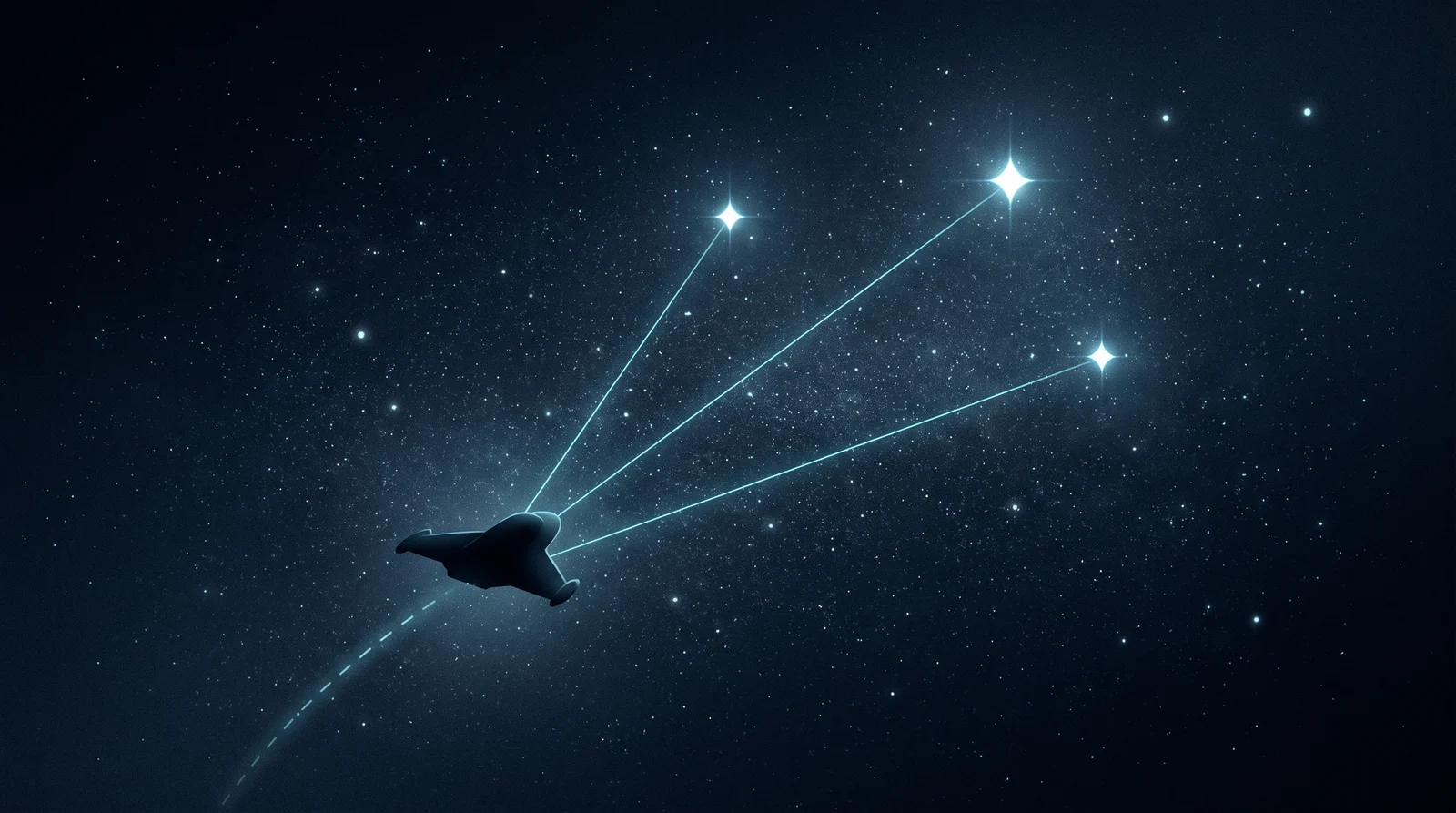
There are no roads in space. No coastline, no horizon, no landmark to steer by — and the one thing every driver on Earth now takes for granted, a satellite constellation whispering you are here, exists only in a thin shell a few thousand kilometres thick around one planet. Leave it, and you are alone with a problem three parts deep: Where am I? Which way am I pointed? And how do I get from here to a place that is itself moving, fast, and won't be there when I arrive?
Get it wrong and there is no recovering: a fraction of a degree of aiming error, multiplied across a hundred million kilometres, is the difference between an orbit and a crater. Get it right and it vanishes — navigation is the quiet skill under all the loud ones, the thing no press release leads with and no mission survives without. Consider the standard it is held to. New Horizons crossed nearly five billion kilometres to Pluto over nine and a half years and arrived within about a hundred kilometres, and about two and a half minutes, of a plan drawn up before it left the launch pad. That is the precision this is about — and the astonishing thing is how old, and how human, the ideas behind it turn out to be.
Because the answer has barely changed. The machines got smaller and then got smart; the distances grew until the ground could no longer keep up; but underneath, spacecraft still navigate the way an eighteenth-century sailor did — by measuring angles to the only fixed things there are, the stars, and by keeping honest count of every push they've ever felt. This is the story of that count, and of the slow handover of the whole delicate business from a room full of people on the ground to the spacecraft itself.
The art of honest counting
Start with the hardest of the three questions, the one that sounds easiest: where am I? On Earth you look. In space, for a long time, you couldn't — so instead you kept count.
The technique is called dead reckoning, and it is exactly as old as ocean navigation. If you know where you started, and you measure every acceleration you've felt since — every engine burn, every nudge — you can add them all up and know, in principle, where you are now. A spacecraft does this with an inertial measurement unit: a cluster of gyroscopes that hold a fixed orientation and accelerometers that feel every change in motion, integrating quietly at the craft's core the whole journey into a running guess at position and velocity.
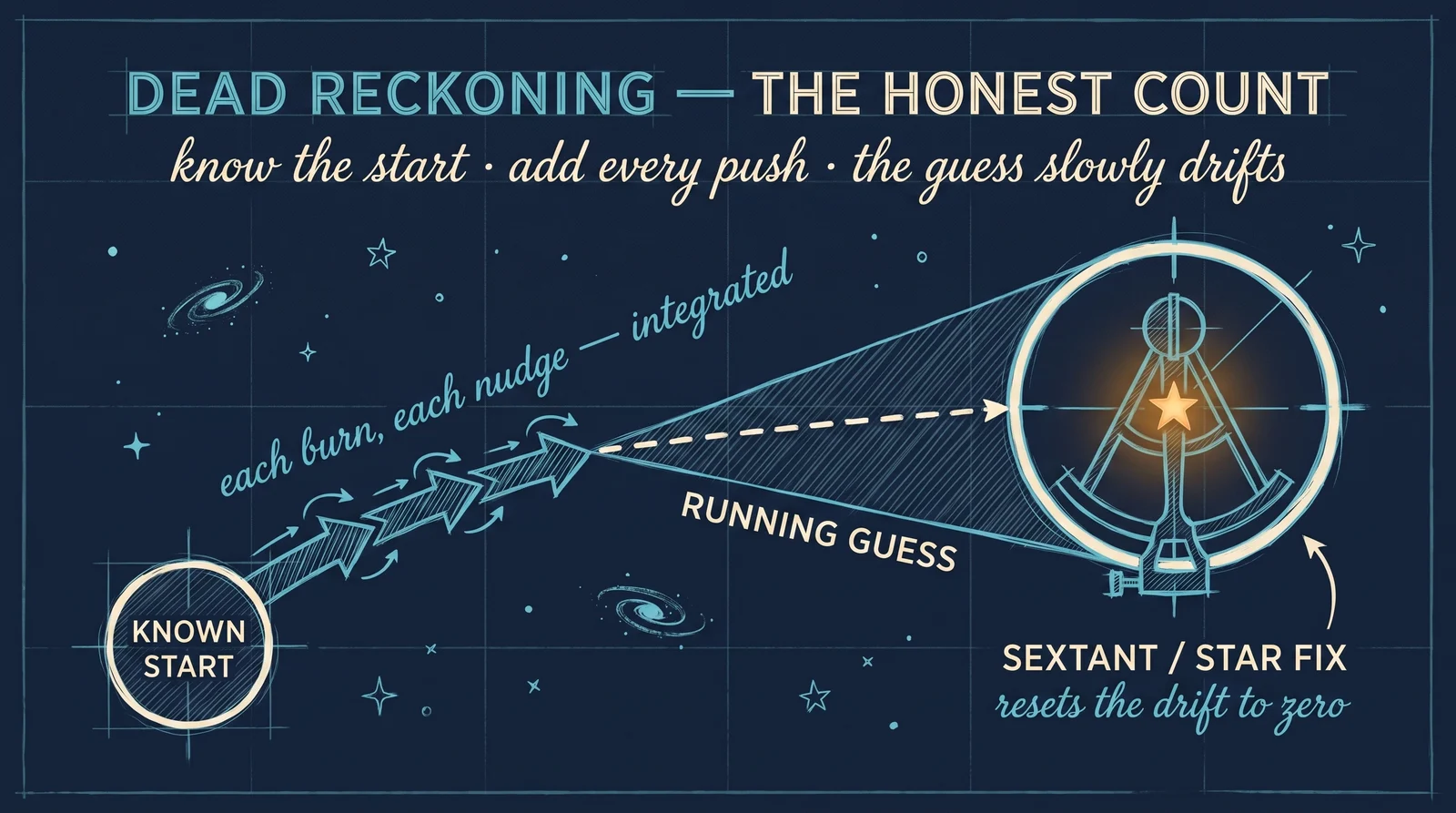
"In principle" is carrying weight in that sentence. Dead reckoning drifts. Every tiny error in every measurement accumulates, so the guess slowly rots, and the further you go the worse it gets. Which is why, on the flights that mattered most, they put a human in the loop with a sextant.
This is the detail worth holding onto. When Apollo 8 became the first crewed ship to leave Earth's gravity and navigate to another world in December 1968, its crew steered in part the way Cook crossed the Pacific: Jim Lovell at a telescope and sextant built into the hull, sighting known stars against the Earth's horizon, feeding the angles into a computer to correct the drift. The Apollo Guidance Computer that ran those sums had about 72 kilobytes of fixed memory and ran at a clock speed a modern doorbell would sneer at — and it flew nine crews to the Moon and two hands' worth of them onto it. The genius wasn't the hardware. It was the recognition that a machine to keep the count and a human to check it against the stars, together, could do what neither could alone.
The idea did not even belong to spaceflight. In those same years a reconnaissance aircraft was flying it: the SR-71 Blackbird, cruising at three times the speed of sound where the daytime sky is already dark, carried a star tracker behind the cockpit that sighted stars through a quartz window — at least two at a time, matched against an onboard catalogue — and used them to correct the drift of its inertial platform, exactly as a spacecraft does. Its crews called the unit R2-D2. The problem is the same problem at seventy thousand feet or in orbit: keep an honest count, and check it against the one thing that does not move.
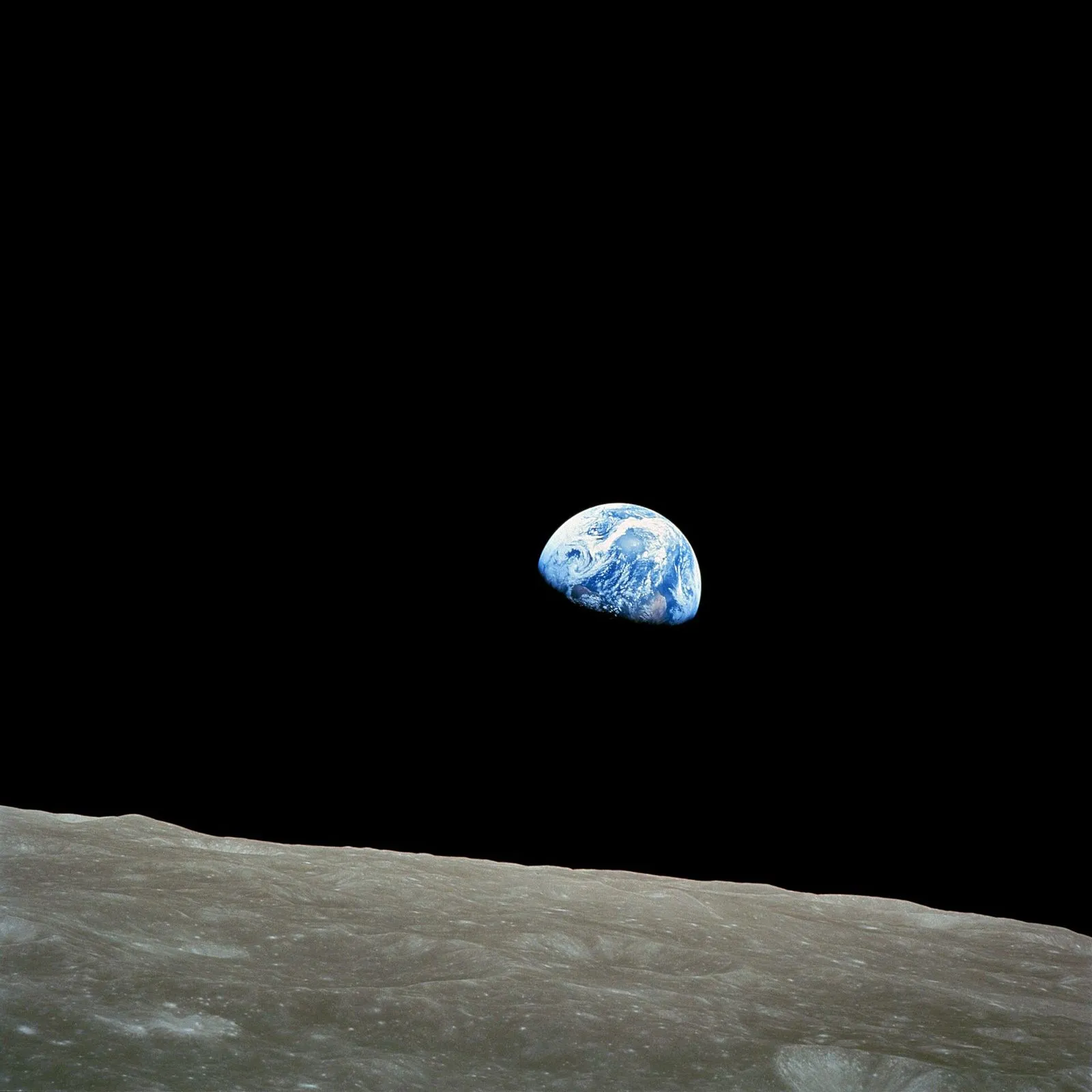
Every deep-space craft still carries the machine half of that pair. But the crewed sextant was a stopgap for a specific decade. For everything uncrewed — every probe to every planet — the honest count had to be checked some other way. It had to be checked from the ground.
The ground does the flying
Here is the fact that undoes most people's intuition about space navigation: for most of the missions in this atlas, the spacecraft doesn't know where it is. The ground does.
The instrument is the Deep Space Network — three great dish complexes spaced roughly 120° apart in California, Spain, and Australia, so that as the Earth turns, at least one of them can always see into deep space. When a dish points at a probe, it isn't mainly listening for data. It's measuring two things with monstrous precision. First, range: it sends a timing signal, the spacecraft echoes it back, and the round-trip time — multiplied by the speed of light — gives the distance, good to a few metres across billions of kilometres. Second, velocity: the craft's radio, shifted in frequency by its motion toward or away from us, is read for its Doppler shift, and the shift gives the speed along the line of sight to a fraction of a millimetre per second.
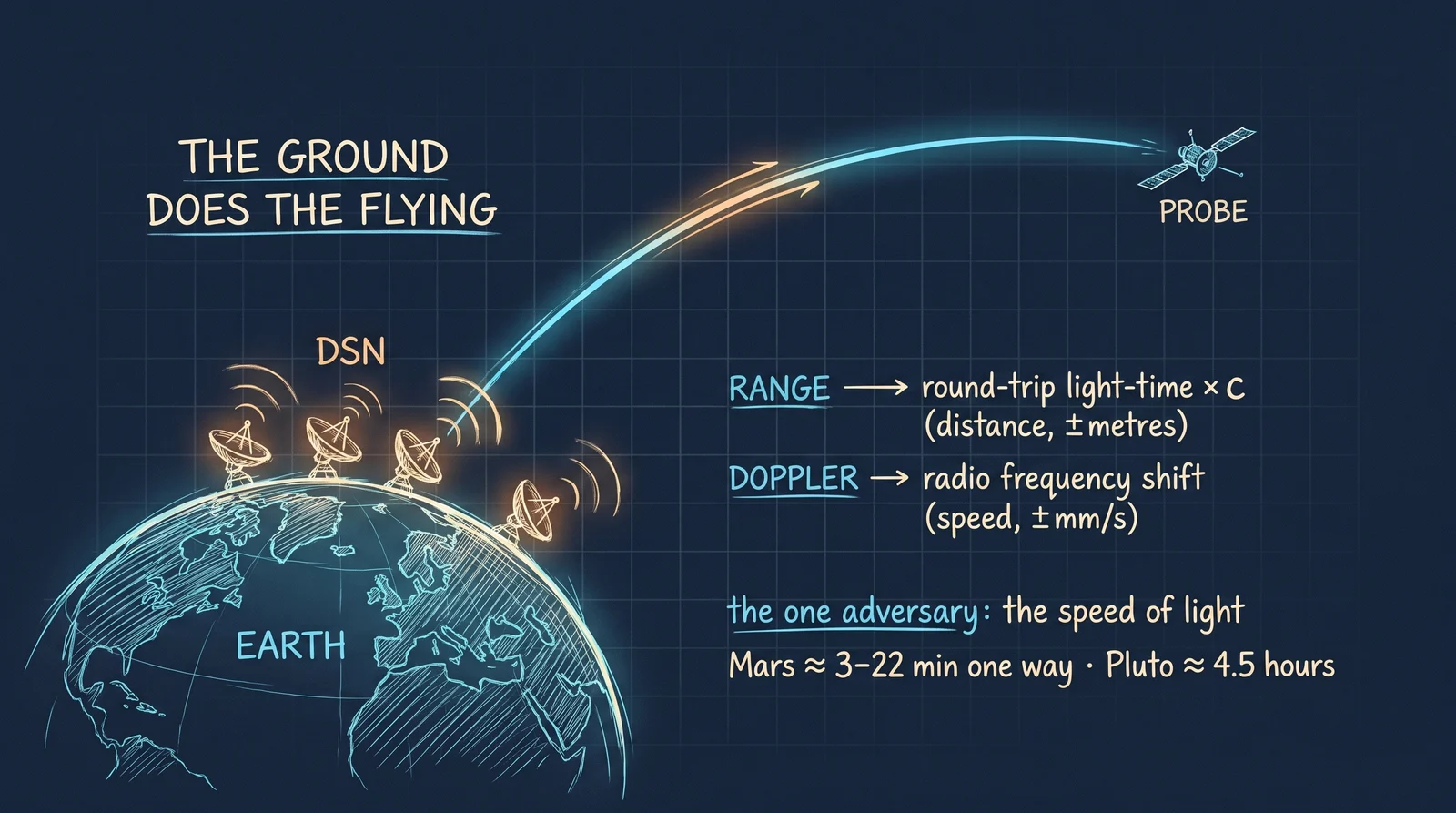
Track those two numbers over hours as the Earth rotates and the geometry changes, and a room of navigators can reconstruct a spacecraft's path through the solar system without the spacecraft having any strong opinion about it at all. When Mariner 4 returned the first close photographs of another planet in 1965, the craft was a passenger; the navigating was done on Earth. The same was true of the Voyagers and of Cassini — and that knife-edge arrival at Pluto, the one that opened this essay, was flown the same way: reconstructed and corrected almost entirely from three dishes on the ground.
But the Deep Space Network has one adversary it cannot argue with, and its name is the speed of light. At Mars, a command takes anywhere from about three to twenty-two minutes to arrive, and the acknowledgement takes just as long to come back. At Pluto it is four and a half hours, one way. The ground can navigate a probe beautifully — as long as nothing needs to be decided faster than light can carry the news home and a reply back out. For seventy years, almost nothing did. That is about to be the whole problem.
Which way is up
Before you can go anywhere, you have to solve the second question — which way am I pointed? — and space is quietly hostile to it. There is no up. There is no down. A spacecraft tumbling in the dark has no floor to tell it which way it's facing, and getting that wrong means pointing your antenna away from Earth, your camera away from the target, your engine the wrong way down the trajectory.
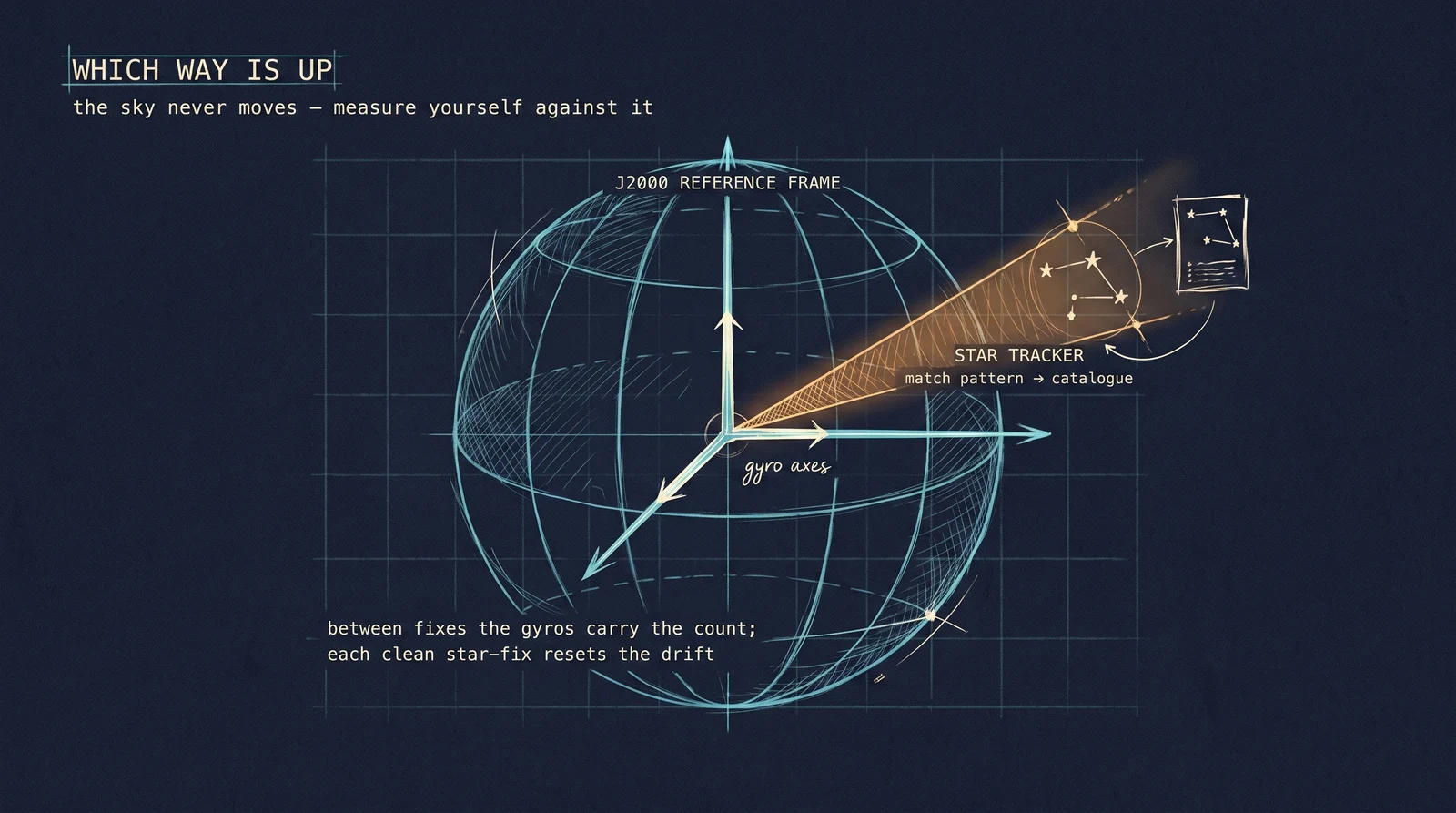
The fix is to agree, in advance, on a set of directions that never move, and to measure yourself against them constantly. That agreement is a reference frame — for most of modern spaceflight, the one called J2000, an orientation pinned to the average positions of the stars at noon on the first day of the year 2000. It is an arbitrary anchor, chosen for convenience, and it is now the shared grid that nearly every spacecraft, ephemeris, and mission plan quietly hangs from.
To find its place in that grid, a craft reads the sky. A star tracker is a small camera that photographs a patch of stars, matches the pattern against an onboard catalogue, and from that single fix knows precisely which way it is oriented in the fixed frame — a machine doing, in a fraction of a second, exactly what Lovell did by hand at his sextant. Between fixes, the drifting gyroscopes carry the count; each time the star tracker gets a clean look, it resets the drift to zero. The sky, again, is the only thing worth trusting. Everything else is interpolation between glimpses of it.
Aiming at a moving planet
Now the third question, the one that turns navigation from bookkeeping into something closer to marksmanship. You know where you are. You know which way you're pointed. Mars is somewhere else — and by the time you get there, it will have moved.
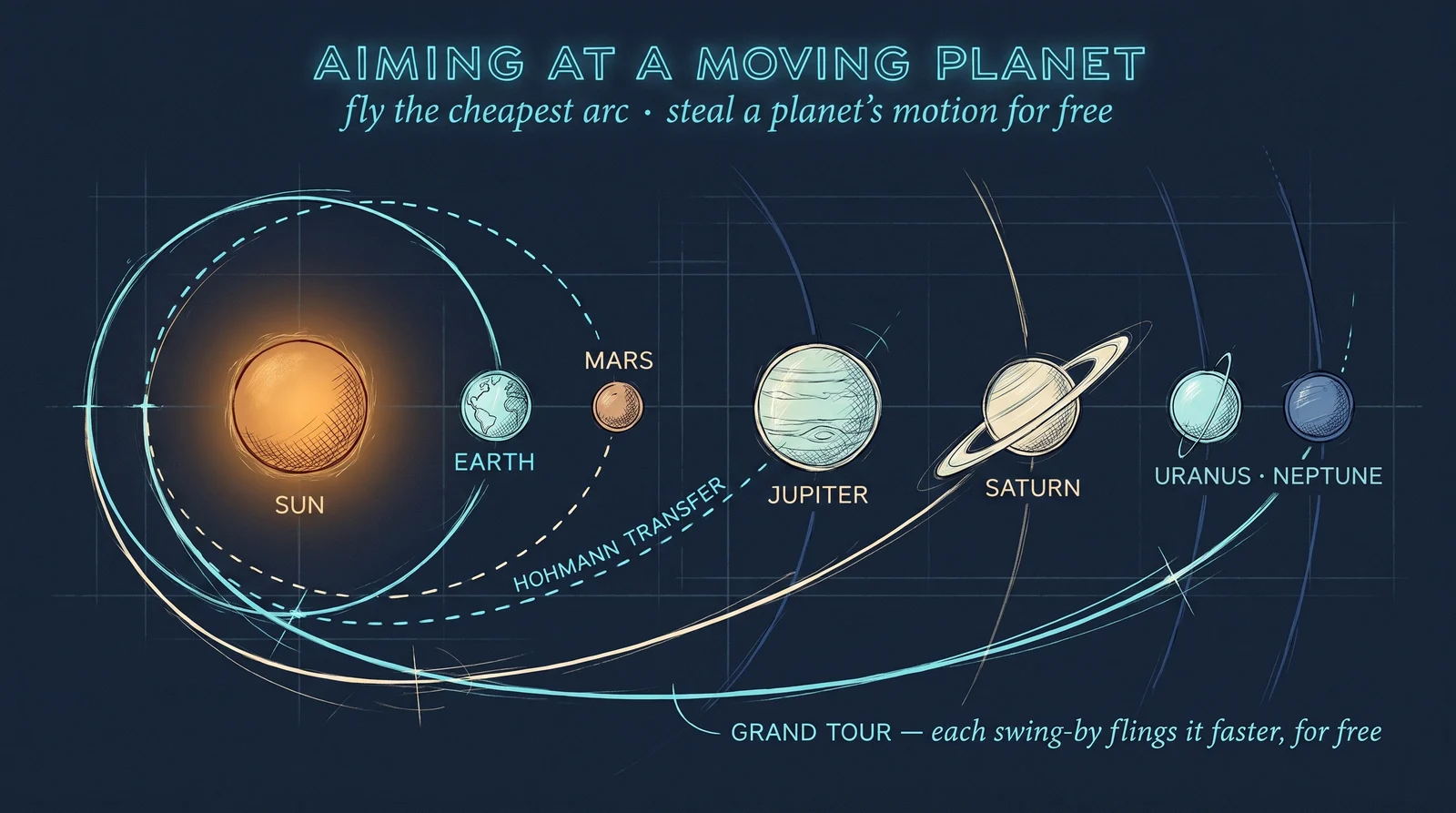
You do not, ever, fly straight at it. Fuel is the currency of spaceflight, and there is never enough, so you fly the path that costs the least: a long, curving transfer orbit that leaves Earth and coasts, engineless, along an arc calculated so that its far end and the target planet arrive at the same rendezvous point at the same instant, months later. Working out that arc — what velocity, in what direction, gets me from this moving point to that moving point in exactly this much time? — is a piece of orbital mechanics old enough to have a name, the Lambert problem, and solving it is the core of every interplanetary launch window.
The most elegant trick in the whole discipline is to let the planets do the pushing. A spacecraft that swings close past a planet can steal a whisper of that planet's own orbital motion and fling away faster than it came, for free — a gravity assist. In the mid-1960s a young mathematician at JPL named Gary Flandro, working out summer-job calculations, noticed that the outer planets were drifting into a once-in-175-year alignment that would let a single probe bank one assist into the next into the next, all the way out. That observation became the Grand Tour: Voyager 2 used Jupiter to reach Saturn, Saturn to reach Uranus, Uranus to reach Neptune, a four-planet bank shot that saved decades of flight time and remains, today, the only time anything has visited the ice giants at all.
No arc is ever flown perfectly. Small errors at launch become enormous ones over a hundred million kilometres, so every deep-space flight is a slow sequence of trajectory-correction maneuvers — brief, precisely-timed nudges, each one the navigators on the ground closing the gap between where the craft is and where the plan says it should be. Navigation, in practice, is not a single act of aiming. It is aiming, checking, and re-aiming, over and over, for years.
The craft learns to see
Everything so far has a room of people on Earth in the loop. The last act of this story is the machine taking the count away from them — because at the frontier, light is simply too slow to ask permission.
The first crack in the old model was optical navigation: instead of relying only on radio from the ground, the spacecraft photographs the target itself against the background stars and works out, onboard, exactly where the target sits relative to its own approach. Cassini refined this against Saturn's moons; it is how you thread a needle at a body whose position, before you arrive, is known less precisely than your own.
Then came the places where the ground genuinely cannot help. Landing on Mars is the sharpest example — the entry, descent and landing takes about seven minutes, and Mars is light-minutes away, so by the time Earth even hears that the craft has hit the atmosphere, the whole thing is long since over, one way or the other. No one on Earth lands a Mars rover. The rover lands itself. Perseverance carried a system that photographed the ground rushing up, matched it in real time against an onboard map, recognised the terrain, and chose a safe spot to touch down — a machine doing Lovell's job, the Deep Space Network's job, and a bush pilot's job at once, in seven minutes, alone.

OSIRIS-REx did something in the same family at the asteroid Bennu: navigating autonomously against surface features to touch a boulder-strewn rock the size of a small mountain and steal a handful of it. These are not the ground flying a passenger anymore. These are spacecraft that navigate themselves, because the alternative — waiting for the speed of light — would kill the mission.
The sky is the map
Step back, and seventy years collapse into a single line. Apollo 8's Lovell at a sextant, sighting stars to correct a drifting count. The star tracker on a probe doing the identical thing, automatically, a billion kilometres out. Perseverance's descent camera reading the terrain because the people who built it are twelve light-minutes too far away to help. Different machines, sixty years apart, and underneath them one stubborn fact that never moved: there is no map of space, and there never was. There is only the sky, which doesn't move, and an honest count of every push, which slowly does — and the whole discipline comes down to trusting the first to correct the second. Every landing, every flyby, every photograph in this atlas rode on getting that right, and almost none of it was ever the headline.
And it is about to stop being quiet. The further out we push — toward the outer system, toward crewed flights to Mars where a twenty-minute lag is the gap between a correction and a crater — the less the ground can do in time, and the more each craft must become its own navigator: its own sextant, its own Deep Space Network, its own room full of people. We spent seventy years teaching machines to find their way by the sky. We are about to find out how well they learned.
Read next
Sources & further reading
- NASA JPL — Basics of Space Flight, Ch. 13: Spacecraft Navigation
- NASA — The Deep Space Network
- Smithsonian National Air and Space Museum — Deep Space Navigation: Apollo 8
- NASA — New Horizons Pluto flyby (arrival timing + targeting)
- NASA — Perseverance: Terrain-Relative Navigation
- NASA history (SP-4219) — Gary Flandro and the Grand Tour