CMSA · China · 2011–now

Tiangong
Locked out of the world's space station, China built its own — on schedule, and now runs the only other permanently-crewed outpost in orbit.
Station ACTIVE
The land
By 2011 there was one place humans lived in space, and China was not welcome there. The International Space Station was a partnership of the United States, Russia, Europe, Japan and Canada — and that same year the US Congress passed the Wolf Amendment, which barred NASA from bilateral cooperation with China without explicit approval. The message was blunt: the club was closed. China's answer was not to protest. It was to build its own station, on its own rocket, with its own crew capsule, on a timeline it published in advance and then met.
What makes Tiangong — "Heavenly Palace" — different from every station before it is how unhurried and deliberate it was. The Soviets improvised Salyut in a hurry; the ISS grew out of a cancelled American station rescued by a post-Soviet Russia. China did the opposite: it flew a single small test lab, learned from it, flew a second, learned again, and only then launched the permanent station — each step a rehearsal for the next. It is China's first long-term space station, and the second one crewed without interruption today.
Goals
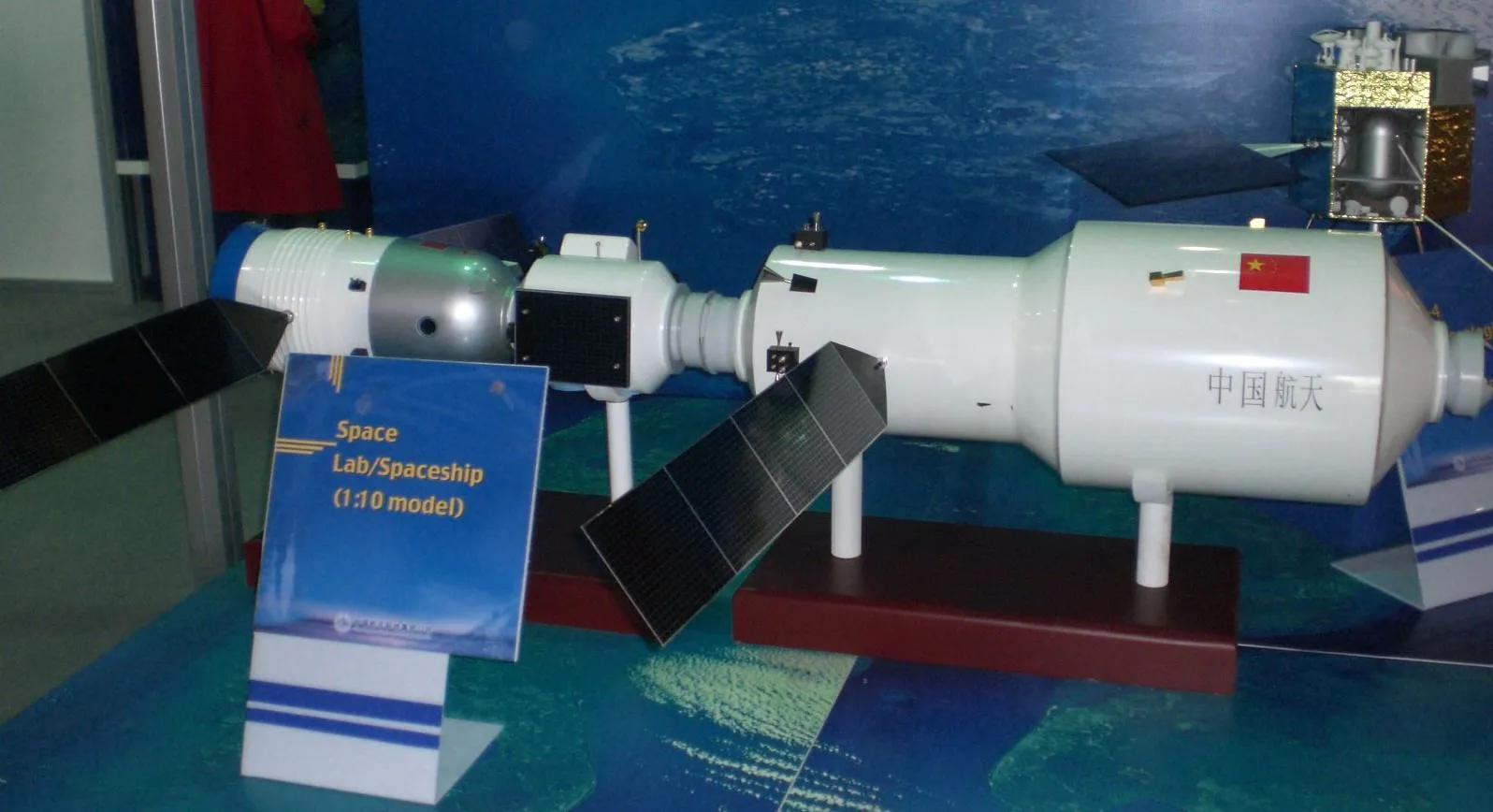
The near-term goal was mastery, not size. Before committing to a permanent outpost, China needed to prove it could do the hard things a station demands: launch a target vehicle, rendezvous and dock with it automatically and then by hand, keep astronauts alive aboard it for weeks, and resupply it. Each of those was flown and checked off deliberately, one at a time, on the two small Tiangong test labs before the real station was ever launched.
The long-term goal was strategic independence. A permanently-crewed station of its own would make China the third space power to operate one — and, as the ISS aged toward retirement, potentially the only one left flying. That is not a small ambition dressed up as a science program; it is a science program built to serve a very deliberate ambition: to be a first-rank spacefaring nation on its own terms, dependent on no one's launch vehicle, no one's docking port, and no one's permission.
Outcome
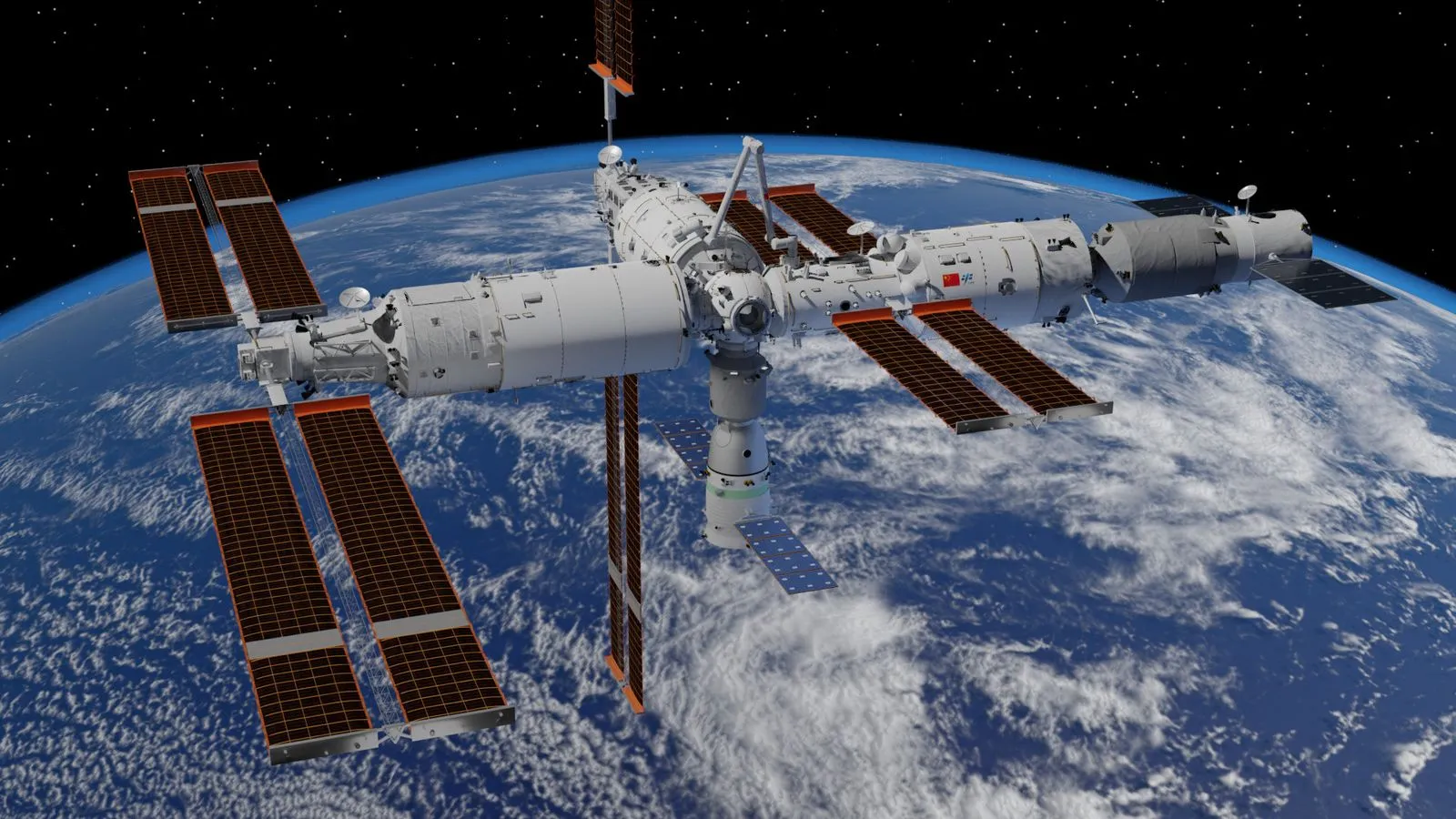
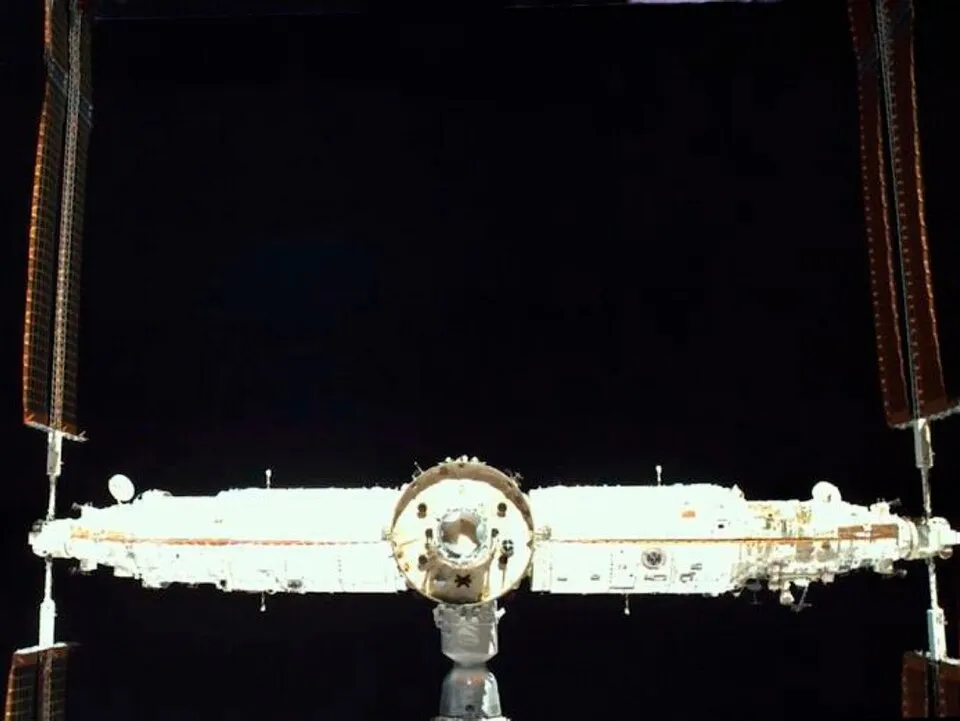
It worked, and it worked on schedule. Tiangong-1 (2011) proved rendezvous and docking; Tiangong-2 (2016) proved crews could live and work aboard for a month and be resupplied by the new Tianzhou freighter. Then, between April 2021 and late 2022, the three modules of the permanent station — the Tianhe core and the Wentian and Mengtian laboratories — were launched and assembled into the T-shaped Chinese Space Station, which has been continuously crewed since June 2022, when the Shenzhou-14 crew began permanent residency.
The station is deliberately modest next to the ISS — roughly 66–70 tonnes against the ISS's 420, three modules against sixteen. But it is complete, modern, and permanently occupied, with a robotic arm, external science platforms, and room for three astronauts (six during handovers). China did in about eighteen months of assembly what the ISS took more than a decade to build, because it had watched everyone else do it first and skipped the mistakes.
The story
The through-line of Tiangong is patience as a strategy. Where the space race was defined by rushing — Voskhod's reckless firsts, Apollo's brutal sprint — China treated human spaceflight as an engineering problem to be retired risk by risk. Shenzhou 5 put the first Chinese astronaut in orbit in 2003, forty-two years after Gagarin, and China was in no hurry to look like it was catching up. It looked, instead, like it was building something that would still be standing when the racing stopped.
There is also a hard edge to the story. The Wolf Amendment did not just exclude China from the ISS; it made independence the only path available. In that light Tiangong is a case study in what exclusion produces: not collapse, but a parallel capability answerable to no one else. China now flies its own crews, on its own rocket, to its own station, and has begun inviting other nations to fly experiments — and eventually astronauts — aboard it. The station that was built because China was shut out has become a door China controls.
What it gave back
Tiangong's first legacy is simply that it exists and is finished. For the first time since the Cold War there are two permanently-crewed stations in orbit at once, run by rival powers — and when the ISS is retired around 2030, Tiangong is positioned to be the only one left. A capability the United States helped pioneer could, within a decade, be one that only China continuously operates.
Its second legacy is a template for how a determined newcomer builds a space program: incrementally, publicly, and without shortcuts. China's step-by-step method — test lab, then bigger test lab, then permanent station — is the same disciplined ladder it is now applying to its robotic lunar program and its plans for crewed lunar landings. Tiangong is the proof of method as much as the proof of capability.
And it is a second front door to orbit. With the ISS partnership historically closed to China, Tiangong gives the rest of the world an alternative host for human spaceflight — one that comes with its own geopolitics, but that materially widens who gets to fly people and experiments to a station at all.
What we can learn
The lesson of Tiangong is that exclusion can manufacture exactly the rival it was meant to prevent. Denied a seat on the ISS, China did not fall behind; it built the capability itself and now holds a card the excluders cannot take back. Shutting a competitor out of a shared project is a bet that they cannot build their own — and it is a bet that, against a patient and well-funded state, tends to lose.
The deeper lesson is about tempo. Tiangong shows that in spaceflight the fastest-looking program is rarely the strongest one. China arrived late to every first and cared about none of them, optimizing instead for a station that would be finished, reliable, and permanent. When the goal is to still be flying in 2035, patience is not caution — it is the strategy.
Assembly — module by module
- 2021 Tianhe The core module — living quarters, life support, propulsion, and the station's control center. The first piece launched, and the heart of the station.
- 2021 Chinarm The station’s robotic arm, mounted on Tianhe, used to relocate modules and assist spacewalks.
- 2022 Wentian The first laboratory module — with a backup control center and an airlock for spacewalks.
- 2022 Mengtian The second laboratory module, completing the T-shaped station; a facility for microgravity science.
Missions
- 1999 first uncrewed Shenzhou test flight — the proof that China could fly its own crew capsule
- 2003 Shenzhou 5 Yang Liwei becomes the first Chinese astronaut in orbit — China joins the US and USSR as the third nation to launch a human on its own rocket
- 2012 Shenzhou 9 → Tiangong-1 first crewed docking with a Chinese station; Liu Yang becomes China's first woman in space
- 2022 Continuous occupation permanent crewing begins with Shenzhou-14 in June 2022; the CSS has been continuously crewed ever since
Hardware
- Tiangong 1 test station
- Tiangong 2 test station
- Tiangong the assembled station
- Shenzhou crew vehicle
- Tianzhou cargo freighter
- Long March 2f crew launcher