The Wall
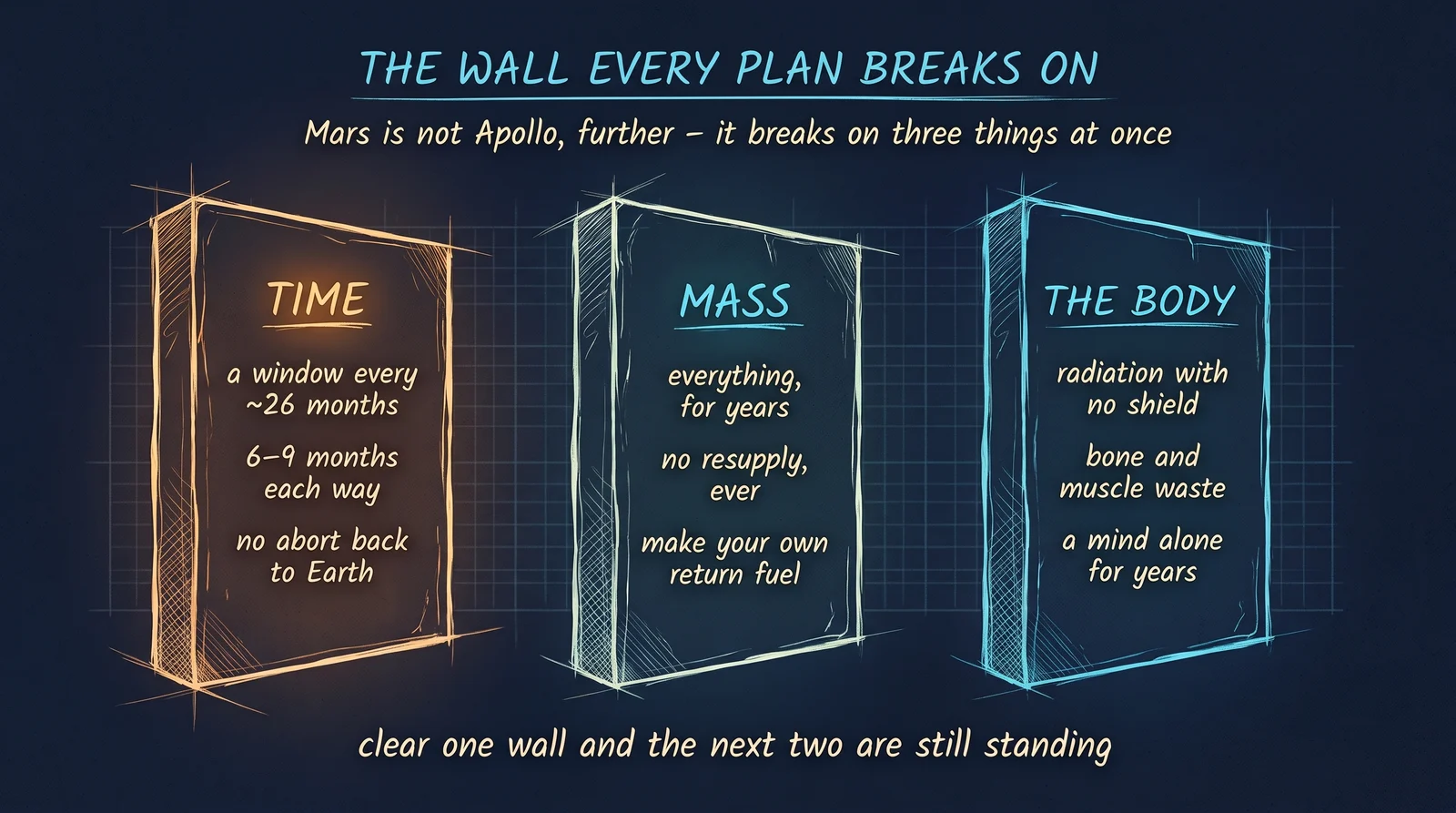
Every human spaceflight plan eventually runs into Mars, and Mars breaks every one of them on the same three things at once: time, mass, and the body. It is not Apollo but further. It is a categorically different problem — and understanding why those confident departure dates keep sliding is the beginning of understanding it honestly.
There is a date that keeps moving. In 1969, Wernher von Braun told a Senate committee that humans could stand on Mars by 1982. In 1986, the National Commission on Space proposed 2010. In 2010, a presidential policy speech aimed at the mid-2030s. Each decade has produced a plan with specific hardware, specific timelines, and a specific decade in which the thing would happen — and each plan has, in one form or another, dissolved. The hardware changes, the agency changes, the rationale changes, but the date reliably recedes by roughly the same distance it was promised to close. Something structural is at work.
The structural thing is not money, though money is always a constraint. It is not political will, though that evaporates too. It is that Mars presents, simultaneously, three problems that human spaceflight has not yet solved together — time, mass, and the body — and solving them separately, one at a time, gives a misleading sense of progress. Together they reinforce each other in ways that make the sum considerably harder than the parts. Mars has been reached robotically by the United States, Russia, the European Space Agency, India, China, and the United Arab Emirates. The vanguard is already multinational, and any honest account of who is trying to go there has to start from that fact.
Not Apollo but further
The comparison to Apollo is almost always the first move in a Mars argument, and it is almost always misleading. What made Apollo work was a specific convergence: a single defined objective, a national emergency framing, essentially unlimited budget growth in the 1960s, and a light-lag of 1.3 seconds that kept crews in real-time contact with the ground. None of that exists for Mars, and none of it can be replicated by wanting it to.
The Moon is, as the going-to-the-moon essay frames it, a practice ground: three days out, abort available, radio real-time, catastrophic failures survivable. Mars is none of those things. At closest approach it is roughly 54 million kilometres away; at farthest, over 400 million. A radio signal takes three to twenty-two minutes one way. The fastest plausible transfer runs six to nine months of coast. Once the trans-Mars injection burn fires, there is no trajectory home on demand. The crew that leaves for Mars is committed.
You cannot leave when you want
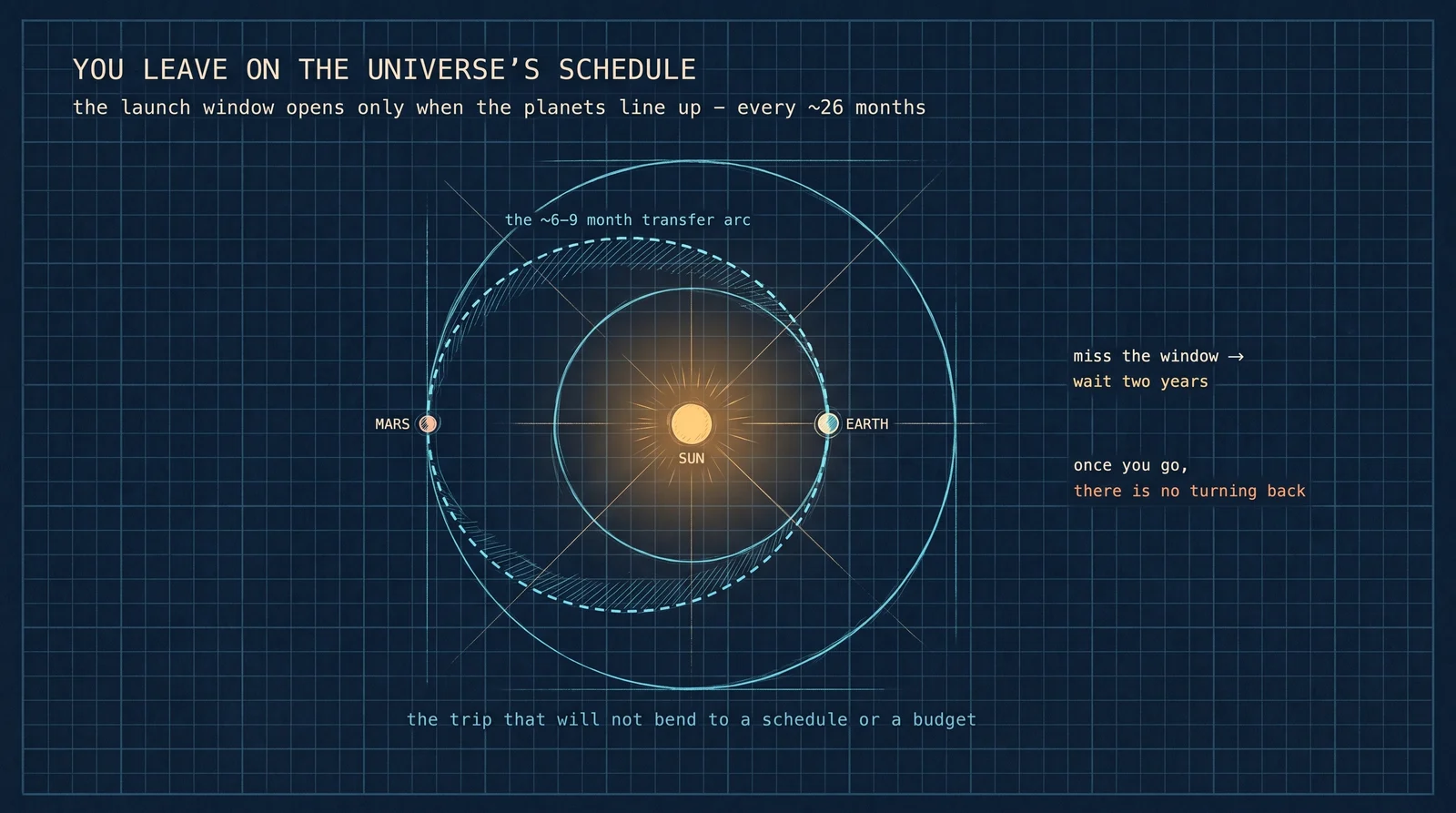
The first wall is time, and it begins before the mission does. Earth and Mars orbit the sun at different speeds — Earth in about 365 days, Mars in about 687 — which means the geometry between them is constantly shifting. A Hohmann transfer orbit, the minimum-energy arc from one planet to another, only works when the planets are in the right relative positions: departure must be timed so that the transfer ellipse's far end intersects Mars's orbit at precisely the moment Mars arrives there. That window opens roughly every 26 months. Miss it and you wait more than two years for the next one.
The alignment affects not just the outbound leg but the return. A crew arriving at Mars will wait at least 14 to 18 months for the planets to cycle back into a return window — which is why a minimum-duration Mars mission, with a six-to-nine month outbound coast, a surface stay of 14 to 18 months, and a six-to-nine month return, runs to roughly 900 days total. Three years, round trip, as a floor. Engineers call the plots that map launch windows and transit times "porkchop plots" — contour maps of delta-v cost against departure and arrival date that look, with some imagination, like the cut they are named for. The cheap valleys in those plots are the windows. The expensive ridges between them are the months when no reasonable mission can fly. The window runs the mission, not the other way around.
The commitment consequence of the window is absolute. Unlike an Apollo lunar mission — where a free-return trajectory kept abort-to-Earth available for much of the outbound cruise — a Mars mission on a Hohmann arc has no such option once the trans-Mars injection burn fires. There is no trajectory that brings the crew home fast if something goes wrong on the way. There are higher-energy abort trajectories, but they require enormous propellant reserves that no mission has yet proposed carrying, precisely because propellant is the second wall.
Everything, for years
The second wall is mass — and specifically, the relationship between mass and distance in a mission from which no resupply is possible. On the International Space Station, a Progress cargo vehicle arrives every few months with food, water, equipment, and spare parts. The station's life-support systems are closed-loop in some respects but leaky in others; water is recycled, but consumables are topped up regularly from Earth. A Mars crew gets no such resupply. Whatever leaves with them is what they have. Every kilogram of food, every litre of water, every spare component for every critical system must either be carried from Earth — at extraordinary launch cost — or produced on Mars itself.
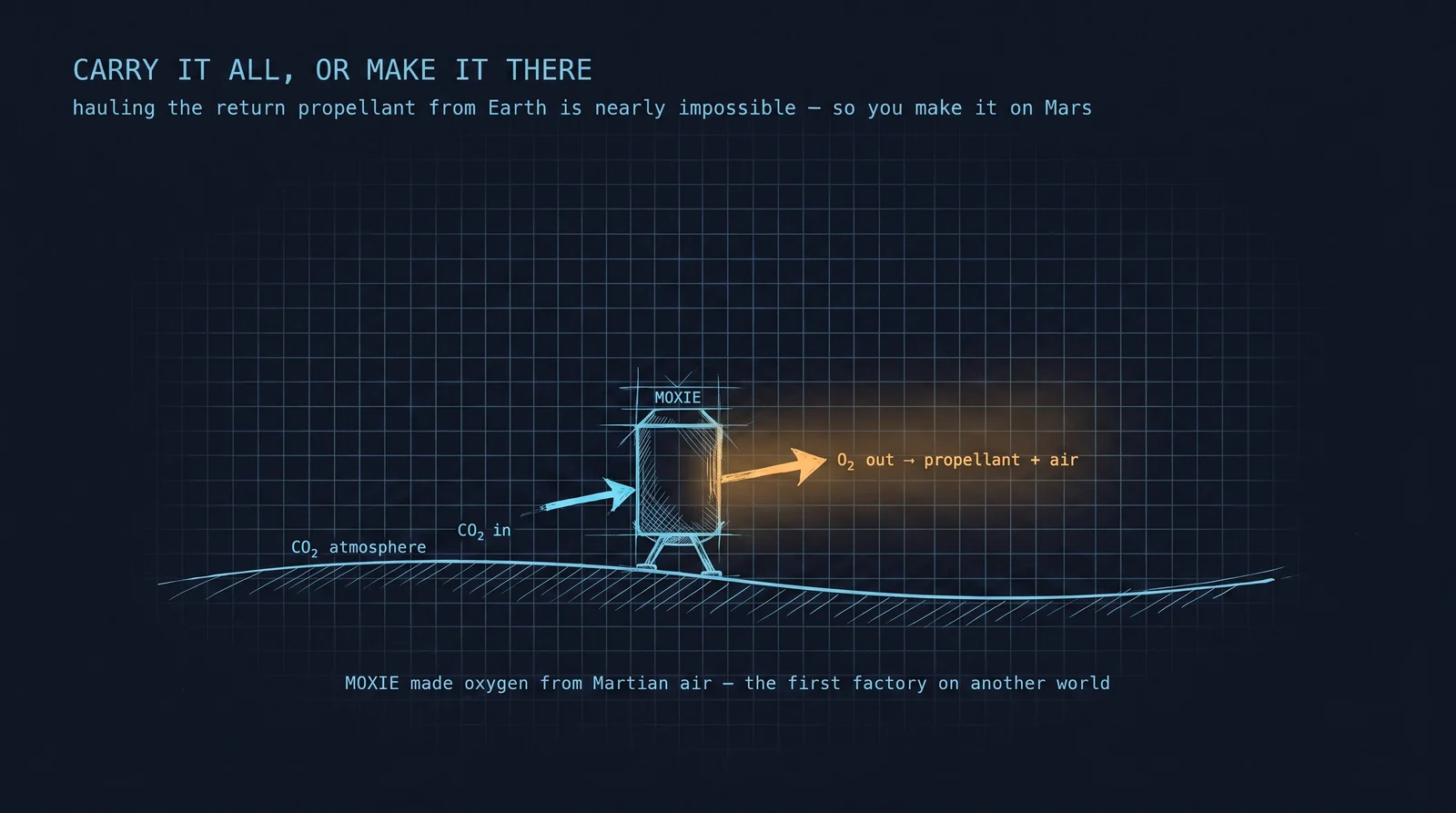
The return-propellant problem is the sharpest version of this. A crewed lander descending to the Martian surface must also carry the propellant to ascend from it, rendezvous with a waiting ship in orbit, and burn for the return. The mass of that propellant, added to the lander, raises the lander's mass, which requires more propellant to land it, which raises the mass further — a spiral that has been studied carefully and comes out to tens of tonnes of propellant that must reach the Martian surface. Carrying it from Earth on a single launch stack is extraordinarily expensive. The escape from this spiral is in-situ resource utilisation: manufacturing propellant on Mars, from Martian resources, rather than hauling it from Earth.
The escape from the propellant spiral is in-situ resource utilisation: manufacturing propellant on Mars from Martian resources. Mars's atmosphere is 95% carbon dioxide; split CO₂ electrochemically and you have oxygen, or process it with hydrogen from water ice to produce methane fuel. Perseverance carried MOXIE — the Mars Oxygen In-Situ Resource Utilization Experiment — which made oxygen from Martian CO₂ at small scale from 2021 to 2023, at rates of up to twelve grams per hour. It is the only proof-of-concept of resource production on another planet. Scaling that to the tonnes of propellant a crewed ascent vehicle needs, alongside a closed-loop life-support system that recycles water and air for three years without resupply, is an unsolved engineering challenge of the first order. The path from ten grams per hour to a full propellant plant exists on paper. It has never been built.
The seven minutes, again — and then some
The third wall's opening act is well documented. Entry, descent, and landing at Mars — the sequence the seven-minutes essay traces in detail — is the hardest landing in the solar system for a specific and unforgiving reason: Mars has just enough atmosphere to generate lethal heat on entry, and not nearly enough to slow you to a landing speed on a parachute alone. Every Mars lander in history has required a bespoke combination of heat shield, supersonic parachute, rockets, and sometimes elaborate mechanical ingenuity — the airbags of Mars Pathfinder, the sky crane of Curiosity and Perseverance — just to get hardware the size of a car onto the surface. The sky crane is, at roughly one tonne of rover, near the outer limit of what the current EDL toolkit can deliver. A crewed Mars lander would mass on the order of twenty to forty tonnes.
That gap — between what has been landed and what a crewed mission requires — is called the EDL gap, and it is not a small engineering extension of existing work. It is a regime change. The physics that governs parachute drag scales poorly with mass: a parachute large enough to meaningfully slow a forty-tonne vehicle in Mars's thin atmosphere would need to be so large that it becomes structurally impractical at supersonic speeds. Alternate approaches — supersonic retropropulsion, inflatable aeroshells, combinations thereof — have been studied and demonstrated at small scale. SpaceX's Starship, if it ever reaches Mars with a functioning propulsive-landing capability, would represent the first attempt at crewed-scale Mars EDL. As of this writing, Starship has not completed a fully successful orbital demonstration on Earth. Its Mars performance is a projection from an unproven system. Every credible analysis of crewed Mars architectures lists EDL as one of the most significant unresolved technical risks. This is not pessimism. It is the engineering record as it stands.
The signal lag applies regardless of EDL architecture. By the time Earth hears that a craft has entered the Martian atmosphere, the seven-minute sequence is already resolved — success or crater — which is why Perseverance selected its own landing spot autonomously using terrain-relative navigation. For a crewed lander the same constraint holds: every descent decision is the crew's alone, and every emergency on the surface is answered by people eleven to twenty-two light-minutes from the nearest help.

The body keeps the score
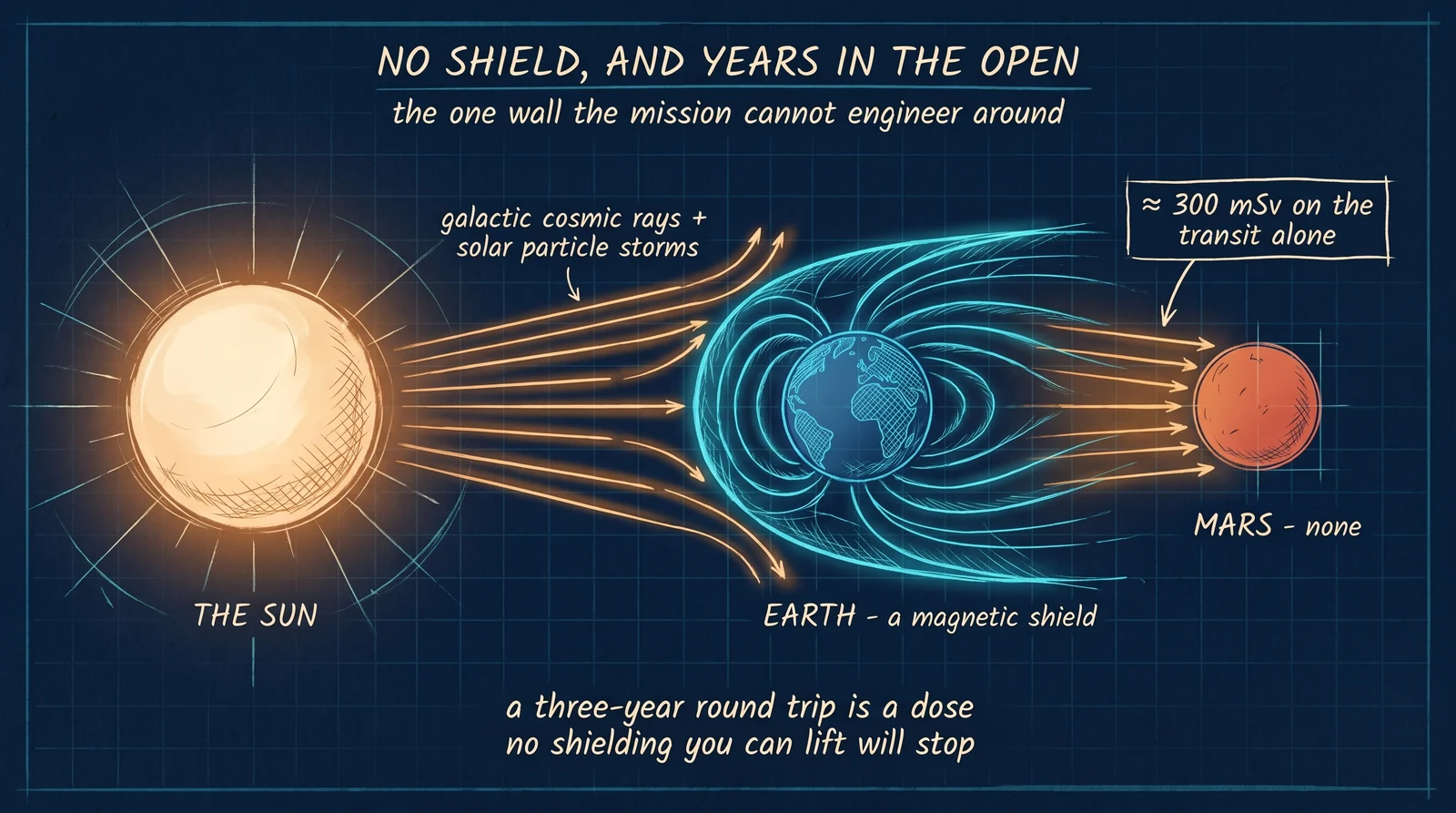
The third wall is the human body, and it is the one the mission architecture cannot engineer around. Mars has no global magnetic field — its core long since solidified, ending the dynamo that once generated the shield. Earth's magnetosphere deflects the bulk of galactic cosmic rays and solar energetic particles; Mars offers no equivalent. A six-month transit through interplanetary space delivers a measured dose of roughly 300 millisieverts — well over a hundred times a typical year of natural background radiation on Earth, absorbed in six months. On the Martian surface, without a magnetosphere, dose accumulates further from secondary radiation. A three-year round trip has been estimated at 600 to 1,200 millisieverts total, depending on solar-cycle phase and shielding — numbers measured in flight by instruments aboard Curiosity.
Current NASA occupational dose limits are designed to cap lifetime excess cancer risk to 3%. A Mars round trip, under most architecture assumptions, exceeds those limits. The radiation exposure is a quantified, documented risk that existing shielding technology does not adequately mitigate; any limit revision permitting the mission would be a policy decision made against acknowledged uncertainty, not a technical problem solved. Beyond radiation, bone density loss and muscle atrophy in microgravity can be slowed by countermeasures but not stopped. ISS crews on six-month tours return needing months of rehabilitation; a Mars crew would spend six to nine months in transit microgravity outbound, more than a year in Mars's one-third gravity — a regime with no long-duration human data — then six to nine months in microgravity again on return. Whether the body can sustain that sequence without permanent damage to bone, cardiovascular function, or vision is an open question that cannot be answered from current data. It can only be answered by going. And then there is the three-year social isolation — a crew in a volume comparable to a large recreational vehicle, beyond real-time communication with Earth, with no rescue available — a psychological experiment for which Antarctic winter-overs and submarine deployments are partial models at best.
The wall is the point
The robotic record at Mars is, if you step back far enough, extraordinary. Viking 1 touched down on Chryse Planitia on 20 July 1976 — the first spacecraft to operate successfully on the Martian surface — and ran for more than six years. Spirit and Opportunity drove across terrain that no human has touched; Curiosity has been reading the geological history of Gale Crater since August 2012; Perseverance is in Jezero Crater right now, caching rock cores that a future sample-return mission may one day bring to Earth.
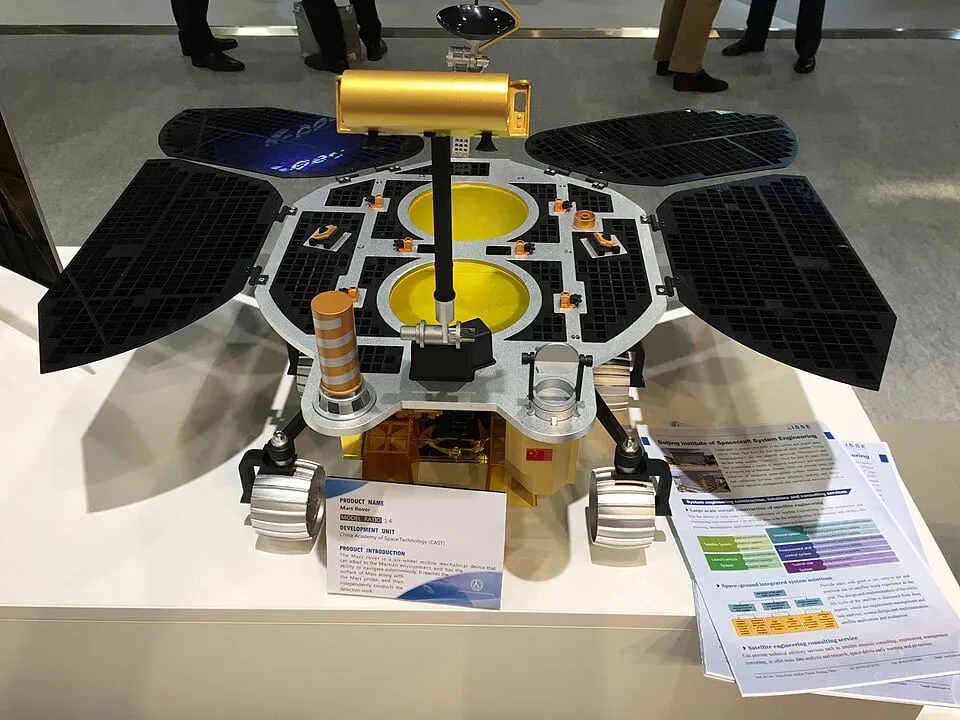
The global dimension of this vanguard is underappreciated. Mangalyaan — the Mars Orbiter Mission of the Indian Space Research Organisation — arrived at Mars on 24 September 2014 on its first attempt, making India the fourth space agency to reach Mars and the first Asian nation to do so, at a total mission cost of approximately $74 million, less than the production budget of the film Gravity. It operated for nearly eight years, far beyond its six-month design life. Tianwen-1, launched by China in July 2020, performed a feat that no space agency had managed on a first Mars attempt: it orbited, landed, and deployed a rover — Zhurong — all in a single mission. Zhurong drove across Utopia Planitia beginning in May 2021 and returned geological and atmospheric data for more than a year. That achievement, on the first try, from a national Mars programme that did not exist before the 21st century, reshapes the geopolitical map of where the capability to go to Mars currently resides.
Against this robotic foundation, Starship stands as the current centrepiece of crewed Mars planning. SpaceX has described architectures in which fully reusable, fully refuelled vehicles carry large crews on six-month transits, landing propulsively and producing return propellant on the surface via ISRU. The ambition is real; a fully reusable vehicle at Starship's scale would change the mass equation substantially. But as of this writing, Starship has not completed a fully successful orbital demonstration on Earth. It has not demonstrated in-space propellant transfer at scale, propulsive landing at crewed-lander mass, or any of the life-support and radiation mitigations that the walls above require. Starship may eventually address those things. It is, right now, an enormous and seriously funded wager — and a wager is not a solution.
What makes Mars the wall is not that it is impossible. The orbital mechanics are solved; the transfer trajectories are mapped; the porkchop plots exist for every window through the end of the century. What makes it the wall is that it requires solving time, mass, and the body simultaneously, at a remove where every failure is final and no help is coming. The going-to-the-moon essay frames the lunar return as a rehearsal precisely because getting it wrong there is survivable. Mars does not offer that. The first crewed mission will be the first time every system runs together in the actual environment, with actual people inside, on an actual three-year commitment — and there is no second attempt built into the schedule.
The date keeps moving because the work is real and the work is hard. The honest answer to "when will humans land on Mars" is: when the three walls have been addressed — not when confidence is high, not when a schedule says so, not when a founder's ambition demands it, but when the EDL architecture has been demonstrated at crewed scale, when a closed-loop life-support system has been proven for three years of operation, when the radiation picture is either mitigated or accepted on known terms, and when a return-propellant supply exists at Mars before the crew leaves Earth. Some of that work is underway. None of it is done. The wall is still there, and the measure of every plan is whether it faces the wall squarely or papers over the hardest parts with optimism. The former is how you eventually get through. The latter is how you move the date.