Running the Solar System on a Whisper
Three dish complexes on Earth carry on every conversation humanity has ever had with anything beyond the Moon. A 22-watt radio signal, a light-hour of patience, and the most oversubscribed network in the solar system — this is how the whole enterprise holds together.
In the navigation essay we named the problem and then mostly set it aside: the speed of light imposes a lag on every instruction, every correction, every answer, and the further out you go the worse it gets. The navigation essay could afford to set it aside because, for most of what it describes, the lag is inconvenient but manageable. A twenty-minute round trip to Mars is long enough to be annoying and short enough to work around. The spacecraft coasts; the ground catches up. But that arithmetic doesn't hold forever. Push it another order of magnitude — to Saturn, to Pluto, to the place where Voyager 1 is right now, almost a full light-day from the Earth — and "hold on, we're thinking" stops being a workable answer. The problem that navigation named but deferred is the one this essay is about.
Before we get to the lag, though, there's a more fundamental strangeness to absorb. Every probe, every rover, every lander in this atlas maintains exactly one thread of connection to Earth: a radio link through a handful of large dishes on the ground. Not a constellation of relay satellites. Not a mesh network. Not a pair of backups standing by in case the primary goes down. One link, through one of roughly forty antennas spread across three sites, and the whole solar system runs on it. Everything we've learned about Mars, Saturn, Jupiter, Uranus, Neptune, Pluto, the asteroid belt, and interstellar space beyond the heliosphere has traveled down that single thread. The miracle isn't that we've lost spacecraft. The miracle is how few.
Three sites, one sky
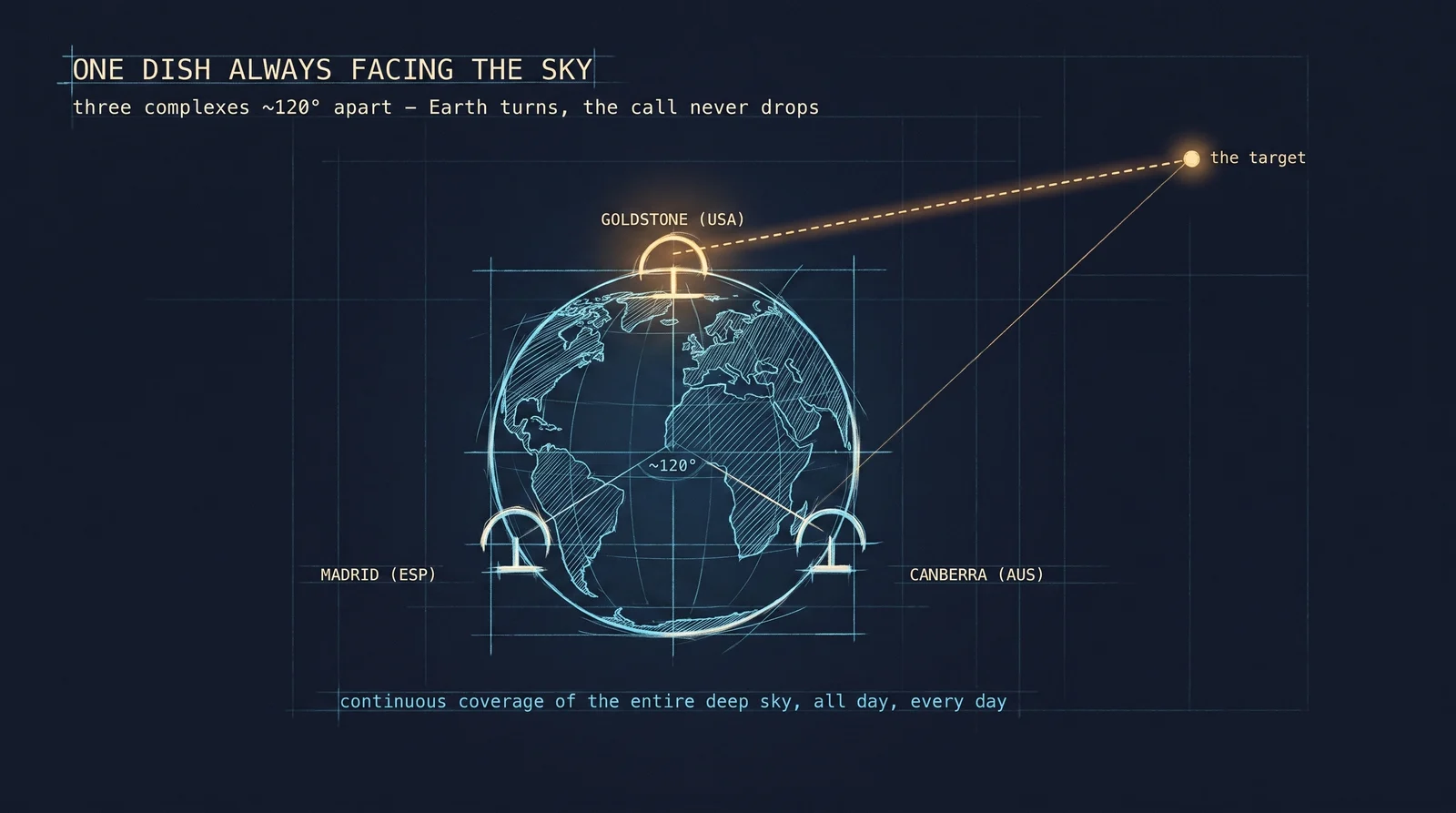
The Deep Space Network is a creation of the early 1960s, built when the first probes were heading for Venus and Mars and the question of how to talk to them as they receded became urgently practical. The answer JPL arrived at was elegant in its simplicity: place antenna complexes roughly 120 degrees of longitude apart around the planet, so that as the Earth rotates, at least one of them always faces the part of the sky where the mission is. Three sites: Goldstone in the California desert, Madrid in Spain, and Canberra in Australia. They have been the ears and mouth of the solar system ever since.
The crown of each complex is its 70-metre dish — a structure about the size and weight of a naval destroyer balanced on a bearing that lets it track a point in the sky to within a fraction of a degree, hour after hour, as the Earth turns beneath it. The three 70-metre antennas (DSS-14 at Goldstone, DSS-43 at Canberra, DSS-63 at Madrid) were built as 64-metre dishes and then, between 1982 and 1988, expanded specifically to support Voyager 2's approaching encounter with Neptune — a civilisational upgrade to a global network, for one flyby, of one planet. Canberra's DSS-43 carries a distinction the other two don't: because Voyager 2's trajectory took it south of the solar plane, it is the only antenna on Earth with a line of sight to it. One dish, on one continent, is the reason Voyager 2 is still in the conversation.
Arrayed around the 70-metre giants at each site are a family of 34-metre dishes — some with high-efficiency beam waveguide feeds, some optimised for different frequency bands, all contributing to a schedule that is, even in good years, relentlessly oversubscribed. Demand on the DSN has been running roughly 40 percent above capacity; by the early 2030s NASA projects it will grow by a factor of ten, driven by Artemis lunar missions, a surge in science probes, and commercial operators who want their own slice. The upgrade program meant to address it is running nearly five years late and has roughly doubled in cost. The network that carries every word we speak to the outer planets is doing so on a timetable that leaves almost no margin. Missions negotiate for antenna time the way airlines negotiate for takeoff slots, and the answer is sometimes no.
22 watts across the void
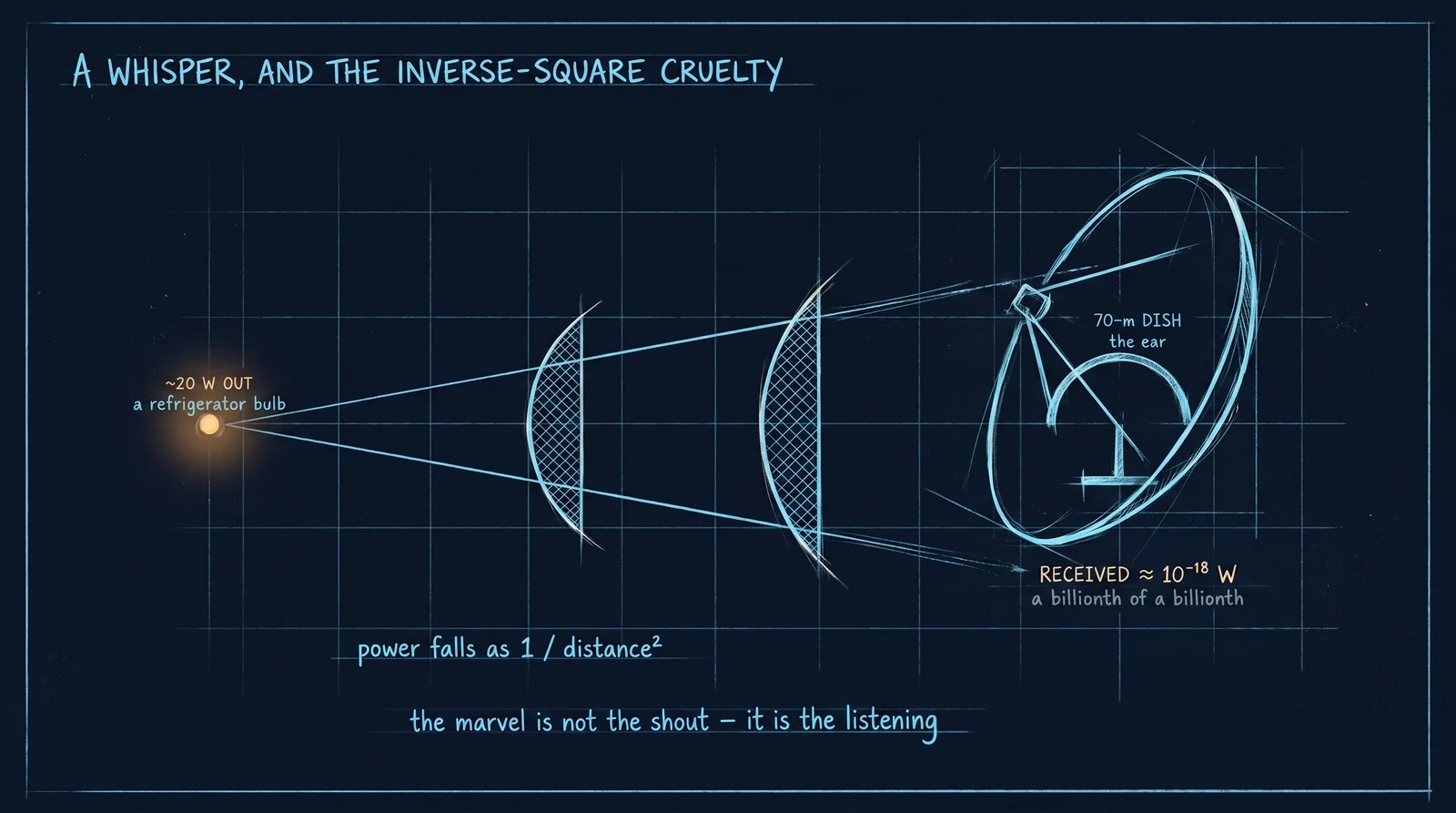
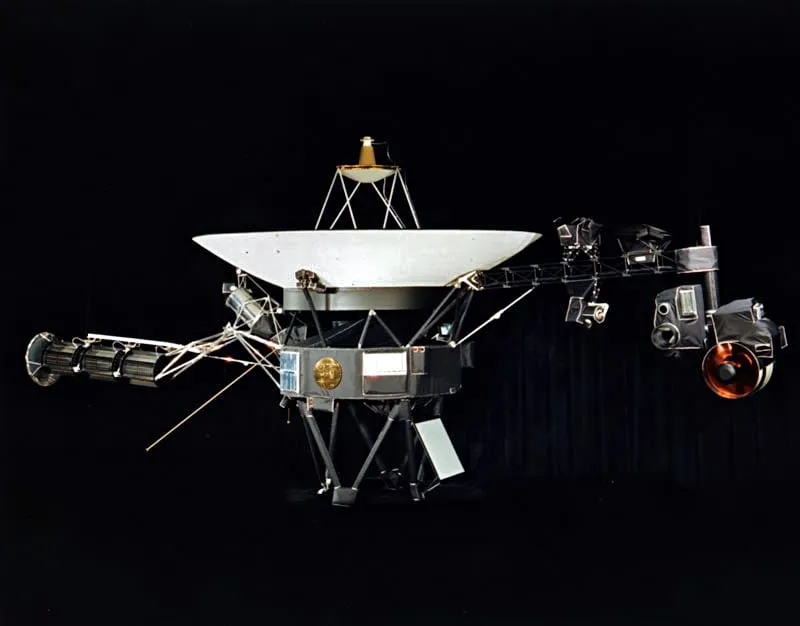
Stand next to a DSN dish while it is locked onto Voyager 1 and try to hold in your head what it is listening for. The spacecraft's transmitter puts out 22.4 watts — roughly the output of a refrigerator's interior bulb, or a dimmer-switch lamp set to half. That signal leaves a 3.7-metre dish on Voyager 1 and begins to spread. Radio waves obey an inverse-square law: double the distance, quarter the power. By the time the beam crosses the distance to Earth — currently about 23 and a half light-hours, a number that grows by roughly 520 million kilometres per year — the power arriving at a 70-metre dish is less than a femtowatt. A femtowatt is 10⁻¹⁵ watts. The number often quoted for Voyager is closer to 10⁻²¹ watts — a single zeptowatt, unimaginably faint. The dish has to fish that out of a sky full of everything else.
That it can do this at all is a feat of engineering in three parts. First, the geometry: a 70-metre dish has roughly 3,600 square metres of collecting area, and every square metre counts. Second, the cold: the receivers sit cooled to within a few degrees of absolute zero, because thermal noise from a room-temperature amplifier would drown the signal entirely — the receiver has to be colder than interstellar space to hear something weaker than starlight. Third, the coding. Voyager's engineers, like every subsequent mission team, knew that individual bits would be corrupted by noise over distances like these, so they encoded the data with far more mathematical redundancy than the information itself requires. A single real bit of science travels inside a protective shell of check bits; the ground-side computer strips the shell away and recovers the original, even from a stream where a significant fraction of the received symbols are wrong. New Horizons used the same principle to send back Pluto's face: each image arrived corrupted and was reconstructed, the way a librarian might reassemble a burned manuscript from a set of redundant copies.
The practical ceiling on data rates is real. Voyager 1 peaked at 115,200 bits per second during its planetary encounters, when the distances were shorter and the dishes could be pointed tighter. At its current remove it manages a few tens of bits per second for engineering telemetry, a trickle that would have been embarrassingly slow on a 1970s modem. Everything we know about what lies beyond the heliosphere — the plasma density, the magnetic field, the particle flux in interstellar space, the data that no other instrument in existence could ever gather — arrives at the DSN at a rate slower than a fax machine. We are grateful for every bit.
The patience required
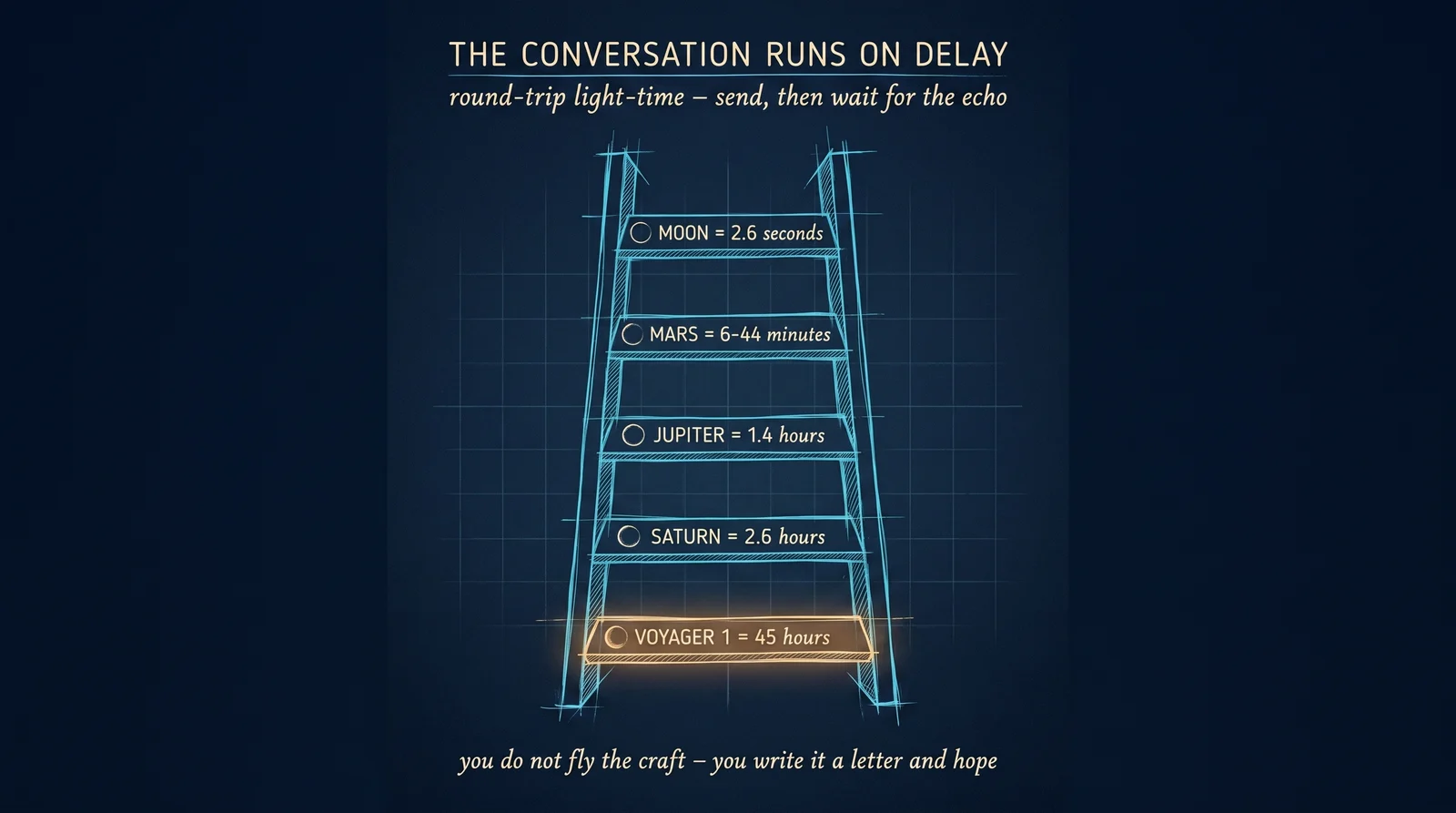
The lag compounds everything. At Mars, a signal takes between 3 and 22 minutes one way, depending on where the two planets are in their orbits. That means a round-trip question and answer — "are you receiving?" … "yes" — can take anywhere from six minutes to nearly three-quarters of an hour. Rover drivers at JPL developed an entire philosophy around this: you can't joystick Perseverance the way you'd drive a car. You plan the day's work in the Martian morning, uplink a command sequence, and watch the outcome arrive hours later. The rover moves autonomously between waypoints; you correct its course tomorrow. The planet is close enough that a human can still be meaningfully in the loop, if the human is willing to think in Martian sol-lengths rather than real-time.
At Cassini, orbiting Saturn, the one-way lag ran between 68 and 85 minutes. At New Horizons during the Pluto flyby it was four and a half hours. Every command sent to New Horizons on its closest approach day had been uplinked — and confirmed received — well in advance, because there was no time to react. The flyby sequence ran entirely on stored instructions while the ground held its breath. The spacecraft would either do what it was told or not, and no one on Earth would know for hours. It did.
Now consider Voyager 1, which in July 2026 is approximately 23 hours and 32 minutes of light-travel time from Earth — and which, on a specific day in November 2026, will cross a threshold no human-made object has ever crossed: one full light-day from the planet that built it. Send a command Monday morning at eight; the acknowledgement arrives Wednesday morning. A round trip between Earth and Voyager 1 takes nearly two days. In that span, whatever the spacecraft does, it does alone. It has been alone, in this sense, since the day it launched. The ground is not flying it anymore. The ground is listening to it.
What patience costs
That patience has shaped every mission in ways the public almost never sees. Trajectory corrections for outer-planet probes are planned weeks in advance and uplinked as timed sequences; if the spacecraft's position turns out to be slightly different from the prediction — which it always is, by some small amount — the navigators have to wait for the next DSN track, reconstruct the actual position, plan a correcting burn, and uplink it, all before the window closes. For a spacecraft approaching its target at several kilometres per second, that timing can be the difference between threading the gap and missing. The navigation essay described the Deep Space Network as the instrument that lets the ground fly the spacecraft. What it didn't dwell on is that the ground can only respond to what the spacecraft reported minutes or hours ago, and can only correct what it predicted minutes or hours from now. Navigation is perfect in principle, patient in practice, and always slightly behind.
There is a related cost that rarely makes mission descriptions: the sheer cognitive weight of maintaining these conversations over years. Cassini operated at Saturn for thirteen years. Teams at JPL developed what amounted to a working relationship with a machine they could not see, could not touch, and could never respond to in less than an hour. Procedures existed for every contingency — a failed reaction wheel, a software fault, an unexpected safe-mode entry — and those procedures had to be rehearsed on the ground before they could be uplinked, because there was no room to improvise at the speed of a crisis when every reply took longer than a lunch break. The people who ran Cassini built a kind of institutional memory for a spacecraft: knowing its habits, its quirks, its patterns of health, better than some operators know their own machinery. They had to, because the spacecraft couldn't ask for help.
The turn toward light
Radio has carried every conversation we've had with the solar system for sixty years. It is mature, well-understood, and operates at the edge of physics — the DSN dishes are close to the thermal noise floor; the coding schemes approach the Shannon limit for the signal-to-noise ratios involved. There isn't a factor of ten left to find in radio. But there is in optics.
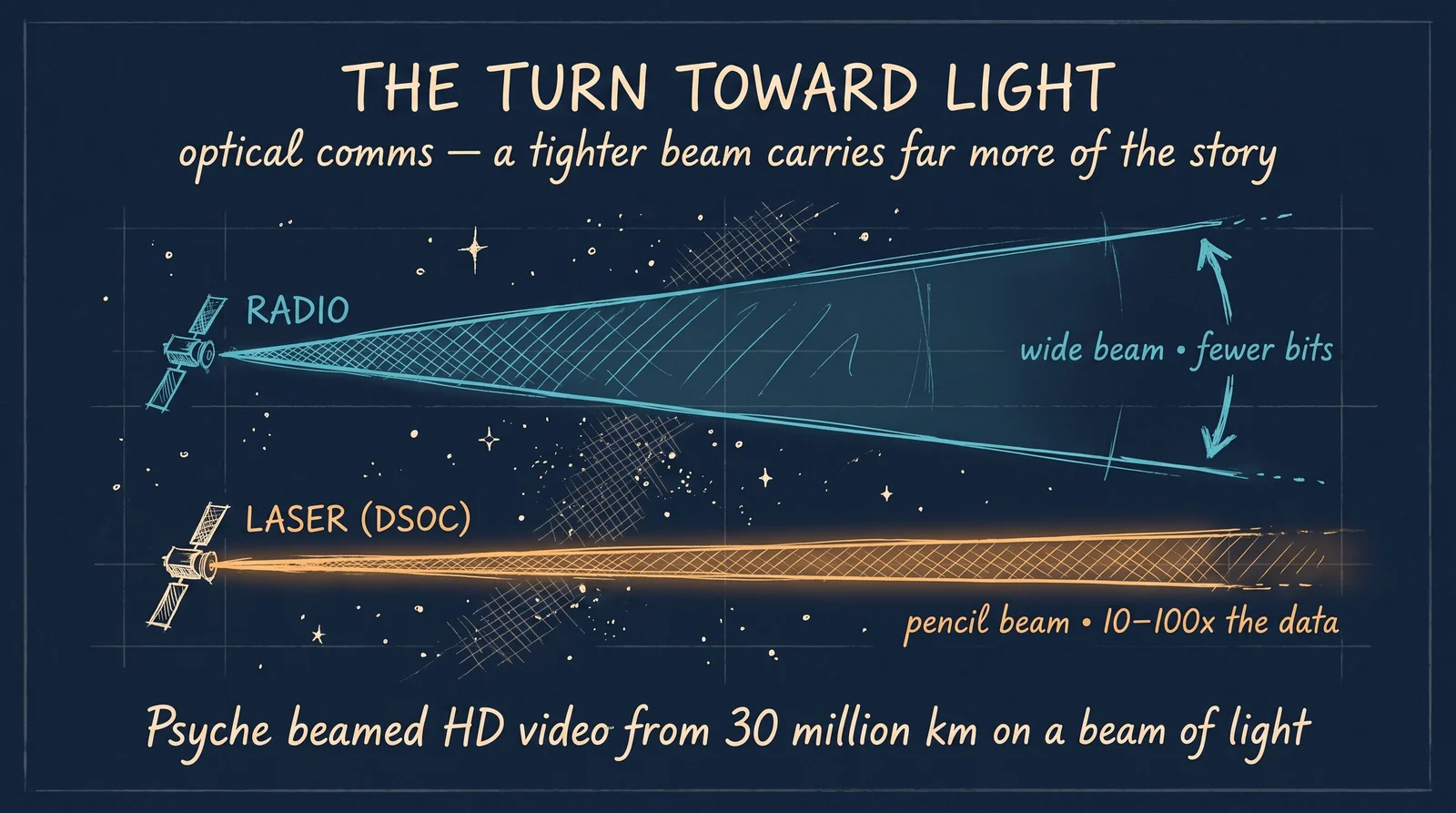
In October 2023, a small laser terminal bolted to the side of the Psyche spacecraft launched toward the asteroid belt carrying an experiment called DSOC — Deep Space Optical Communications. The concept is straightforward: an infrared laser, tightly focused, can concentrate far more power into a far narrower beam than a radio transmitter of the same mass and electrical draw. The beam spreads less with distance, which means more of it arrives. By April 2024, DSOC had transmitted engineering data from 140 million miles at 25 megabits per second — faster than most household broadband connections, from a distance greater than the Earth-Sun separation. By December 2024 it had set a distance record: downlinking Psyche mission data from 307 million miles, 494 million kilometres out. The project demonstrated 10 to 100 times the throughput of radio at equivalent power.
This is not a small step. The bandwidth bottleneck is one of the binding constraints on what deep-space science can do: the more data you can return per watt, the more instruments you can fly, the higher the camera resolution, the denser the scientific haul from each mission. DSOC's laser link, scaled up and deployed on future spacecraft, would transform the economics of talking to the outer planets. The catch — there is always a catch — is that optical links require exceptional pointing precision (the beam is narrow enough that a pointing error of a fraction of a milliradian spills it off target) and are blocked by cloud cover at the ground station. The DSN's radio dishes work through weather. Optical ground terminals don't. The architecture for a reliable optical deep-space network will need multiple geographically spread receive sites, clear-sky redundancy, and decades of operational experience to mature. It will come. The question is whether it comes before the radio architecture buckles under the weight of demand.
The weight of the whisper
Here is what the whole apparatus actually amounts to. Three patches of desert and scrubland on three continents. Roughly forty antenna mounts, of which the big work falls on three 70-metre bowls that have been pointing at things no one can see with the naked eye since the first one locked onto a Mariner in 1963. A budget that, in real terms, has been shrinking. An upgrade programme running years behind. A schedule so overbooked that some missions go without their allocated tracks, and the people who run them learn to live on less contact than they planned.
And through this: everything. The Voyager images of Neptune that no spacecraft has repeated in the thirty-seven years since. The Cassini portraits of Saturn — the hexagonal storm at the pole, the geysers of Enceladus, the braided F ring — delivered one compressed frame at a time across more than an hour of silence. The Perseverance samples staged for eventual return, their GPS coordinates known to the centimetre because every transmission of the rover's position came back through a dish in California or Spain or Australia, was checked against the orbital mechanics, and became a number the whole atlas stands on. Everything in this atlas that came from beyond the Moon arrived here through a 22-watt whisper and a room full of people patient enough to wait for the reply.
The lag never goes away. Light travels at the fastest speed physics allows, and it is not fast enough. As we push further — human crews to Mars whose round-trip communication delay will be measured in tens of minutes on a good day; robotic probes to the ice giants; whatever comes next in the generations after those — the distance will keep growing and the patience required will keep compounding. What changes is only who bears it: the ground team waiting for a reply, or the spacecraft itself, making decisions faster than any signal can carry permission. The DSN isn't becoming obsolete. It is becoming one layer of a deeper architecture, the radio backbone of a solar system where more and more of the thinking happens out there, in the dark, on craft that have learned — because they had to — to manage without asking. We built the network so we could stay in the conversation. We're slowly discovering that the conversation, at these distances, looks less like a dialogue and more like letters sent between people who have both already moved on by the time any answer arrives.
Read next
Sources & further reading
- NASA — Deep Space Network overview
- NASA OIG — Revitalizing the Deep Space Network (audit, 2023)
- NRAO — How strong is Voyager 1's signal when it reaches Earth?
- NASA JPL — DSOC laser comms demo exceeds expectations (2024)
- NASA JPL — DSOC sets deep-space distance record, December 2024
- IFLScience — Voyager 1 to reach one light-day from Earth, November 2026