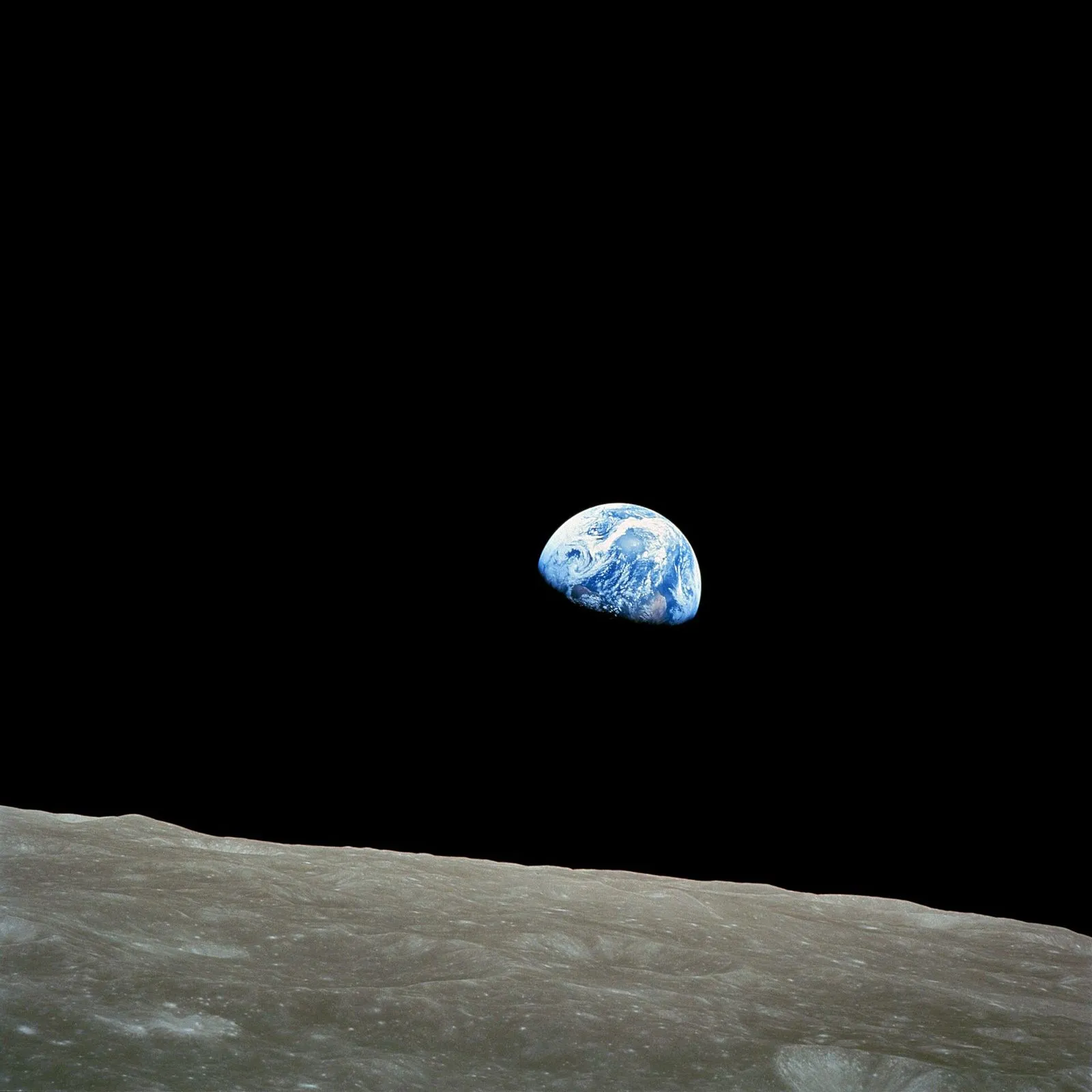
The Ship Becomes a World
If we cannot go fast, the only alternative is to go slow — to trade speed for time and let the crew become a lineage. The generation ship is not a plan anyone is building. It is a mirror held up to everything we already are.
The interstellar-exploration essay does the arithmetic honestly, and the arithmetic is unkind. The nearest star system, Alpha Centauri, sits 4.37 light-years away. Voyager 1, the fastest object humanity has ever launched on an escape trajectory from the solar system, left Earth in 1977 and is now — after nearly five decades of flight — less than 0.003 light-years out. At that pace, a ship aimed at Alpha Centauri would arrive in roughly 75,000 years. The propulsion essay catalogues the exits: ion drives, solar sails, nuclear-thermal engines. They help at the margins of the solar system. Against interstellar distances, even the most ambitious of them buys perhaps a factor of ten in speed. Ten times faster than Voyager still means 7,500 years. No technology we can point to, and no physics we understand, closes that gap to a human lifetime.
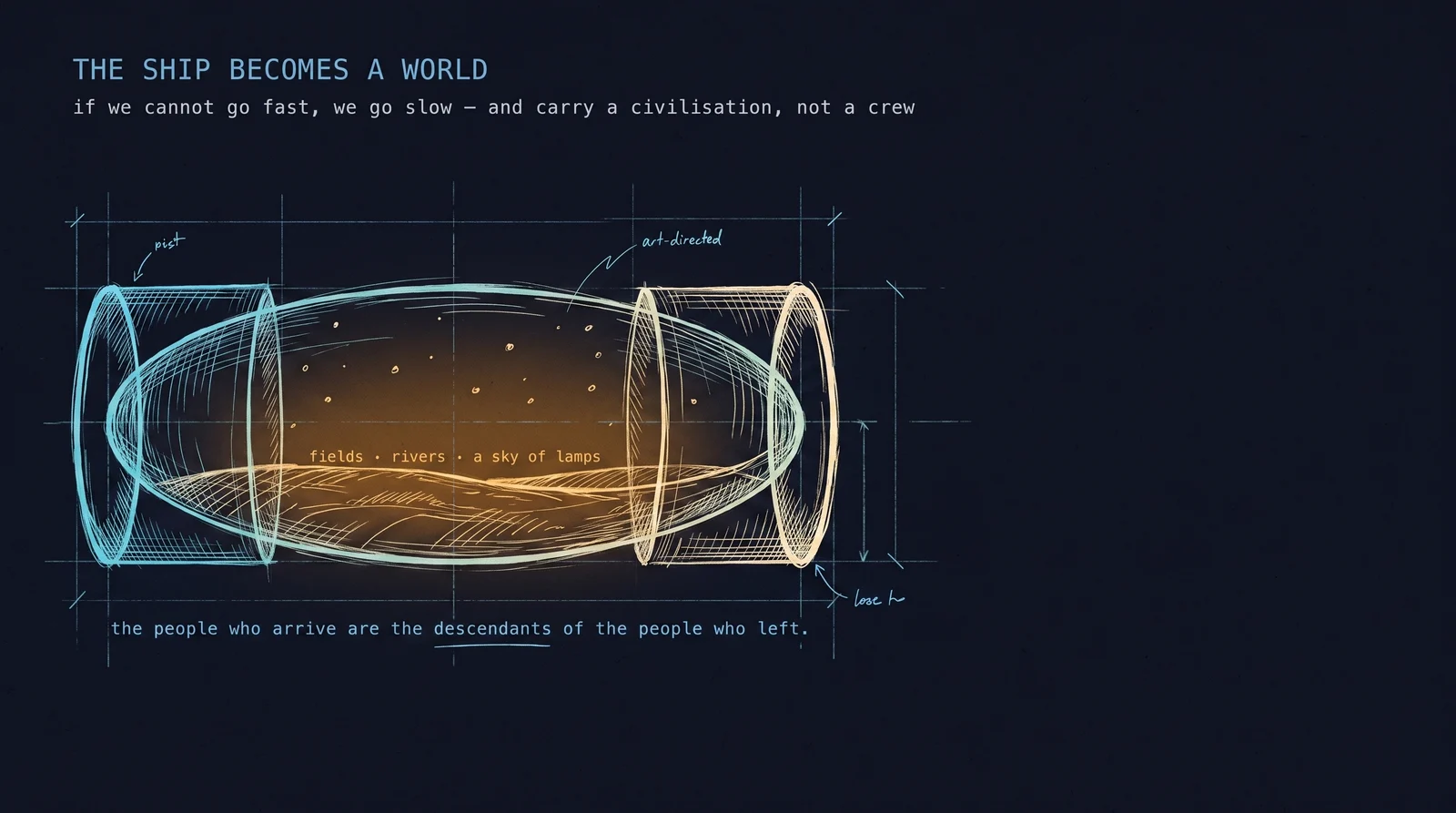
There is one response to this that is not a fantasy: accept the timescale. Don't compress the journey — accommodate it. Build a vessel large enough and self-sufficient enough to sustain human life not for years but for centuries, and send it knowing that the people who step off at the destination will be the great-grandchildren, perhaps the great-great-grandchildren, of the people who stepped on. The generation ship. It is not, to be clear, a plan anyone is currently executing, or close to executing. No government has budgeted for it. No engineering programme is working toward it. It belongs to the category of ideas that are taken seriously by physicists and demographers and ethicists precisely because they are not constrained by near-term practicality — thought experiments with real teeth, where the thinking reveals things that more modest ambitions obscure. The value of imagining a generation ship is not the ship. It is what the ship requires, and what those requirements say about us.
Because what they say, mostly, is that we do not yet understand the problem we think we understand. We imagine the engineering — the hull, the drives, the reactor — and we underestimate everything else. A generation ship is not a big spacecraft. It is a civilisation in a bottle, hurled into the dark, with no resupply, no rescue, and a communication lag that grows, over the decades of flight, from hours to days to weeks, until the comms essay's "letters between people who have both already moved on" becomes not a metaphor but a literal description of the relationship between ship and home. The hard problems are not the ones in the engineering textbooks. They are the ones in the ecology and genetics and governance and philosophy textbooks, and those disciplines have been thinking about them, in their own terms, for a long time.
The slow answer
The trade is brutal but coherent: substitute time for speed, and carry a civilisation instead of a crew. Any crewed mission to another star must either travel at a meaningful fraction of the speed of light, sustain the crew across many centuries at slower speeds, or do something we do not yet know how to do. The first requires propulsion that remains speculative even in principle — accelerating a crewed vessel to ten percent of the speed of light demands energy that dwarfs the total output of human civilisation. The third is science fiction in the precise sense: we don't have the physics. The second option is generation ships, and the reason they persist in serious discussion is that they require nothing we do not already know how to think about. No exotic physics. Only the willingness to accept that the voyage is the work of a lineage, not a crew.
A ship aimed at Proxima Centauri at one percent of the speed of light — an order of magnitude faster than anything we have built, but not physically inconceivable — would arrive in about 430 years. Roughly the time that separates us from Shakespeare. The people who departed would not live to see the destination; neither would their children, nor their grandchildren, nor several generations after them. The ship would need to sustain a functioning, reproducing human society across that entire span, with no external input and no possibility of resupply, and a communication delay to Earth that would, within decades of departure, grow long enough that no real-time guidance from home would be possible. Voyager 1's current one-way light-travel time to Earth is about 23 hours. A ship one light-year out would wait a year for any reply. Three light-years out: three years. The isolation is not metaphorical. It is absolute.
A closed world
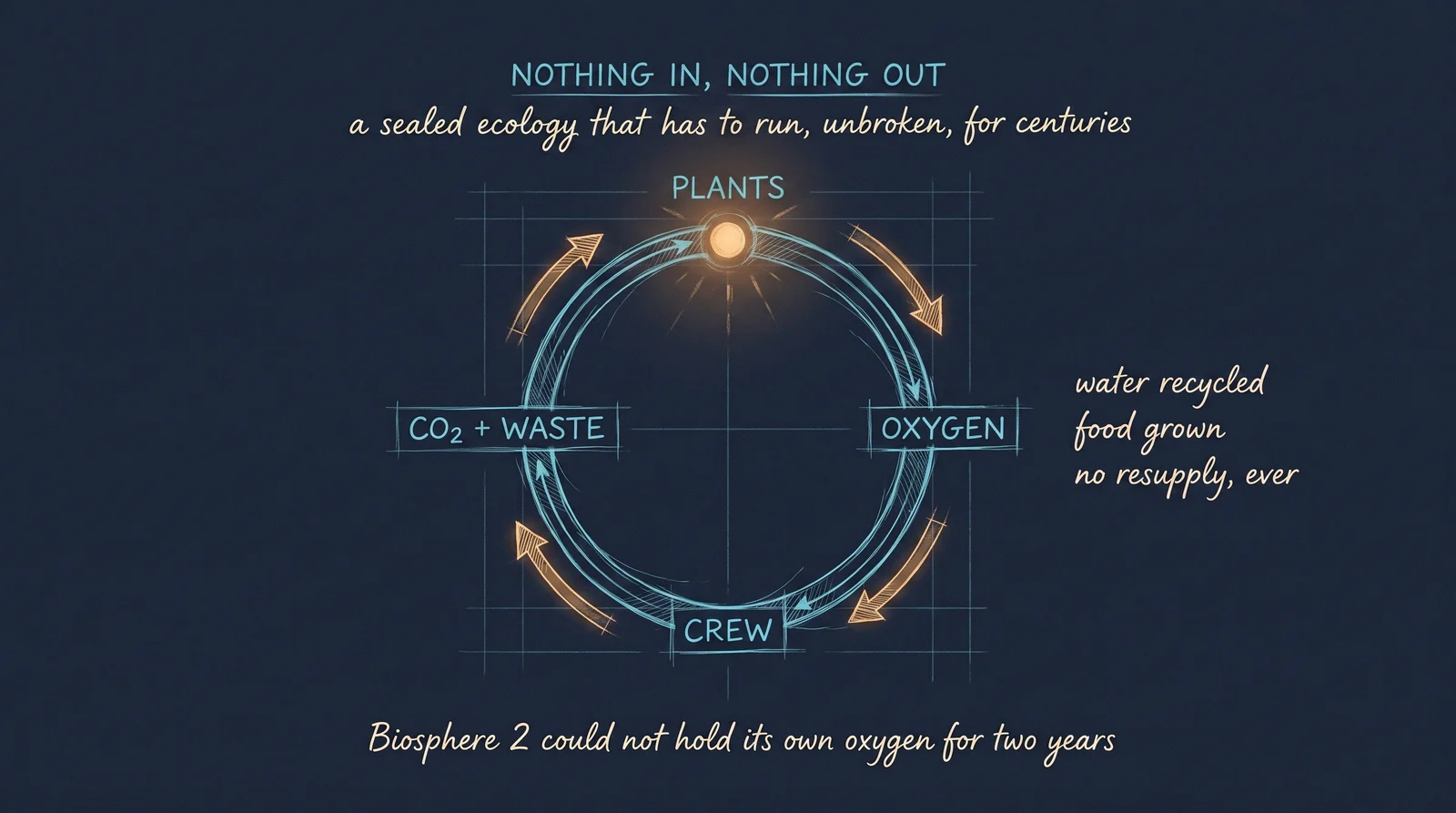
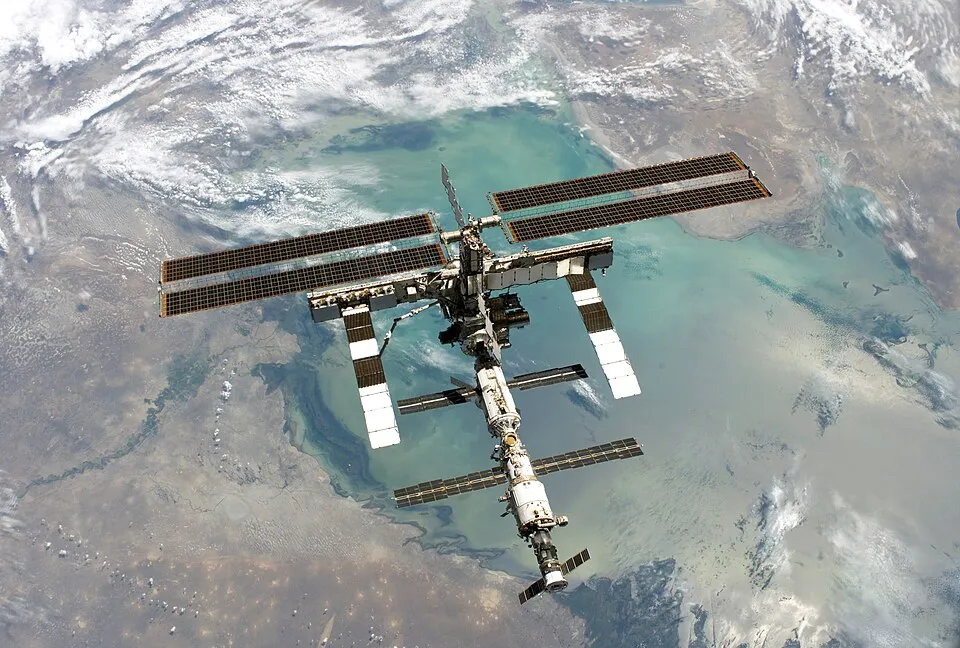
The first engineering problem is the most fundamental: nothing arrives, and nothing leaves. Every atom of oxygen, water, nitrogen, carbon, and trace mineral that the crew needs for the entire voyage must either be launched with the ship or regenerated aboard it, indefinitely, without failure. The ECLSS life support system aboard the International Space Station is the most sophisticated closed-loop life-support system humanity has operated — it recovers water from humidity, urine, and cabin air; it generates oxygen by electrolysing water; it scrubs carbon dioxide from the atmosphere. It is resupplied by cargo vehicles several times a year. Remove the resupply, and every inefficiency in the loop accumulates: every kilogram of water not recovered, every molecule of gas not recycled, is a kilogram or a molecule permanently lost from the ship's total inventory. Over a four-century voyage, the compounding of small losses becomes existential. A system that is 99.9 percent efficient loses, over 430 years, the equivalent of its entire working stock many times over. The loop must be, in practice, complete.
The only existence proof for a closed ecology at scale is Earth itself, which has been running its loops for 4.5 billion years on a planet-sized substrate with input only from sunlight. Everything smaller has been attempted and has struggled. The most instructive attempt — because it was serious, well-funded, and failed in a way that taught precise lessons — was Biosphere 2, the 1.27-hectare sealed glass and steel structure built in the Arizona desert and inhabited by eight people from September 1991 to September 1993. The designers intended it as a demonstration of a self-sustaining closed ecology: five biomes, a farm, an ocean, a marsh, a rainforest, a desert, all sealed within a shell through which only sunlight and electricity passed. The crew was to breathe air regenerated by the plants, drink water cycled through the system, and eat food they grew themselves.
What happened instead was instructive. Within months, oxygen levels began falling — from the Earth-normal 21 percent to 14.5 percent over about sixteen months, the equivalent of living at an altitude of 4,000 metres. The culprit turned out to be the concrete in the structure itself: it was absorbing carbon dioxide faster than the biology was producing oxygen, an effect the designers had not modelled. Morning glories, introduced as a food crop, escaped into the rainforest biome and crowded out other plants. Nineteen of the twenty-five vertebrate species introduced died out. The crew lost body weight on the farm's output and had to supplement from emergency stores. Oxygen had to be injected twice to keep the crew functional. Two years, in a 1.27-hectare structure with eight people, with active intervention possible from outside at any moment: Biosphere 2's lessons for a four-century sealed voyage are not encouraging. They are, however, exact.
A generation ship would need to be an ecology, not merely a life-support system. The soil microbiome, the decomposition cycles, the nutrient flows that keep farmland from exhausting itself are all biological processes that require their own populations of organisms, their own balances, their own space. Agriculture alone cannot close these loops; the loops that close them are the ones Biosphere 2 discovered it could not maintain. The failure modes of a closed ecology are not dramatic. They are subtle — slow accumulations, unexpected sinks, one species thriving at the expense of the system's balance — and they operate on timescales that dwarf any experiment we have run. After Biosphere 2, the ecological questions remain substantially unanswered. For a four-century voyage, they are the first questions, not the last.
The crew is a population
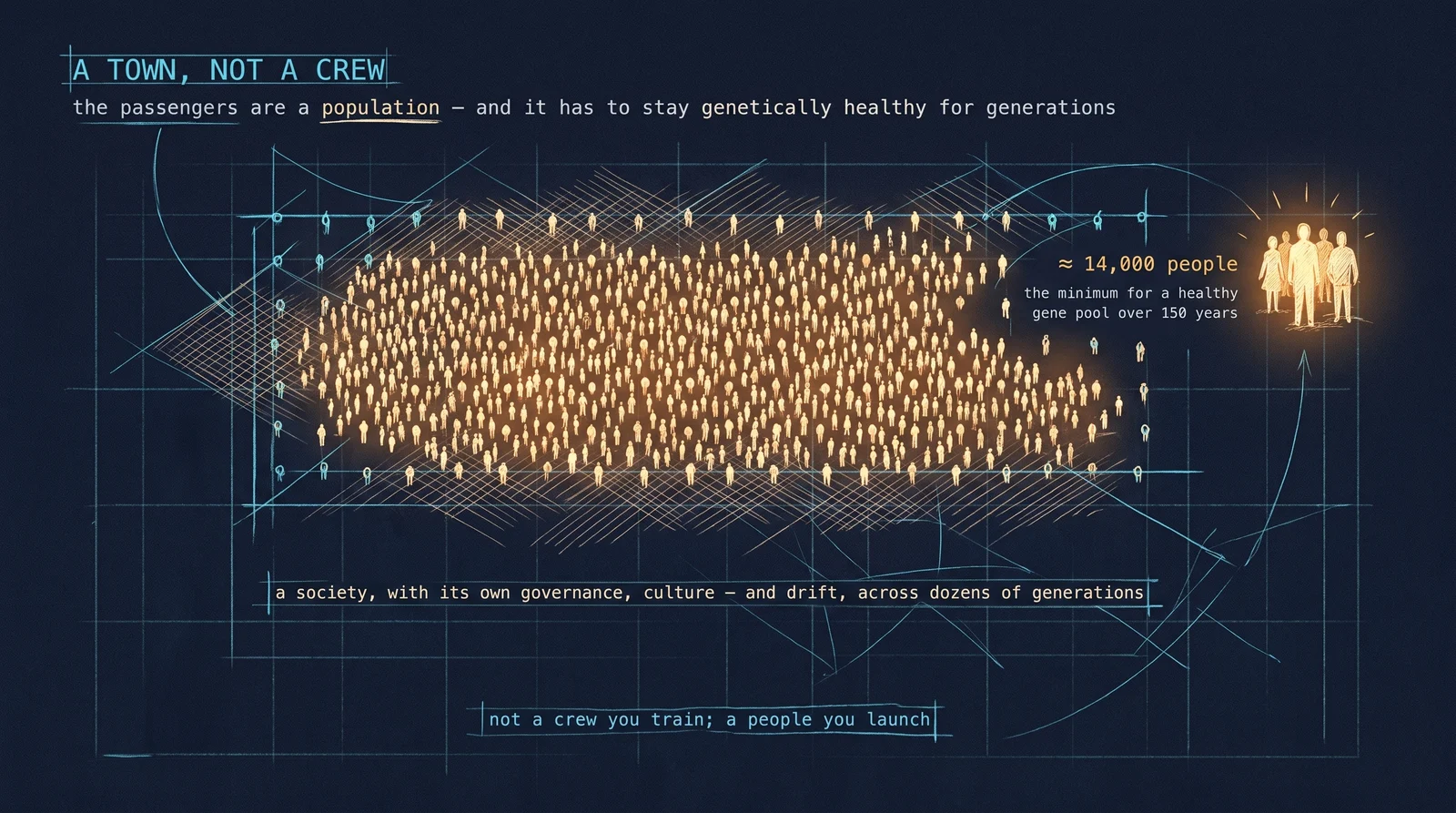
The second problem is genetic, and it has a name: minimum viable population. A species that reproduces sexually needs a certain number of breeding individuals to maintain genetic diversity over generations — to avoid inbreeding depression, to retain the reservoir of variation that allows adaptation to disease, stress, and environmental change. The question for a generation ship is: how many people do you need aboard to arrive at the destination with a population that is genetically healthy, i.e., not so inbred as to have lost the variation that long-term survival requires?
The estimates are not reassuring. A 2014 study by anthropologist Cameron Smith at Portland State University, working from population genetics models and the specific conditions of a multigenerational interstellar voyage, concluded that a minimum founder population of around 14,000 people would be needed to sustain genetic health over a 150-year, multigenerational voyage, accounting for disease, accidents, and the natural variance in reproductive success. Earlier and more optimistic estimates — some suggesting a few hundred, others a few thousand — typically assumed ideal reproductive behaviour, no bottleneck events, and conditions of genetic management (essentially, controlled breeding) that most ethicists would find troubling. Even the most conservative analyses converge on a number that is not a crew in any conventional sense. It is a town.
Beyond genetics, the population problem is cultural. Human societies across dozens of generations do not remain static. Languages drift; religions evolve or die; governance systems that seem stable over decades fracture over centuries; the institutional memory of why rules exist erodes and the rules either calcify into dogma or dissolve into anomie. A four-century voyage from departure to arrival spans roughly the same time as the entirety of the Scientific Revolution — from Copernicus through Newton through Darwin to Einstein. The society that arrives at the destination will not be the society that departed, in any cultural sense that matters. Whether it will still understand the mission, still have the technical knowledge to execute the landing and the establishment of a colony, still carry forward the skills and the social structures needed to survive in an alien environment — these are not engineering questions. They are questions about how knowledge is transmitted across generations, how institutions persist or fail, how identity holds together under conditions of radical confinement and radical isolation. History is not optimistic on any of them.
The long-duration spaceflight research we have done — from the Skylab crews of the 1970s through the Mir years and the continuous human presence aboard the ISS program since 2000 — addresses crew dynamics over months, not decades. The longest continuous human spaceflight on record is about 437 days. We know a great deal about what happens to a body in microgravity over a year. We know almost nothing about what happens to a society over a century, in confinement, under the specific pressures of a sealed world with no outside. The body-in-the-dark essay covers the physiological arc. The sociological and psychological arcs are longer, less studied, and in some ways more alarming.
Born into the mission
Here is the question that most discussion of generation ships eventually arrives at and then tends to move past quickly, because it does not have a comfortable answer. The people who board the ship consent to the voyage. They are adults who have chosen, knowingly, to give their lives to a project whose completion they will not live to see — a choice that has precedent in human history, from the builders of cathedrals to the planters of orchards that their grandchildren would harvest. The choice is unusual but it is, at least, a choice.
The people born on the ship did not make that choice. They inherit a sealed world and a task — arrive at a star, establish a colony — that was decided by people who died before them, in a time and a context they can only know from records. They cannot leave. They cannot refuse the mission without threatening the survival of everyone aboard. The ship is their entire world: its politics are the only politics, its social norms the only norms they have ever known, its mission the framing condition of every life they have ever observed. In what sense are they free? In what sense is it ethical for the founders to make, on their behalf, a choice this total?
The philosopher S. Matthew Liao and others working in reproductive ethics have engaged this question directly, and their conclusions are not simple. The standard argument for generation ships — that the descendants will be glad to exist, and that existing in a ship is better than not existing at all — runs into the well-known non-identity problem: you cannot wrong someone by bringing them into existence, because non-existence is not a harm that can be compared to existence. But this cuts awkwardly in both directions. If you cannot wrong the unborn descendants by launching them into a sealed multi-century voyage, you also cannot, by the same logic, make the voyage a gift to them. They are not being given a choice. They are being given a world, and then being told the world has a task, and that the task is non-negotiable, and that there is no exit. The founders of a generation ship would be making the most consequential irreversible decision in human history: committing not just themselves but every descendant of theirs, for centuries, to a project they cannot withdraw from. The ethics of that decision have not been resolved, and the honest position is that they may not be resolvable — that the generation ship sits at the intersection of two genuine moral imperatives (expanding the reach of life versus the freedom of individuals to determine their own conditions) that cannot both be fully satisfied.
Will they arrive first?
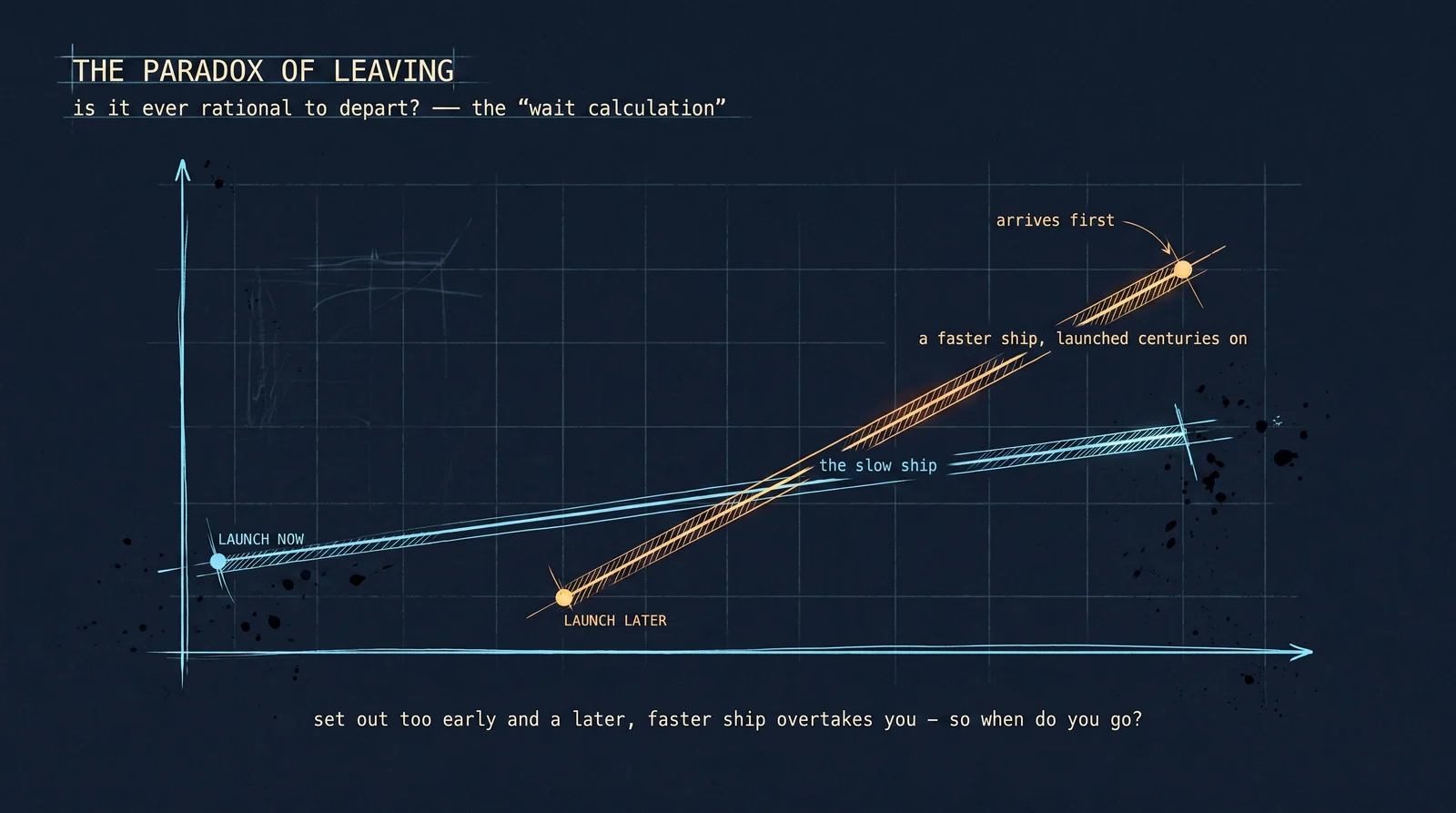
Even granting all of the above — the ecology, the genetics, the governance, the ethics — there is one more problem, and it is the strangest. It was articulated clearly by the mathematician Andrew Kennedy in a 2006 paper in the Journal of the British Interplanetary Society, and it goes by the name the "wait calculation". The argument is this: if you launch a slow ship now, toward Alpha Centauri, and human technology continues to improve — if, decades or centuries into the future, we develop propulsion systems that allow travel at ten or twenty or fifty percent of the speed of light — then a faster ship launched later might depart after your slow ship but arrive before it, or at the same time. In that case, was it rational to depart early? The people who left in the slow ship would spend centuries in transit; the people who left in the fast ship might spend decades or years; they might arrive to find the colony already established by the descendants of the slow ship, or they might — if the slow ship had not yet arrived — be the first ones there, despite having left later.
Kennedy worked out the mathematics for this. Given reasonable assumptions about the pace of technological improvement in propulsion (based on historical rates), the optimal departure time for any given destination is not "as soon as possible" but "when the technology is good enough that waiting any longer produces diminishing returns". For Alpha Centauri, the wait calculation suggests that a ship launched before a certain threshold of propulsion capability would be irrational — that waiting for better technology would always be worth doing, up to a point. The paradox is that this reasoning can keep updating indefinitely: the ship you are about to launch is always in danger of being overtaken by a better ship launched later, so the rational choice always appears to be to wait. It is a genuine dilemma, and it has not been resolved. The only coherent answers involve either accepting that some pioneer voyages will be overtaken and that this is acceptable, or positing a scenario in which technological progress plateaus and waiting genuinely stops being rational. Neither answer is fully satisfying.
The mirror
Here, at the end of this collection, is the thing the generation ship is really for. Not the destination — there is no mission and no star. The thought experiment is a mirror, and what it reflects is the world we already inhabit.
Consider what a generation ship actually is. A sealed, finite world. A fully closed ecology that cannot be allowed to fail. A population of humans who did not choose the conditions of their birth and who are committed, by circumstances they did not create, to the maintenance of systems they did not build. A set of resources that cannot be replenished from outside. A governance problem spanning generations, with decisions made today binding people centuries hence. A communication lag — not from a distant ground control, but from every preceding generation to every subsequent one — that means the people running the system now are always working with instructions written by people who could not have anticipated the present situation, and leaving instructions for people who will face circumstances impossible to foresee.
This is not a description of a hypothetical ship. It is a description of Earth. The closed ecology is the biosphere — the same loops of carbon and nitrogen and water that Biosphere 2 tried to miniaturise and found it could not hold for two years. The radiation exposure, the bone loss, the vestibular drift that the body essay traces in individual astronauts are the sharp-focus version of a slower, civilisational version of the same problem: humans evolved for conditions that are changing around them, and the timescale of adaptation is not the timescale of the change. The food production challenge that a ship's designers must solve — how to feed thousands indefinitely on a finite substrate with no imports — is the same challenge that global agriculture faces, at planetary scale, with a population that is still growing. The governance question — who decides, for how long, on behalf of people not yet born — is the exact question that climate policy, nuclear waste storage, pension systems, and debt management all try and largely fail to answer.
None of this is comfortable. The generation ship thought experiment is not comforting — it is clarifying, which is a different thing. It strips away the assumption that we are temporary passengers on this world, that the systems we depend on are someone else's problem, that the decisions we make about the atmosphere and the oceans and the soil are reversible or deferrable in ways that the decisions a ship's founders make are not. They are not. We have been launched. The ship — this one, the actual one, the only one we have ever inhabited — is already underway. The people who arrive at whatever destination this civilisation reaches will be the descendants of the people who made, or failed to make, the choices that the long view has been circling for the length of this collection.
The Voyagers will keep flying. Pioneer 10 is still outbound, silent now, its transmitter long since dead, coasting through interstellar space on the momentum of a 1972 launch. Pioneer 11 the same. They are the furthest physical extensions of this civilisation, and they will outlast it — outlast the Sun, probably, coasting through the galaxy for billions of years after every human structure has dissolved. They carry plaques, because the people who built them thought, correctly, about the long view: not just what these spacecraft would do, but what they would mean to anyone who found them after we were gone. That instinct — to build for recipients you will never meet, to send something forward into a time you cannot see — is the generation ship impulse in miniature. It is also, in the most honest reading of where we are, the only impulse that might matter. We are the crew. We are already in flight. The question the generation ship poses — can a civilisation maintain, across generations, the systems and the intentions and the care that survival requires? — is not a question about a ship that does not exist. It is the question of this century, asked in the language of the stars.