The Honest Arithmetic
The nearest star is not far in the way that Mars is far, or even Pluto. It is a categorically different kind of distance — and the sober math of getting there has a way of making every serious proposal look quietly heroic and quietly doomed at the same time.
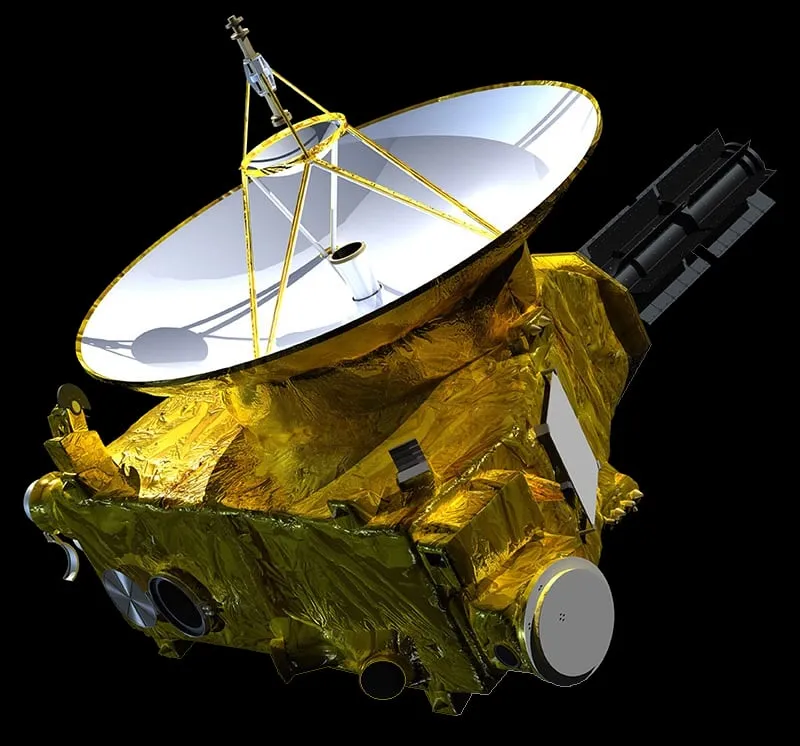
There is a habit of mind that spaceflight encourages, and it is a reasonable one up to a point. You learn the distances — the Moon is three days away, Mars is six to nine months, Jupiter is years — and you absorb the scale of the solar system as something that is vast but navigable, something that human ingenuity has been steadily eating into for seventy years. Voyager 1 reached interstellar space. New Horizons crossed five billion kilometres to Pluto and arrived within a minute of its schedule. The outer system feels, from inside this frame, like a problem of patience and engineering, not of fundamental limits.
Then you turn to face the nearest star, and the frame breaks.
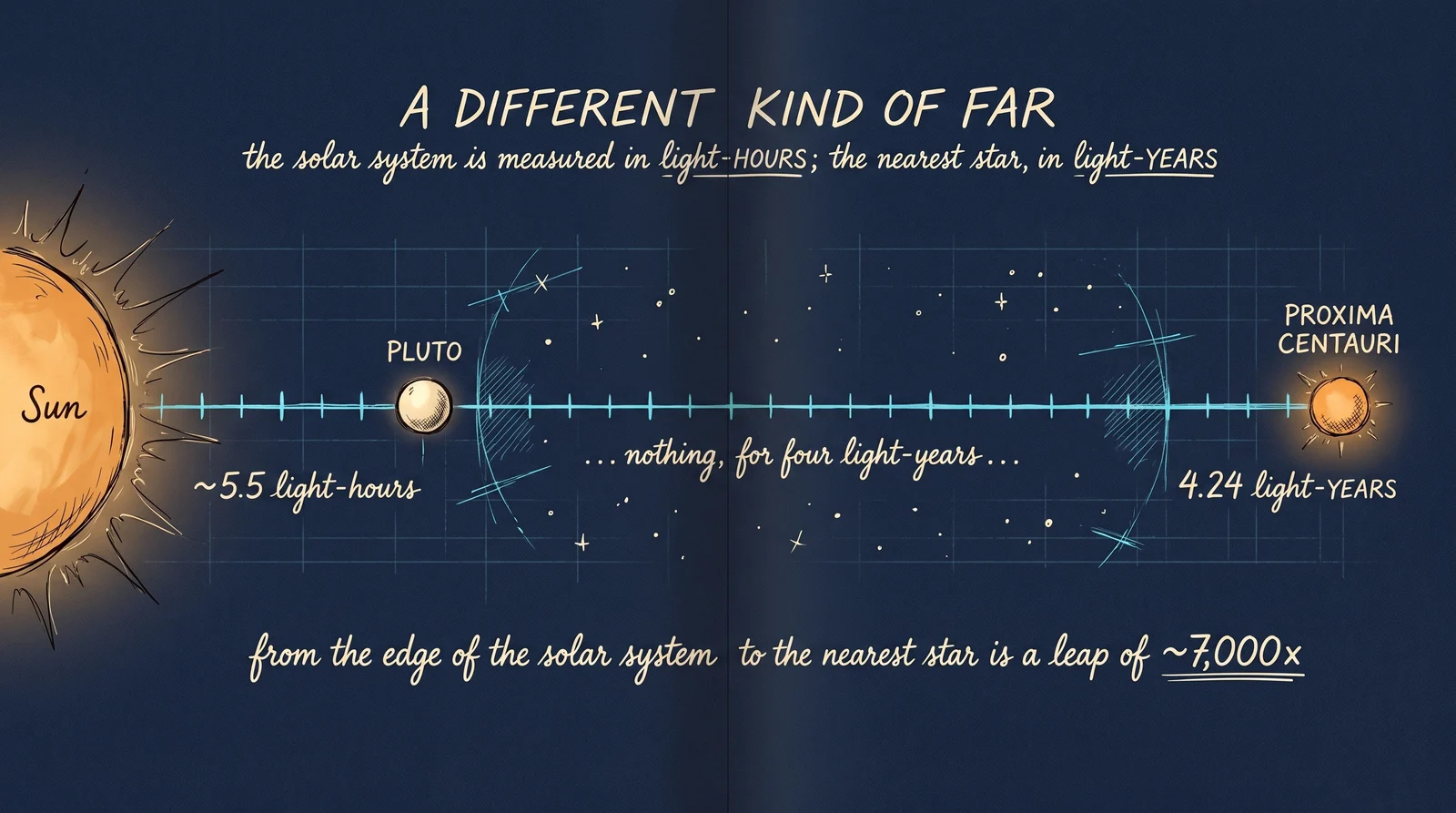
Proxima Centauri is 4.24 light-years away. That sentence has to be unpacked slowly to land with its full weight, because light-years and light-minutes are the same unit and the scale difference is not intuitive. A light-minute is the distance light covers in sixty seconds: about 18 million kilometres, which is roughly the gap between Earth and the Sun divided by eight. The solar system — the whole inhabited and explored volume from Earth's orbit out past Neptune — fits inside a sphere about five light-hours across. Pluto, at the edge of the classical system, is about five and a half light-hours from the Sun. The Oort Cloud, the outermost gravitational reach of the Sun's influence, extends to perhaps a light-year or two. Proxima Centauri, the closest star to our own, is more than twice even that. The distance to the nearest star is not the distance to the outer solar system scaled up by some manageable factor. It is roughly nine thousand times the distance from Earth to Pluto. The solar system does not prepare you for it.
The humbling speed of everything we have launched
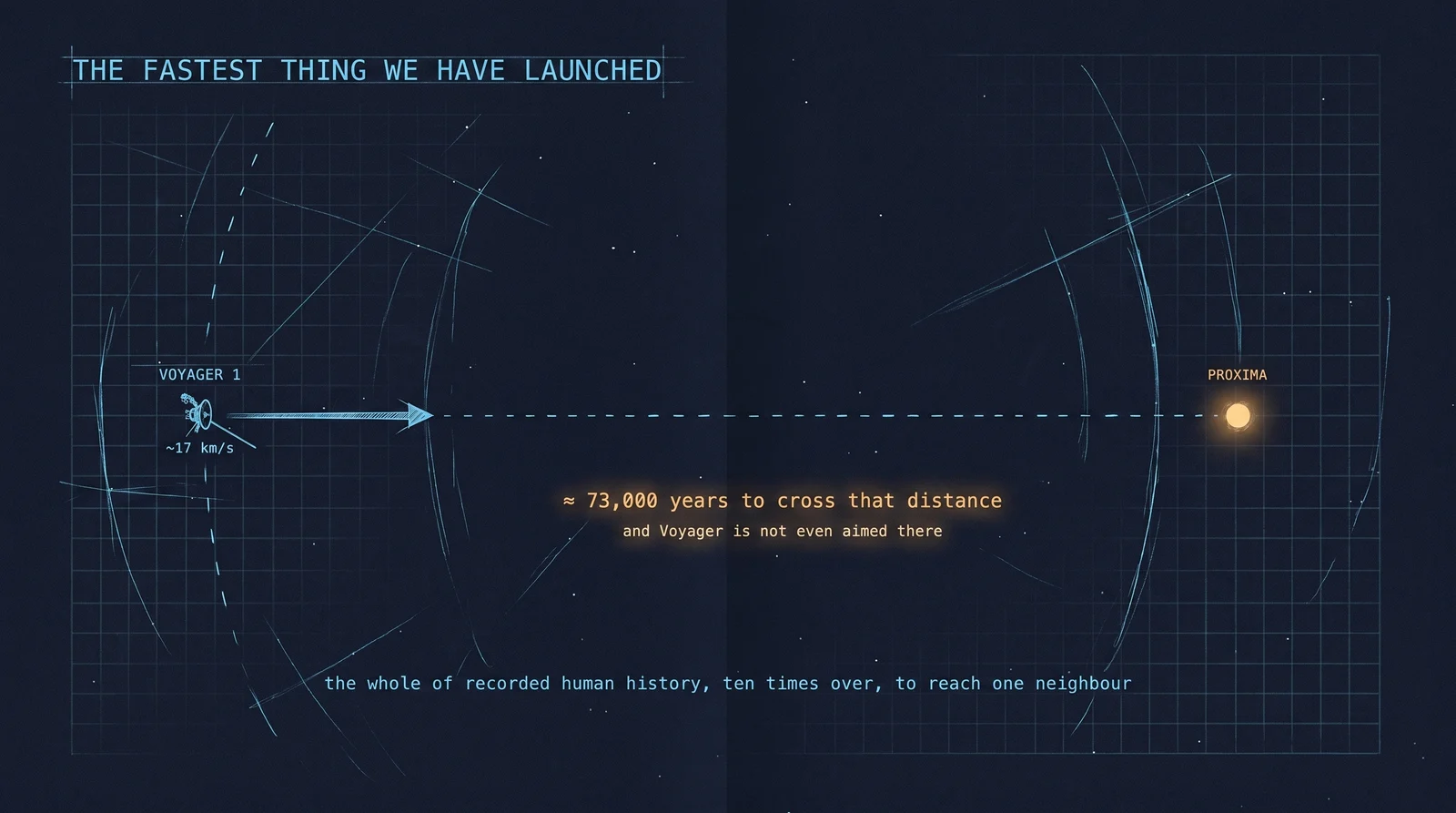
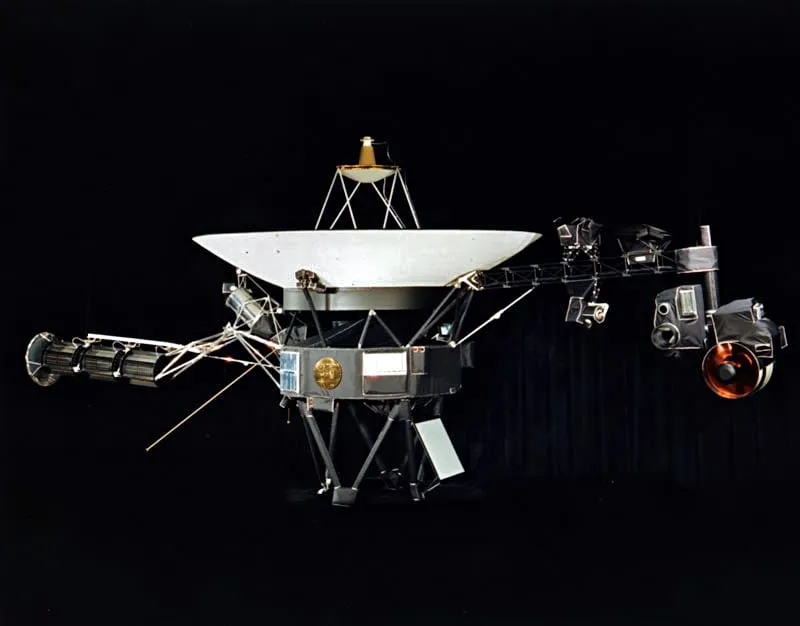
Voyager 1 is the fastest-receding human object in existence. Launched in 1977, slung past Jupiter and Saturn on a trajectory that borrowed energy from both planets' gravitational fields, it is now travelling at roughly 17 kilometres per second relative to the Sun — about 61,000 kilometres per hour, a speed that would take you from London to Sydney in about seventeen minutes. By any terrestrial measure it is unimaginably fast. By interstellar measure, it is glacial. At 17 km/s, Voyager 1 would take on the order of 73,000 years to cover the distance to Proxima Centauri — and it is not even aimed there. It is headed in a different direction entirely, toward the constellation Ophiuchus, on a trajectory that was designed to survey the outer solar system, not to reach the stars.
Pioneer 10 and Pioneer 11, the first spacecraft to cross the asteroid belt and survey Jupiter and Saturn, are also departing the solar system on hyperbolic trajectories. New Horizons is moving at around 14 km/s. None of them will approach another star within any timeframe that matters to the civilisation that launched them. The fastest things humanity has ever flung — the culmination of seven decades of rocket engineering and gravity-assist trajectory design — would need tens of thousands of years to cover the interstellar gap. When people say "the stars are far away," they mean something more specific and more sobering than the phrase usually conveys: they mean that everything we have ever done to push a spacecraft faster has not moved the scale of interstellar travel by a single order of magnitude.
What the rocket equation forbids
To reach Proxima Centauri in a human lifetime — say, in forty years — a spacecraft would need to travel at roughly ten percent of the speed of light. Ten percent of c is approximately 30,000 km/s. Voyager 1 travels at 17 km/s. The ratio is nearly 2,000 to one. You would need to go roughly two thousand times faster than the fastest thing we have ever launched.
The Tsiolkovsky rocket equation — the iron law that governs every propellant-burning vehicle — makes this precise, and the precision is brutal. The equation says that the velocity a rocket can achieve depends on two things: the ratio of its initial mass (fully fuelled) to its final mass (empty), and the exhaust velocity of its propellant. To go faster, you either carry more propellant or expel it faster — but carrying more propellant increases the initial mass, which increases the propellant you need to accelerate that propellant, in a compounding trap that grows exponentially. Chemical rockets, as the propulsion essay traces in detail, are already at the ceiling of what their exhaust velocity allows. The best chemical engines achieve specific impulses around 450 seconds, corresponding to exhaust velocities of about 4.4 km/s. To reach ten percent of the speed of light with a chemical rocket, the mass ratio required is not ten, or a thousand, or a million. It is a number so large that the observable universe does not contain enough hydrogen to fuel the engine. Chemistry is not a path to the stars. It is not even a first step.
Nuclear-thermal propulsion — heating hydrogen in a reactor and expelling it through a nozzle — roughly doubles the exhaust velocity, achieving specific impulses around 825 seconds in the best ground-tested engines of the NERVA programme. Doubling the exhaust velocity does not halve the required mass ratio; it takes the square root of it — a far larger gain. At interstellar velocities, nuclear-thermal propulsion is still categorically inadequate. The rocket equation does not care how the propellant is heated. It cares only how fast it leaves. And no propellant-burning architecture yet conceived can expel matter fast enough to reach a meaningful fraction of c without requiring a fuel load that makes the mission impossible on its face.
The serious proposals — and the walls they meet
There are a small number of proposals for interstellar flight that are serious in the sense that physicists do not immediately rule them out. None of them is easy. Each one, examined carefully, has a wall behind the initial optimism.
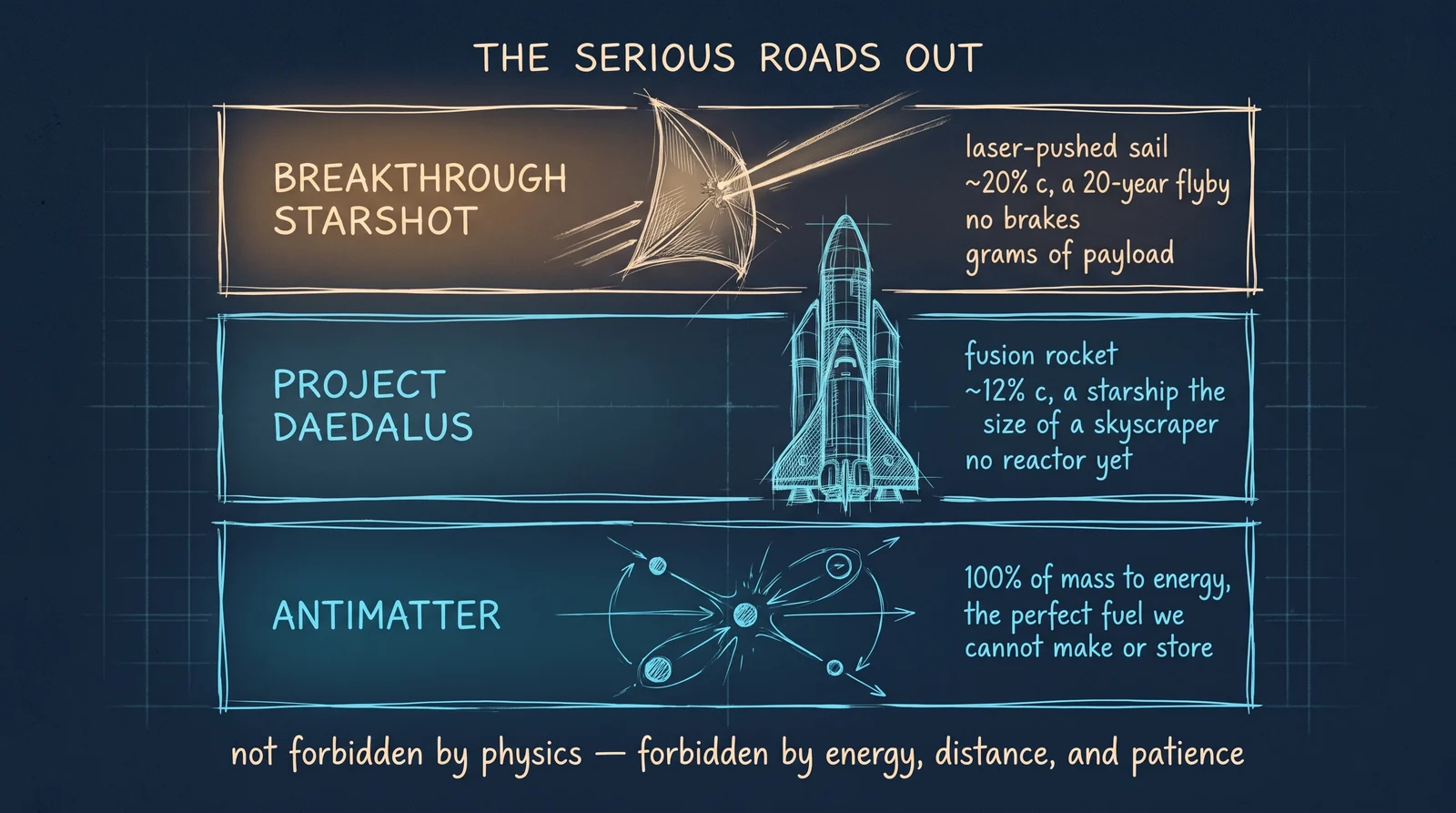
The most concrete current proposal is Breakthrough Starshot, announced in 2016 by a collaboration of scientists and technologists. The concept is elegant: dispense with large spacecraft entirely. Build gram-scale lightsails — wafers of material thinner than a sheet of paper, with a small electronics package attached — and accelerate them with a ground-based laser array delivering, in aggregate, around 100 gigawatts of power over a brief illumination pass. At that power level, a gram-scale sail could theoretically be pushed to around twenty percent of the speed of light, crossing the distance to Proxima Centauri in approximately twenty years. The physics are, in principle, sound. Solar sailing works — IKAROS proved it in 2010, and the Planetary Society's LightSail 2 raised its orbit on sunlight alone in 2019. Scaling the concept to laser propulsion is a different problem in engineering, not in kind.
The walls are substantial. A 100-gigawatt phased laser array does not exist. Building one would be an engineering and financial undertaking comparable to the largest projects in human history, and maintaining beam coherence and pointing accuracy across a departing target at relativistic speed requires technology that is far beyond current demonstration. More fundamentally: the lightsails accelerate. They cannot decelerate. There is no mechanism to slow a gram-scale sail as it approaches Proxima Centauri at 20% c — no laser array waiting there, no atmospheric braking available. The flyby would last a matter of hours. After decades of travel and years of signal transmission at the speed of light, Proxima Centauri and any planets orbiting it would receive a few hours of attention. Whatever the sensors captured during that passage would take 4.24 years to arrive home. Breakthrough Starshot is not a mission to explore another star. It is a mission to glance at one.
Project Daedalus, proposed by the British Interplanetary Society in a study from 1973 to 1978, aimed at something more substantial: a two-stage fusion-driven starship, using inertial confinement ignition of deuterium-helium-3 pellets, designed to reach Barnard's Star (then thought to have planets) at about 12% of the speed of light, arriving in roughly fifty years. The ship it envisaged was enormous — initially fuelled, it would have massed around 54,000 tonnes, the size of a small skyscraper. Its successor study, Project Icarus, revisited the concept from 2009 onward with updated physics and broader propulsion options. Both studies converge on the same honest assessment: the fusion drive works, in principle, but the technology required — sustained inertial confinement fusion at the scale and repetition rate needed for propulsion — has not been achieved, and the fuel requirement for helium-3 vastly exceeds anything that can be extracted from Earth. The helium-3 would have to be mined from the atmosphere of Jupiter. No mechanism exists to do this.
Antimatter is the theoretical ceiling. Matter-antimatter annihilation is the most energetic process permitted by known physics, converting mass to energy at one hundred percent efficiency — compared to about 0.7% for nuclear fusion and a fraction of a percent for chemical combustion. An antimatter drive, if the annihilation could be directed efficiently, could in principle accelerate a spacecraft to a substantial fraction of c with a relatively modest fuel mass. The wall is production. The entire accumulated production of antimatter by particle accelerators worldwide — across all of human history — amounts to a few nanograms. A Daedalus-scale interstellar mission would require something like tens of thousands of tonnes of antimatter. The energy needed to produce that quantity would exceed the total energy output of human civilisation, multiplied by centuries. Antimatter propulsion is not a near-term engineering problem. It is a civilisational-scale energy problem.
The message problem
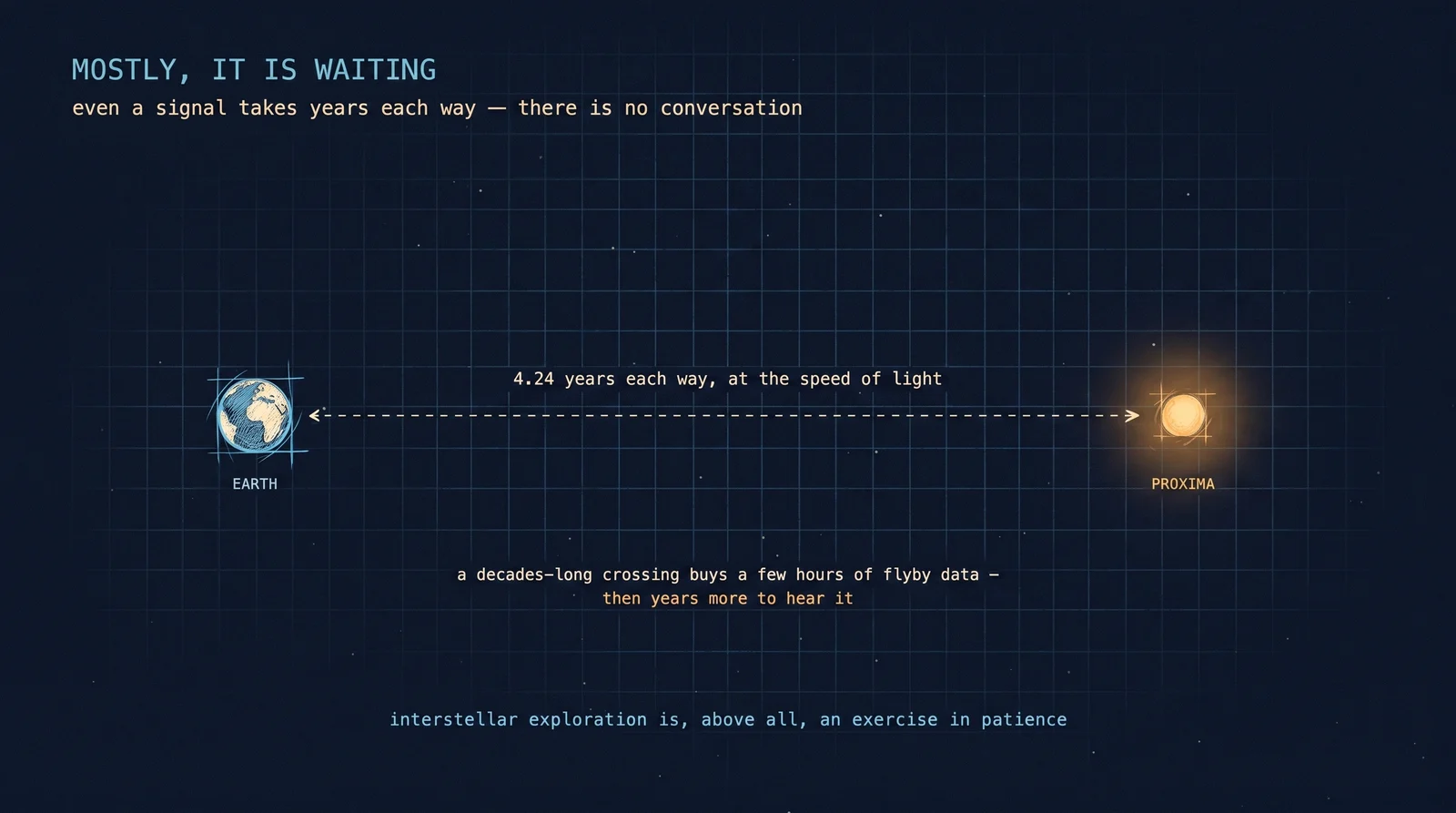
Even setting aside propulsion, interstellar exploration has a second structural difficulty that chemistry and engineering cannot solve: the speed of light itself. A radio signal from Proxima Centauri takes 4.24 years to reach Earth. A question transmitted at the moment of a spacecraft's arrival receives an answer, at best, 8.48 years later. There is no meaningful real-time control. There is no mission controller calling out course corrections during an approach. Whatever a spacecraft does at Proxima Centauri, it does entirely alone — more alone, by orders of magnitude, than the seven minutes of autonomous EDL at Mars, where the craft at least knows that humans are monitoring from twelve minutes away.
The communication architecture this demands is qualitatively different from anything we have built. The Deep Space Network handles interplanetary distances because the round-trip lag, while painful at the outer planets, is still measured in hours — a cadence that human mission controllers can work within. Interstellar lags are measured in years. Data volumes would be transmitted at the speed of light but the photons carrying them would travel for years before arriving at a dish on Earth, and any follow-up command or retransmission would take just as long. Space communication across the solar system is already a discipline of patience; interstellar communication would be a discipline of generations. You send a message. Your grandchildren receive the reply.
In the Breakthrough Starshot scenario, a gram-scale probe screams through the Proxima Centauri system at 20% of the speed of light in a matter of hours. Its sensors collect whatever they can in that window. The compressed data is then transmitted home at the speed of light, arriving 4.24 years later. There is no second pass. There is no follow-up instrument deployment, no orbit insertion, no surface mission, no ability to respond to a surprising finding with a new observation. This is the honest content of "interstellar exploration" at the only speed we know how to reach: a brief, unidirectional snapshot, transmitted home across years of silence, from a probe that cannot slow down and will never be heard from again.
The honest horizon
None of this means interstellar travel is forbidden. There is no physical law that prohibits a spacecraft from crossing four light-years. There are only engineering walls, energy budgets, and the specific impulse ceiling of every propulsion system human beings have yet conceived. These are real constraints, not absolute ones — they are the constraints of a civilisation at a particular moment in its development, a civilisation that can launch a gram-scale probe to a nearby star on a laser beam, in principle, but cannot yet build the laser. The distinction matters. "Forbidden by physics" and "beyond current engineering" are different sentences.
But the gap between "not forbidden" and "achievable in any near timeframe" is enormous. The slowest serious proposal — a fusion starship at 12% of c — would require technology that does not exist, at a cost that dwarfs any space programme in history, to deliver a crewed vessel to another star in roughly fifty years. The fastest serious proposal — Breakthrough Starshot's laser-driven lightsail — would deliver a gram of instruments to a flyby that lasts hours, and return data for years, at a cost that its proponents estimate in the tens of billions of dollars, assuming the laser array can be built at all. Between these extremes, there is no middle option that is both technologically feasible and adequate for meaningful exploration. The scale of the problem simply does not have a moderate solution.
There is a third path, and it is the most human one: go slowly, and go in ships large enough to carry lives. If you cannot accelerate to ten percent of the speed of light, you accept the journey time — centuries, millennia — and you build a vessel that is itself a world. This is the idea behind generational starships: not a spacecraft in the conventional sense but a closed ecological and social system, launched at speeds achievable by ambitious but conceivable near-future propulsion, aimed at Proxima or another nearby system, carrying the ancestors of the people who will arrive. The physics are forgiving in a way that the rocket equation is not. The problems shift from engineering to biology, ecology, sociology, and ethics: what it means to be born into a journey you did not choose, and to die before it ends. These are not smaller problems. They are different ones.
What the arithmetic ultimately delivers is not despair. It delivers proportion. The solar system — the vast volume from Earth's orbit to the Oort Cloud — is the largest thing human beings have ever navigated, and it took the better part of a century to build the tools to explore even its near reaches. Interstellar space is not the next step on that ladder. It is a cliff above it. The cliff is not infinite; it has a top. But reaching the top requires either a revolution in energy production and materials science (the laser array), a sustained mastery of fusion propulsion (Daedalus/Icarus), or a civilisational commitment to patience at a timescale no human institution has yet maintained (the generation ship). All three of those are genuinely possible. None of them is imminent.
This is what "the long view" means when it faces outward past the heliopause. Not that we cannot go, but that going honestly requires holding the scale in your mind without flinching — the 73,000 years Voyager 1 would need, the gram-scale probe screaming through in hours, the great-great-grandchildren arriving at a star their ancestors pointed the ship toward. The nearest star is not a destination. It is a definition: of how far we have come, how far the physics still permits us to go, and how much of the distance between those two points we have not yet crossed.