Staged combustion — closing the cycle
Instead of dumping the turbopump's drive gas overboard, feed it into the main chamber and burn it too. Nothing is wasted, so the engine runs hotter, at higher pressure, and with more performance — at the cost of fearsome plumbing.
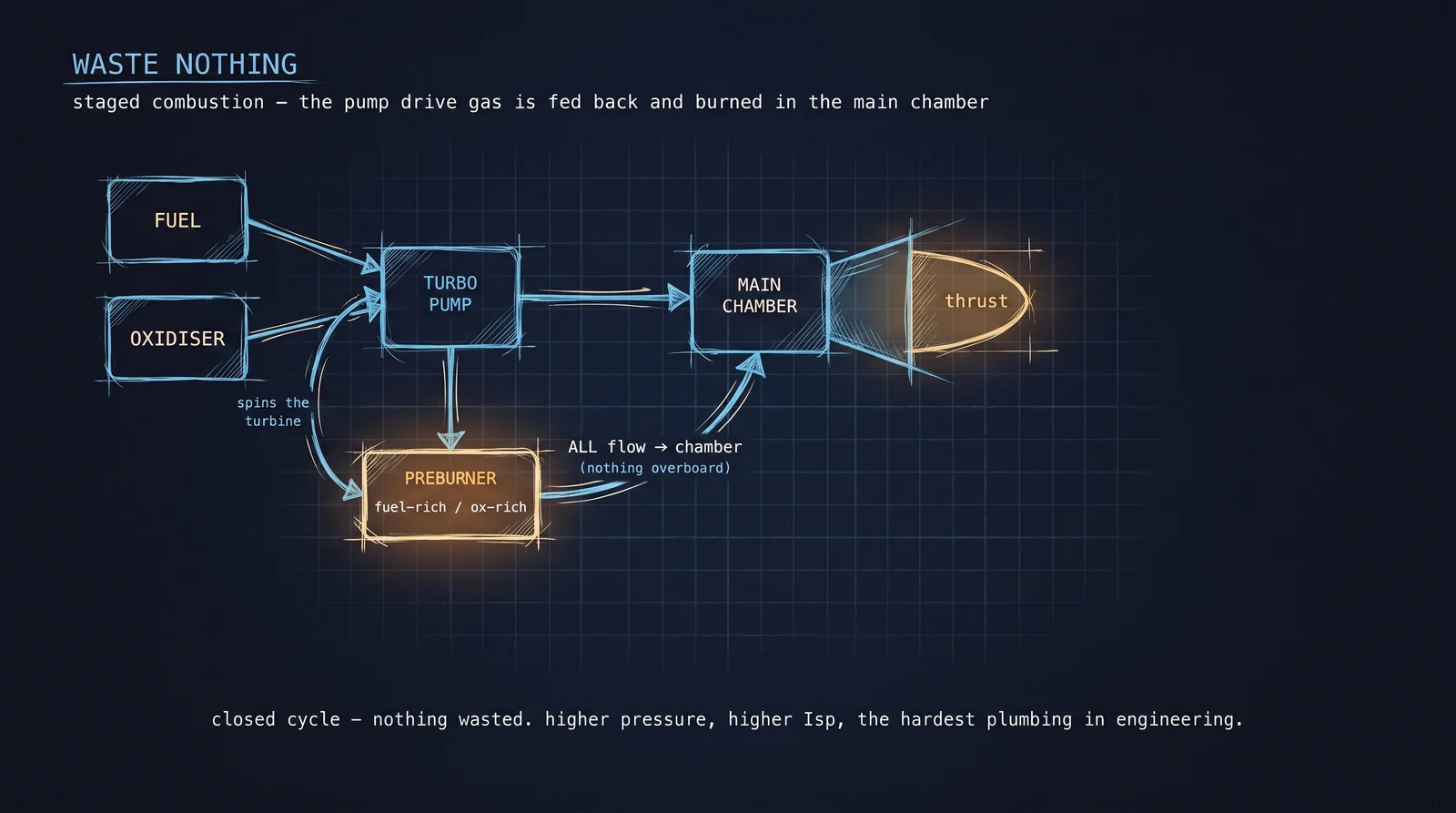
Staged combustion takes the gas-generator idea and closes the loop. A preburner still burns propellant to drive the turbopumps, but its exhaust — thick with unburned fuel or oxidiser — is not dumped. It is routed into the main combustion chamber and burned a second time, so every gram of propellant ends up producing thrust. Closing the cycle buys two things at once: higher specific impulse, because nothing is thrown away, and much higher chamber pressure, because the pumps can be driven harder. Higher chamber pressure means a smaller, more powerful engine for the same thrust. The price is brutal operating conditions — the turbine now sits in the full propellant flow at extreme temperature and pressure.
There are two ways to run the preburner, and the choice split the spacefaring world for decades. American engines like the RS-25 (the Space Shuttle main engine, now flying on SLS) went fuel-rich: excess hydrogen keeps the preburner gas relatively cool and easy on the metallurgy. Soviet engineers took the harder road of oxidiser-rich staged combustion — the RD-170 family, RD-180 and RD-253 drive their turbines on hot, oxygen-rich gas that corrodes ordinary alloys on contact. Solving that was a metallurgical triumph that Western engineers had long believed impossible. China's YF-100 carries the oxidiser-rich tradition forward today, while Japan's LE-7A is a modern fuel-rich staged-combustion engine in the RS-25 mould.
The ultimate version is full-flow staged combustion, which uses two preburners — one oxidiser-rich, one fuel-rich — so that both propellants are fully gasified before they meet in the main chamber. Both turbopumps get their own drive gas, temperatures stay manageable, and the seals no longer have to separate a fuel-driven turbine from liquid oxygen. It had been designed on paper for half a century, but SpaceX's Raptor, on Starship, is the first full-flow staged-combustion engine ever to fly. Each rung up this ladder buys perhaps twenty to forty seconds of specific impulse over a gas-generator engine — and adds a corresponding step in complexity, mass, and development cost.
SEE IN THE APP
- /fleet RS-25 (Space Shuttle / SLS, fuel-rich), RD-180 and RD-253 (oxidiser-rich, Russian), YF-100 (Long March), LE-7A (H-IIA) and Raptor (full-flow, Starship) are staged-combustion engines