Throttling and gimbaling — how rockets steer and how they hover
Once an engine is lit, two control inputs remain: how hard it pushes (throttle) and where it points (gimbal). Together they steer ascent, manage crew g-loads, and allow propulsive landings.
Throttling sounds trivial — turn a valve — but is one of the hardest things a rocket engine does. Combustion chambers are tuned for a specific operating point: chamber pressure, mass-flow ratio, injector velocity. Drop the flow and combustion becomes unstable; rough burning starts to chew the engine apart within seconds. Most engines have a narrow band: Merlin 1D throttles 40-100%, Raptor 2 throttles 40-100%, RS-25 throttles 67-109% but is qualified only for full power throughout an ascent. The F-1 had no throttling at all — its only control was 'on'. Solid boosters cannot throttle at any throughput; the burn profile is locked when the grain is cast.
Deep throttling (below ~40%) is a different class of problem. Soft landings need engines that can hold the vehicle just above its own weight — TWR ≈ 1 — for the final hover-and-set-down. Apollo Lunar Module Descent Engine throttled 10-65%, a record for its era, by using a variable-area pintle injector that physically moved to maintain injector velocity. The same pintle-injector descent is in Merlin and (with a different mechanism) Raptor. The reason Mars rovers cannot land directly on engines (Curiosity / Perseverance use the Skycrane) is that no engine in the MR-80 class has deep enough throttle for direct touchdown of a one-tonne rover, and lighter throttleable engines lack the thrust. The latest Chinese Tianwen-1 / Zhurong landing used a 7500 N variable-thrust engine that did hover-then-set; SpaceX Starship's landing depends on Raptor's deep-throttle qualification.
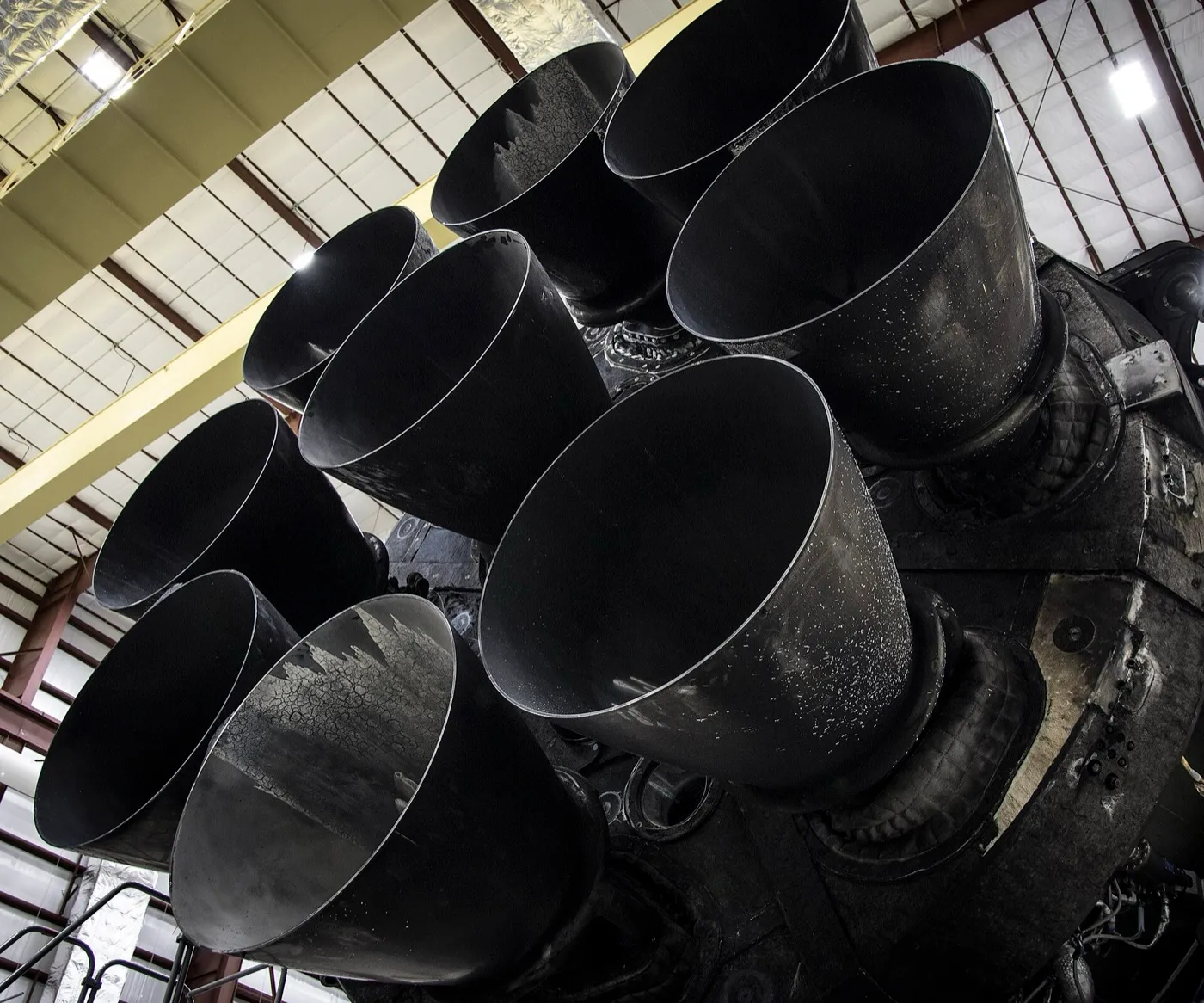
Gimbaling — pivoting the engine bell to redirect thrust — is how almost every modern rocket steers. Two hydraulic or electric actuators tilt the engine on a gimbal block; the thrust vector follows. Falcon 9 first stage: ±5° on each Merlin, with the centre engine doing most of the steering work and the outer eight contributing roll authority through differential gimbal. Starship Super Heavy: the inner 13 Raptors gimbal, the outer 20 are fixed. SLS: each RS-25 gimbals ±10.5°. Solid boosters cannot gimbal in flight (the bell is bolted on) — they use a *flex bearing* that lets the entire nozzle pivot relative to the case, which the Shuttle SRBs and SLS boosters use to provide steering in the booster phase. SLS lost most of its trans-stage steering when Shuttle SRBs were inherited; the flex-bearing nozzles handle it.
A handful of vehicles steer differently. Soyuz uses fixed main engines with separate gimballed vernier engines around the booster cores. The Saturn V S-IC gimballed the four outer F-1s; the centre F-1 was fixed. Cold-gas thrusters at the booster top or side handle attitude in coast phases (Falcon 9 between booster shutdown and reentry, Starship during high-altitude flips). And many small spacecraft use no gimbal at all: a single fixed engine plus reaction wheels and small RCS thrusters. The choice is mass-trade: gimbal hardware costs 50-200 kg per engine; for a launcher with ten engines and a 200-tonne payload the cost is worth paying, for a 100-kg smallsat with a single kick motor it usually is not.
SEE IN THE APP
- /fleet Throttle ranges by vehicle: Merlin 1D (40-100%), Raptor 2 (40-100%), RS-25 (67-109%, no shutdown-mid-burn), F-1 (no throttle), solid boosters (zero throttle, profile cast at manufacture)
- /missions Apollo LM descent engine — throttled deep (10-65%) for the powered descent; landings on Moon and Mars rely on deep throttle to hover-then-touch