∆v as Mission Budget
The single number that says whether a mission is possible — total velocity change you need to spend, summed over every burn.
101 · zoom in
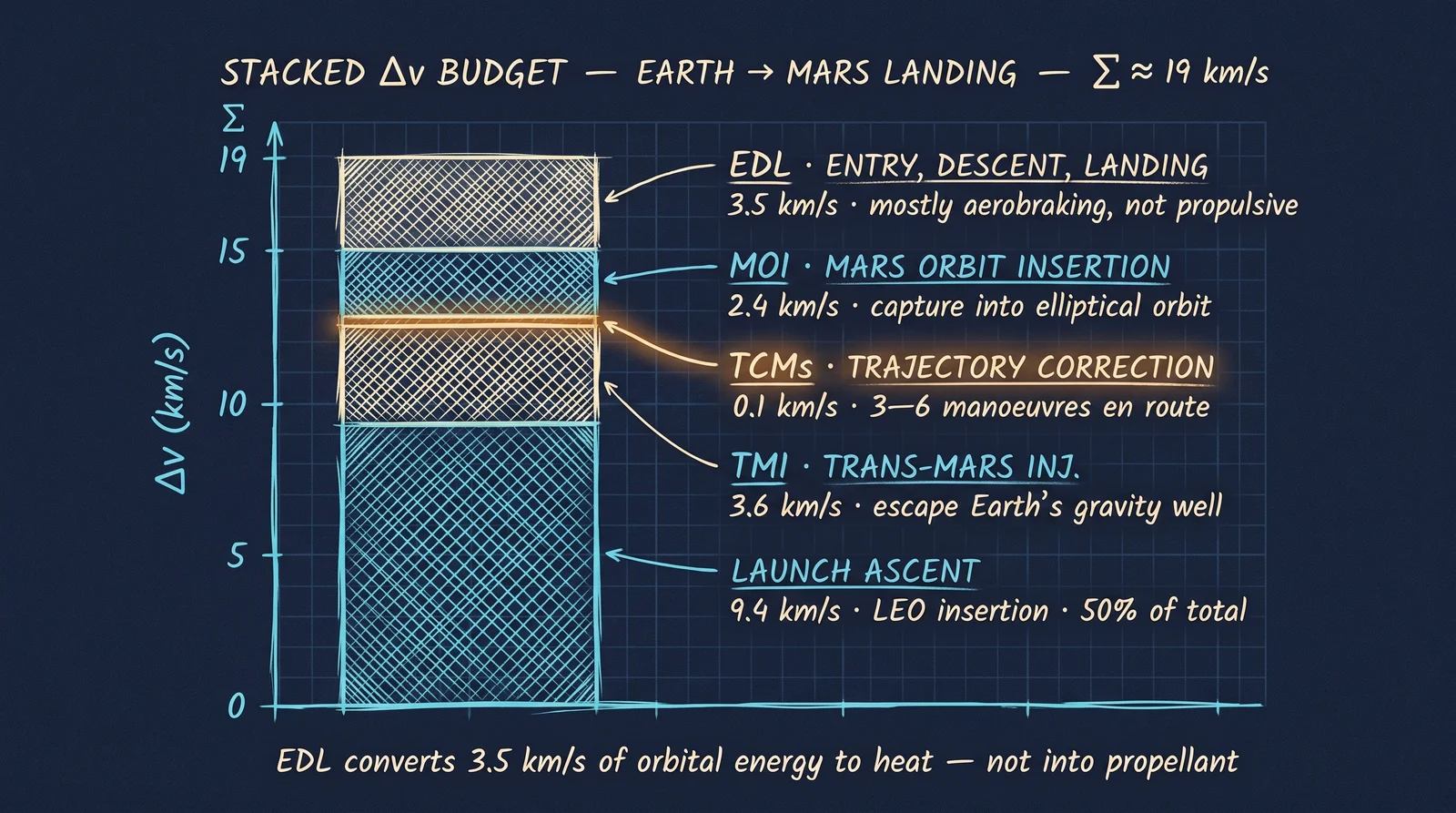
Money for spaceflight isn't dollars. It's ∆v — pronounced "delta-v" — and it's measured in kilometres per second. Every burn your rocket does costs some ∆v. Every move you make on a trajectory has a price tag in km/s. The mission's ∆v budget is just the running total: launch + injection + course corrections + arrival + landing. Add it up, that's your bill.
Now here's the killer twist. Your rocket doesn't have unlimited ∆v. It has a hard ceiling, set by the Tsiolkovsky equation, dictated entirely by how much of your rocket is fuel and how good your engines are. If your bill exceeds the ceiling, the mission is impossible. Throwing more money at it doesn't fix it. The math wins.
Quick reference numbers to internalise: getting off Earth into orbit takes ~9.4 km/s. From orbit to a Hohmann to Mars adds ~3.6. Insertion at Mars adds another ~2. That’s around 15 km/s to reach the Mars system and brake into orbit — Mars’s thin atmosphere then does most of the landing. This is why landing on Mars is so much harder than landing on the Moon, and why every gram of mass on a Mars lander gets fought over.
∆v (delta-v) is the bookkeeping currency of spaceflight. Every engine burn — getting off Earth, leaving orbit, correcting course, slowing down at the destination — costs you some change in velocity. Add them all up and you have the mission's ∆v budget.
On the supply side: your rocket's ∆v capability comes from the Tsiolkovsky equation — engine `Isp` and propellant fraction set the ceiling. On the demand side: trajectory design picks the path with the cheapest summed cost. A mission flies if budget supply ≥ demand. It doesn't if it doesn't, no matter how much money you throw at the problem.
Some reference numbers: Earth surface to LEO costs ~9.4 km/s of ∆v (most of it fighting gravity and atmosphere). LEO to a Hohmann transfer to Mars adds ~3.6 km/s. Mars orbit insertion adds another ~2 km/s. That’s around 15 km/s to reach the Mars system and capture into orbit — Mars’s thin atmosphere handles the descent, not additional propulsion.