Engine clustering — Saturn V's 5 vs Starship's 33
Two opposite philosophies for getting megaton-class thrust: build one giant engine and use a few of them (F-1, RS-25), or build a medium engine and use a lot of them (Merlin, Raptor). The second won.
Saturn V's first stage clustered five F-1 engines. Each F-1 produced 6.77 MN of thrust at sea level — at the time and for fifty years afterwards, the largest liquid engine ever flown. The development arc was long and painful: combustion instability nearly killed the programme through the early 1960s; Rocketdyne ultimately solved it by tuning the injector plate to interrupt resonant modes. The Apollo programme's bet was that fewer, larger engines meant fewer points of failure during a 165-second first-stage burn. The Soviet response was the opposite: the N1's first stage clustered *thirty* NK-15 engines. Without an F-1-class engine in their inventory and with NK-15s small and cheap to produce, the Soviets chose engine count over engine size. All four N1 flights failed — though the failures were as much about plumbing and KORD shutdown-controller software as the cluster itself.
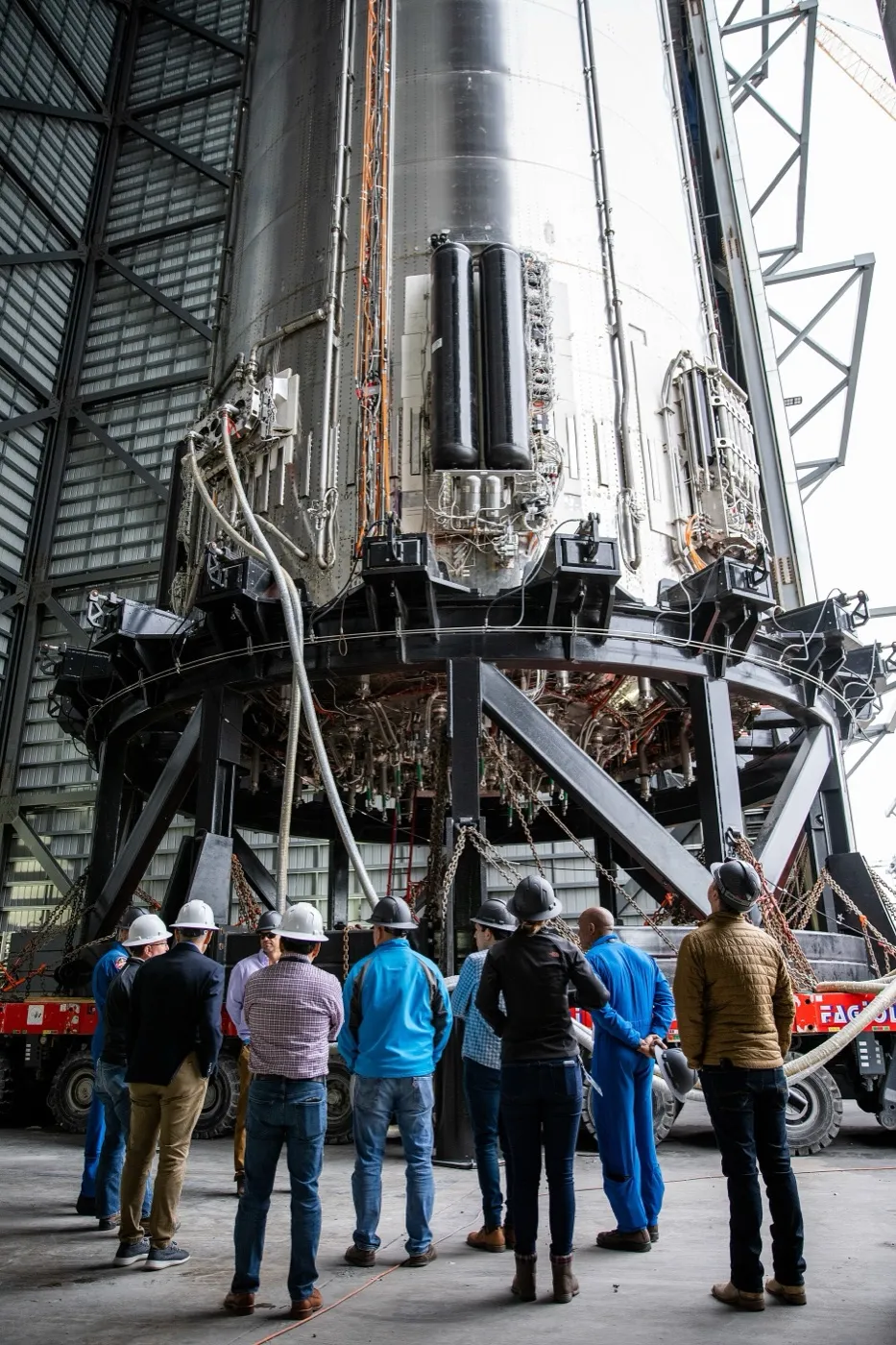
The modern verdict is the opposite of Saturn V's. Falcon 9 clusters nine Merlin 1Ds in a 3-3-3 grid (later an 'octaweb' — 8 around the perimeter, 1 centre) for ~7.6 MN at lift-off. Falcon Heavy stacks three Falcon 9 first stages side by side: 27 Merlins, 22.8 MN. Super Heavy carries 33 Raptor 2 engines (13 in a central cluster, 20 around the outer ring) for ~76 MN at lift-off, double Saturn V's stage thrust. Three things changed since 1969 that swung the argument toward many-small. First, modern thrust-vector and engine-shutdown control can compensate for an engine failure mid-flight: Falcon 9 has lost engines on ascent (CRS-1, October 2012) and still inserted payload. Second, mass production of one engine across hundreds of vehicles drives unit cost down — economics that Saturn V's nine-flight career could never achieve. Third, computational fluid dynamics now lets you predict and damp the acoustic and base-heating interactions that historically made clusters fragile.
Engine clusters fail differently from single engines. With five F-1s, losing one means you cannot finish the mission — Apollo 6 lost two J-2s on its S-II stage and limped to a degraded orbit, ultimately a non-mission. With 33 Raptors, losing one (or three, or six) on Super Heavy is designed-for: the avionics shut down the failed engine plus its symmetric partner to keep the thrust vector through the centre of mass, then redistributes throttle across the survivors. Falcon 9 can lose up to two of nine engines after a critical altitude and still complete the primary mission. The cluster-vs-monolith trade has shifted: clustering used to mean fragility because one engine's plumbing rupture could cascade; modern compartmentalisation (Raptor's individual shields, fast-acting isolation valves) means a single engine RUD is contained, not catastrophic.
There is a remaining argument for the monolithic approach. Hydrolox upper stages and core stages still prefer a few large engines: SLS uses 4 RS-25s, Ariane 6 uses 1 Vulcain 2.1, Long March 5 uses 2 YF-77. Hydrogen plumbing is so volumetrically large and so cold that multiplying engine count multiplies tank-bottom complexity. The all-staged-combustion Russian RD-170 generation (and its descendant the RD-180 / RD-191) also stayed at one to four big chambers. The pattern: kerolox and methalox have gone many-small; hydrolox has stayed few-large. The Raptor's full-flow staged combustion at engine-cluster scale is what made Super Heavy possible — that combination of cycle, propellant, and clustering had not previously been attempted.
SEE IN THE APP
- /fleet Engine count per vehicle: Saturn V S-IC (5 × F-1), Falcon 9 (9 × Merlin), Falcon Heavy (27 × Merlin across three cores), Starship Super Heavy (33 × Raptor), SLS (4 × RS-25 + 2 SRBs), N1 (30 × NK-15 — never made orbit)