Gas-generator cycle — the workhorse
Burn a sliver of the propellant in a small side chamber, use the hot gas to spin the turbopumps, then throw it overboard. It costs a little performance, but it is simple, robust, and the most widely flown way to build a rocket engine.
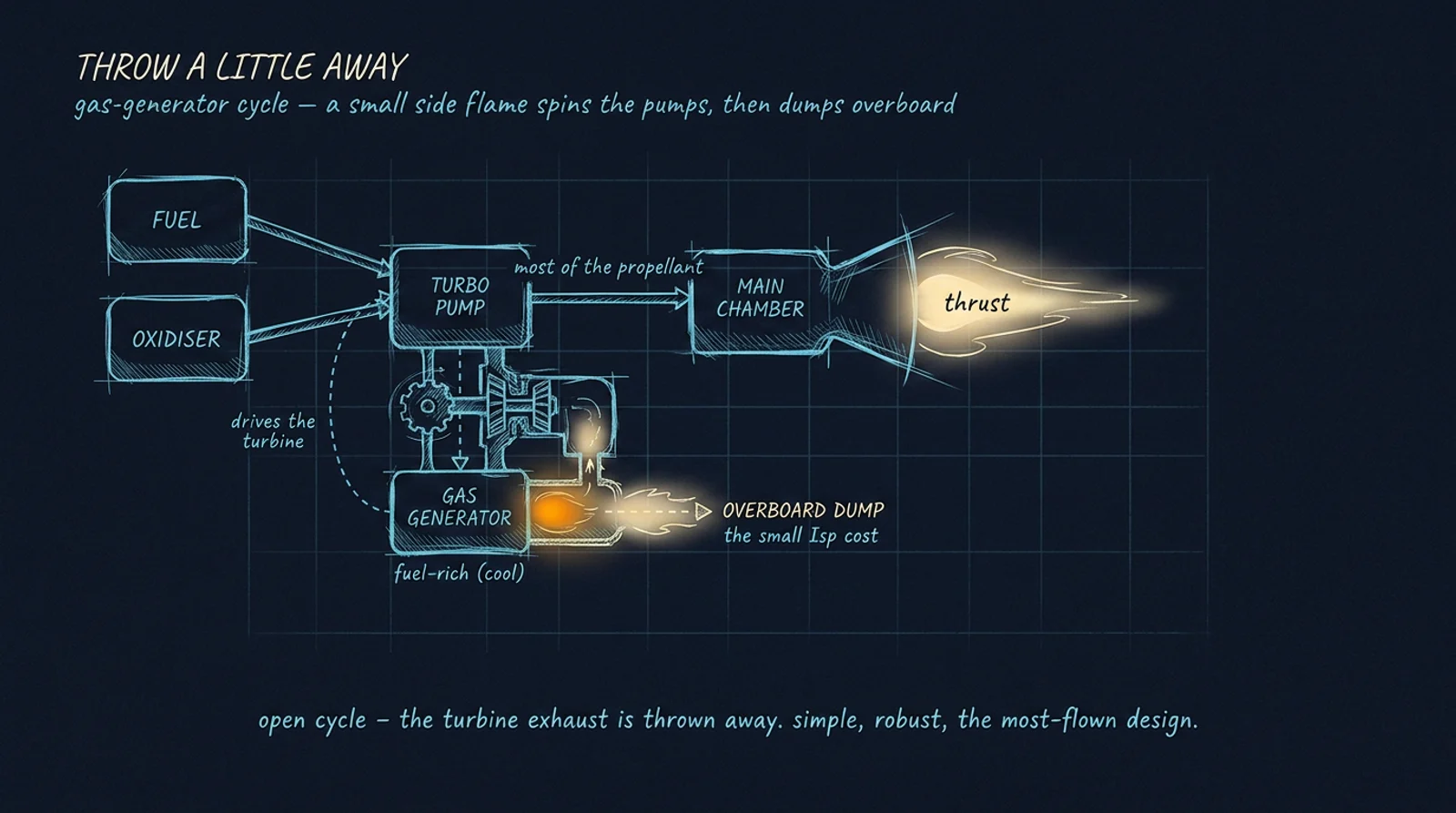
Every pump-fed engine has the same problem: to force propellant into a combustion chamber at hundreds of atmospheres, you need turbopumps, and to spin those pumps you need a power source. The gas-generator cycle solves it the blunt way. A few percent of the fuel and oxidiser are tapped off and burned in a separate small chamber — the gas generator — producing a stream of hot gas that drives a turbine on the pump shaft. Because that gas has done its job before it ever reaches the main chamber, it is simply dumped overboard, usually through a separate exhaust duct or fed into the nozzle skirt where the pressure is already low. This makes it an *open* cycle: some propellant leaves the engine without passing through the main combustion chamber.
Most gas generators run deliberately fuel-rich, because a stoichiometric flame would melt the turbine blades; a few early Soviet engines, including the RD-107 and RD-108, instead spin their turbines on steam from catalytically decomposed hydrogen peroxide. Either way, turbine-inlet temperature is the limiting design number — it caps how hard you can drive the pumps, and therefore the chamber pressure the engine can reach. The overboard dump costs a few seconds of specific impulse versus a closed cycle, since that propellant produces little useful thrust. For a first stage, where raw thrust and low cost matter more than the last few seconds of Isp, that trade is almost always worth it.
The result is the cycle that has flown more hardware than any other: the Saturn V's F-1, the Falcon 9's Merlin 1D, the R-7 / Soyuz family's RD-107 and RD-108, India's Vikas, Europe's Viking, and NASA's RS-68 are all gas-generator engines. Its virtues are exactly the ones a launch operator cares about — fewer failure modes, lower development cost, gentle turbine conditions, and easy restart and throttling. When engineers want maximum performance instead they close the cycle, which is the story of staged combustion and the expander cycle.
SEE IN THE APP
- /fleet F-1 (Saturn V), Merlin 1D (Falcon 9), RD-107/108 (Soyuz), Vikas (PSLV/LVM3) and Viking (Ariane 1-4) are all gas-generator engines — the most-flown cycle in history