Expander cycle — powered by heat, not fire
Let the cryogenic fuel soak up heat off the engine's own nozzle, flash to gas, and spin the turbopump with it. No gas generator, no preburner — the engine's waste heat is the power source. Clean and reliable, but it cannot scale up.
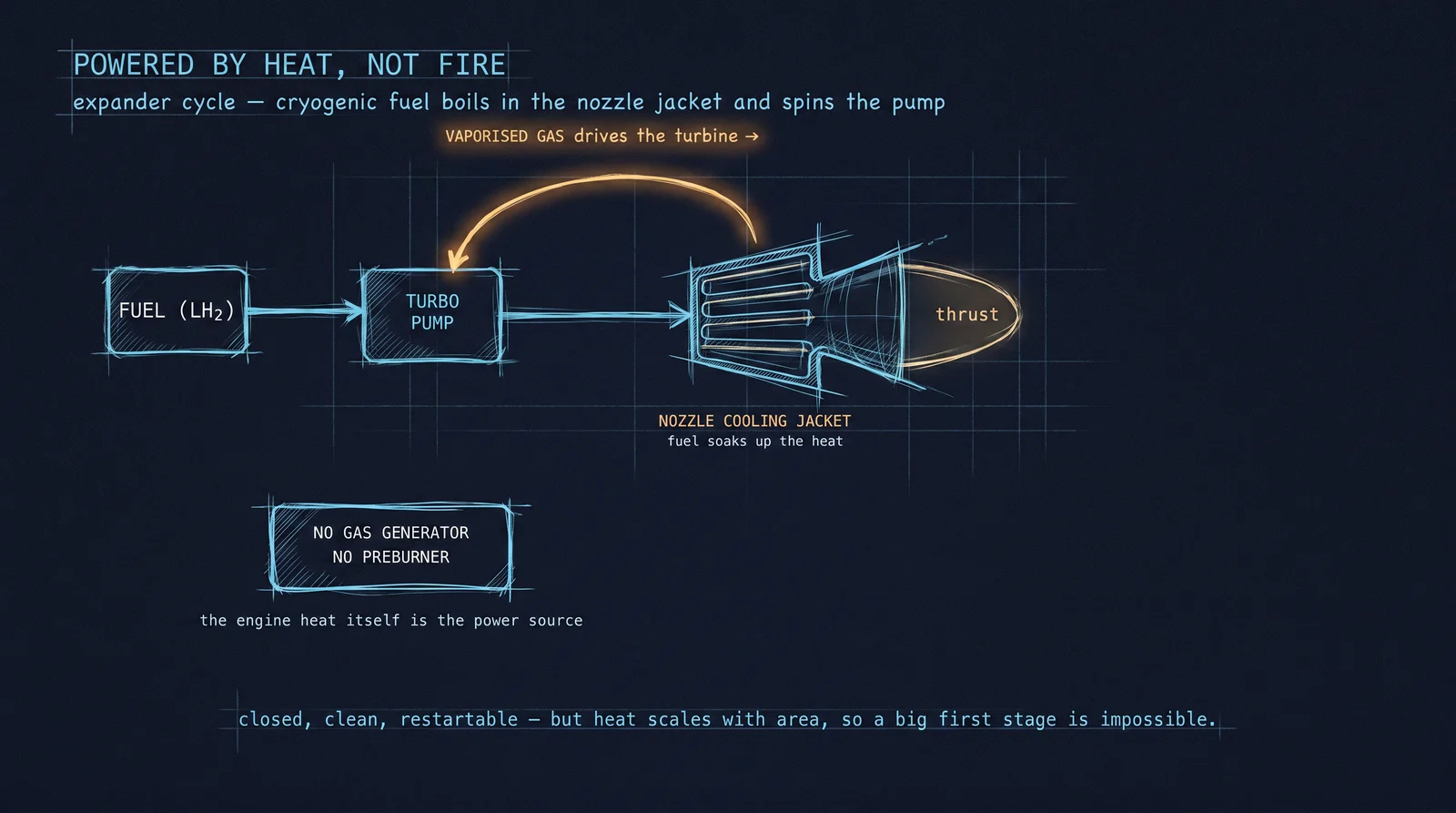
A rocket chamber and nozzle are ferociously hot, and a cryogenic engine already pumps its freezing fuel through channels in the chamber walls to keep them from melting — regenerative cooling. The expander cycle turns that cooling job into the engine's power plant. Liquid hydrogen (or methane) enters the wall channels near the nozzle, absorbs a huge amount of heat, and flashes into a hot, high-pressure gas. That gas is expanded through the turbine to drive the turbopump, and only then is it delivered to the main chamber to burn. No propellant is set on fire just to run the pumps, so the turbine gas is benign, soot-free, and gentle on the hardware — which is why expander engines are famously reliable and restartable.
The catch is a hard physical ceiling. The power you can extract depends on how much heat the walls can hand to the fuel, and that scales with the *surface area* of the chamber and nozzle. But the thrust — and therefore the propellant flow the pumps must move — scales with chamber *volume*. As you make the engine bigger, volume grows faster than surface area, so at some point the walls simply cannot heat enough gas to drive pumps large enough for the flow. In practice a closed expander tops out around a few hundred kilonewtons of thrust. That makes it perfect for upper stages and impossible for a big first stage.
The classic is the RL10, which first flew on Centaur in 1962 and is still in production — one of the longest careers of any engine. That thrust ceiling applies to the fully closed cycle; switching to the expander-bleed variant breaks it. Bleed taps off a portion of the heated gas to drive the turbine and then dumps it overboard rather than routing all of it to the chamber — giving up a little Isp in exchange for far more power. Japan's LE-9 shows how far it can go: an expander-bleed engine producing 1,471 kN, it powers the first stage of the H3, something a closed expander could never do. Its sibling the LE-5B and Europe's Vinci on Ariane 6 use the same bleed approach for upper stages. Where staged combustion chases raw performance, the expander cycle chases reliability and restartability for the quiet, precise work of putting a payload exactly where it belongs.
SEE IN THE APP
- /fleet RL10 (Centaur upper stage, flying since 1962) is the archetypal expander engine; Japan's LE-5B and LE-9 use the expander-bleed variant on H-IIA and H3