The Practice Ground
We went to the Moon once, at extraordinary cost, then stopped for half a century and let the institutional memory die. Now we are relearning it — and this time, the reason we are going has changed.
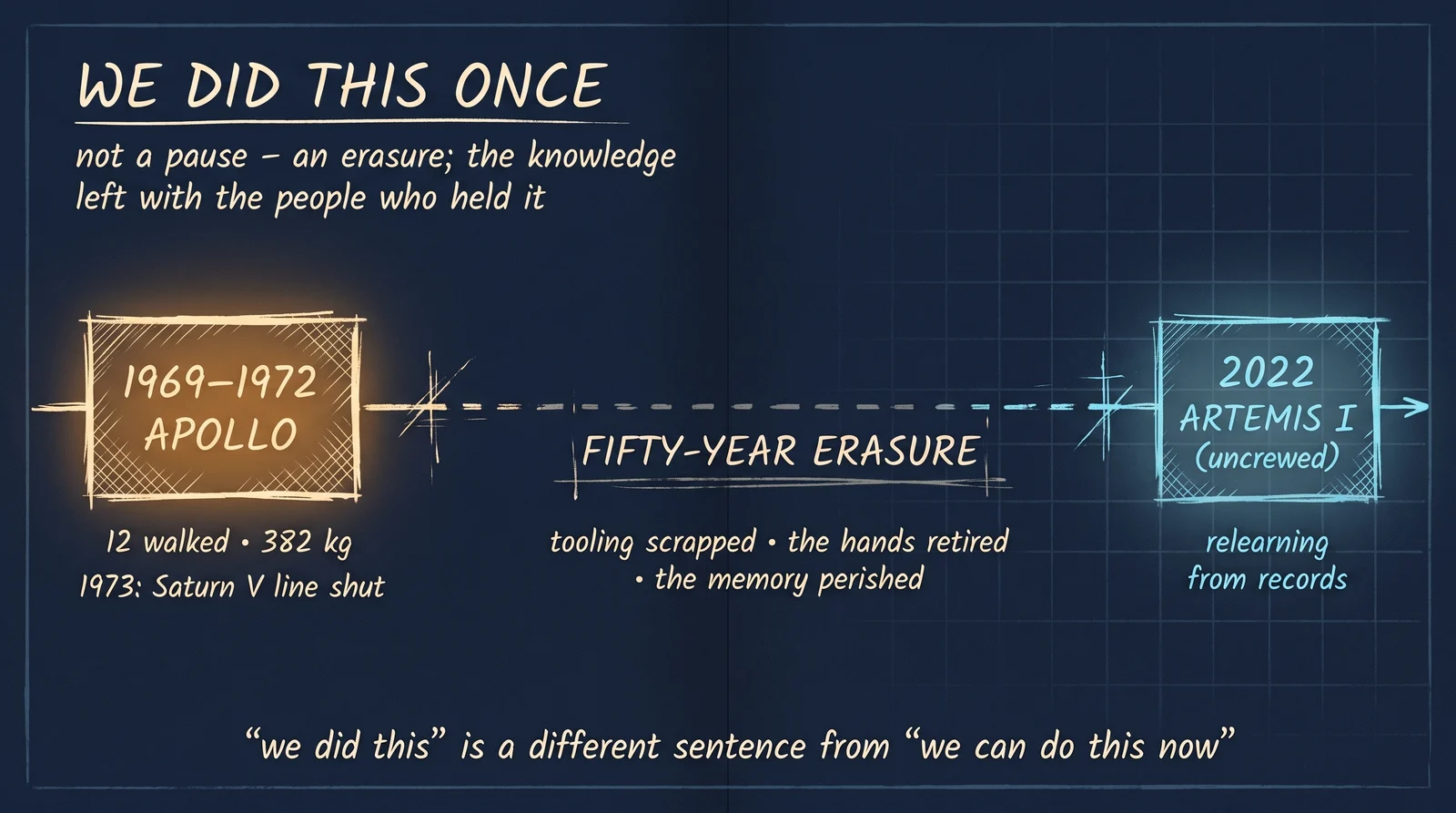
There is a fact about the Moon that ought to be more unsettling than it usually is. We went there, conclusively, between 1969 and 1972. Twelve people walked on it. We brought back 382 kilograms of rock, took thousands of photographs, drove a rover across the highlands, and left behind retroreflectors that astronomers still bounce lasers off today. And then, for reasons that were never fully technical, we stopped — and the six decades that followed were long enough that almost everything we learned about how to do it was lost. Not forgotten in the sense that the records vanished; lost in the deeper sense that the people who held the knowledge in their hands retired and died, the tooling was scrapped, the supply chains dissolved, and the organisations rebuilt themselves around other priorities. The Saturn V production line, the most capable launch system humanity has ever built, was shut down before Apollo 17 even flew. We did this once. That is a different sentence from: we can do this now.
That fact — returning, relearning, rebuilding — sits at the centre of everything happening at the Moon right now. The world is busy there in a way it hasn't been since the 1970s: Chinese landers on the farside, Indian and Japanese spacecraft touching down near the south pole, a wave of commercial American landers, a NASA programme aimed at returning crews. But before any of that can be understood clearly, two things need to be held in mind at once. First: the Moon is the natural first rung of deep-space ambition precisely because it is close enough to be forgiving and real enough to teach the genuine lessons. Second: we already climbed that rung, at staggering expense, then climbed back down and let the rung corrode. The return to the Moon is not a continuation of Apollo. It is a second attempt at what Apollo started, fifty years later, for different reasons, by a different cast — and in some respects starting from further back.
And the reasons, this time, are different enough to matter.
Three days out
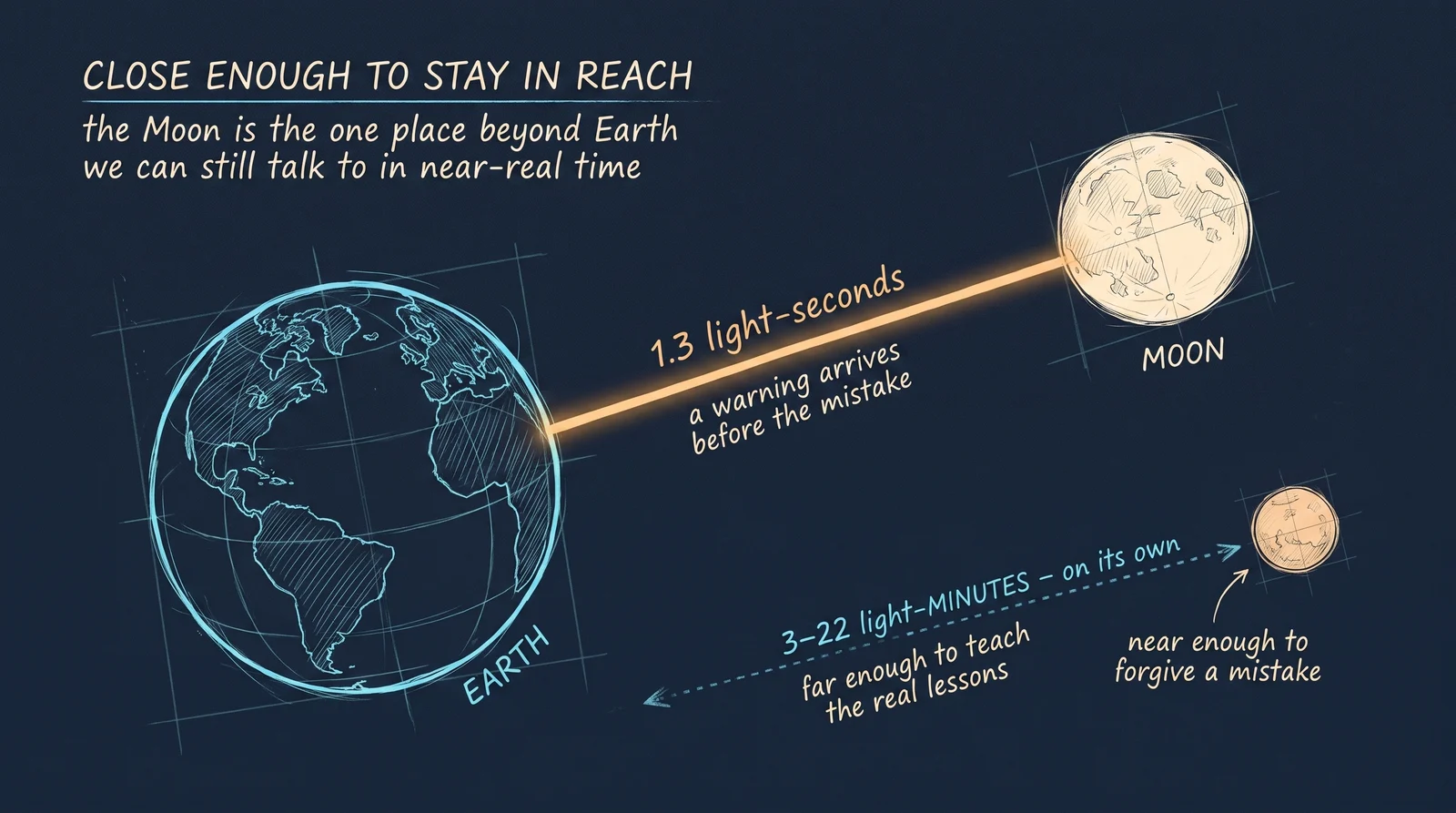
The Moon is approximately 384,400 kilometres away. Light covers that distance in about 1.3 seconds, which means that a signal sent from Earth arrives before you have finished the thought that prompted it. At Mars, the equivalent figure is somewhere between three and twenty-two minutes one way, and at the peak of the seven-minute terror of entry, descent, and landing, the craft is entirely alone. At the Moon, a human crew can still talk to the ground in something approaching real time. Controllers can issue warnings, ask questions, and receive answers before a developing problem becomes an irreversible one. That margin — 1.3 seconds versus twenty-two minutes — is the difference between a place where people can be kept in the loop and a place where they cannot. It is not an incidental detail. It is the structural reason the Moon comes first.
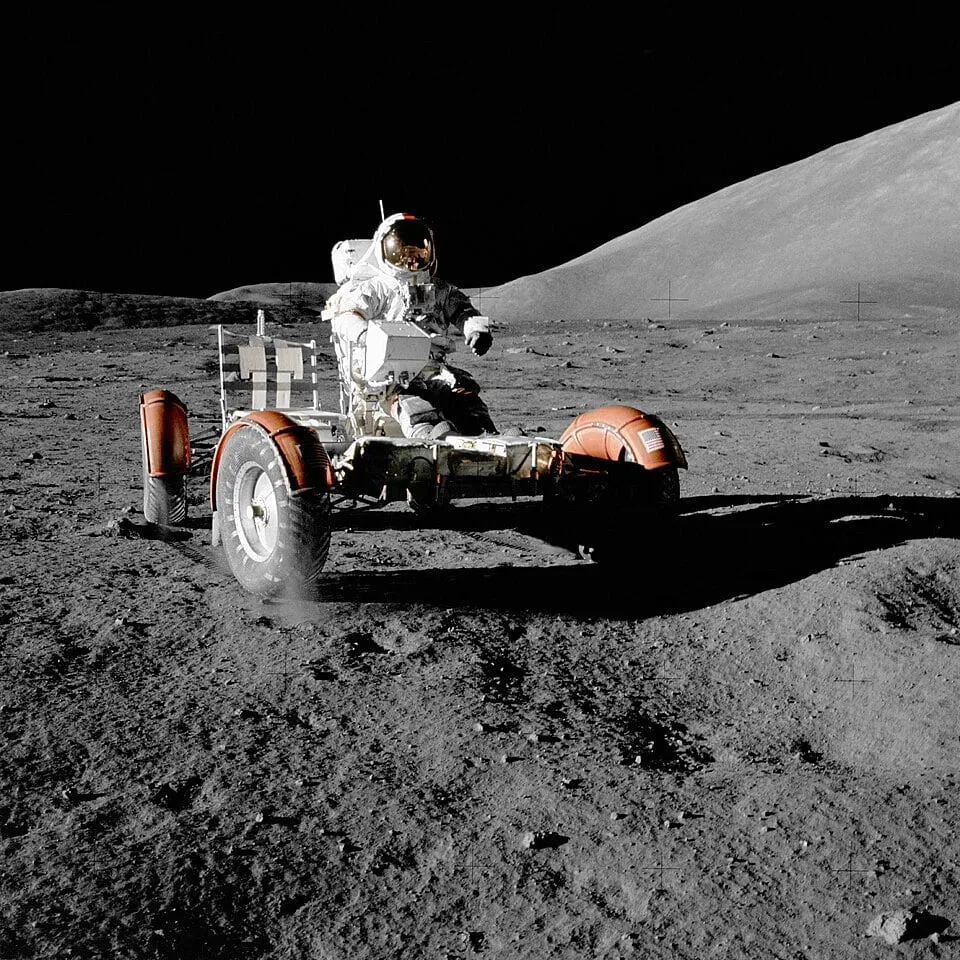
But close does not mean easy. The Moon has no atmosphere whatsoever — not a wisp, not a trace thick enough to slow a descending spacecraft by a single metre per second. Everything the seven-minutes essay describes about the cruelty of Mars — heat shields, supersonic parachutes, the brutal compression of entry — is actually the relatively easy case, because at least Mars gives you something to work with. On the Moon you arrive fast, with only rockets to kill your speed, so you must carry every kilogram of propellant you will ever need from the moment you leave the launch pad. The Apollo Lunar Module's descent engine burned for twelve minutes against a gravity well that, though only one-sixth of Earth's, is a real gravity well — genuine, demanding fuel to fight, unforgiving of errors in the burn timing. And underneath the lander, when you touch, is regolith: a fine, angular, glass-edged powder ground by billions of years of micrometeorite impacts into something that behaves like flour, clings like burrs, and abrades like sandpaper. The suits the Apollo astronauts wore were visibly darkened by it within hours. Dust is not a detail. Dust is a design problem.
Then there is the night. The lunar day lasts about fourteen Earth days, and so does the night, during which temperatures plunge to around −170°C. Solar panels generate nothing. Batteries that power survival systems drain against a cold that would kill most commercial electronics. Every system aboard a lunar lander has to either hibernate through the darkness and survive it, or be designed to work without sunlight for two weeks. The Soviet Luna 9 — which in February 1966 became the first spacecraft in history to make a soft landing on the Moon and transmit photographs from the surface — operated for roughly three Earth days before its batteries died. The lesson was immediate: the Moon is close enough to reach but real enough to make you work for every hour you spend there.
The thing we did and then forgot
Apollo is simultaneously the greatest engineering achievement in the history of spaceflight and one of the strangest stories in the history of institutions. It was built in a decade at a cost — in 2025 dollars — of somewhere north of 250 billion. It employed, at its peak, some 400,000 people directly or through contractors. It required the invention of new metallurgy, new computer science, new manufacturing techniques, new disciplines of systems engineering that didn't exist when Kennedy made his speech. And it worked. Apollo 11 landed on the Sea of Tranquility on 20 July 1969, and by Apollo 17 in December 1972, the programme had refined its techniques to the point where crews were doing genuine field geology at high latitudes with a rover and a suite of scientific instruments. Then it stopped, and the stopping was permanent in ways no one quite admitted at the time.
The Saturn V — the rocket that did it — was 111 metres tall, generated 34.5 million newtons of thrust at liftoff, and has never been equalled for payload to low Earth orbit. The last one flew in May 1973, carrying Skylab. The tooling, the jigs, the vendor relationships, the hands that machined the parts — all of it was wound down. Within a generation, NASA could no longer build a Saturn V even if it wanted to. The knowledge was gone not from the libraries but from the people, and from the infrastructure that gave the knowledge its practical meaning. When engineers began working on what would become the Space Launch System in the 2010s, they could not simply reopen the Saturn V drawings; the manufacturing processes those drawings assumed no longer existed. They had to redevelop them. The gap between Apollo 17 in 1972 and the uncrewed Artemis I flight in 2022 — fifty years — was not a pause. It was an erasure.
This is the sobering context for everything that follows. "We did this before" is true in the narrow sense that the feat was accomplished, the footprints are there, the retroreflectors still work. It is misleading in the practical sense that the organisations, tools, and people who did it are gone, and what has been rebuilt since is being rebuilt from records rather than from living knowledge. Institutional memory is a real, perishable asset. The Moon is teaching that lesson a second time.
Not the same Moon we left
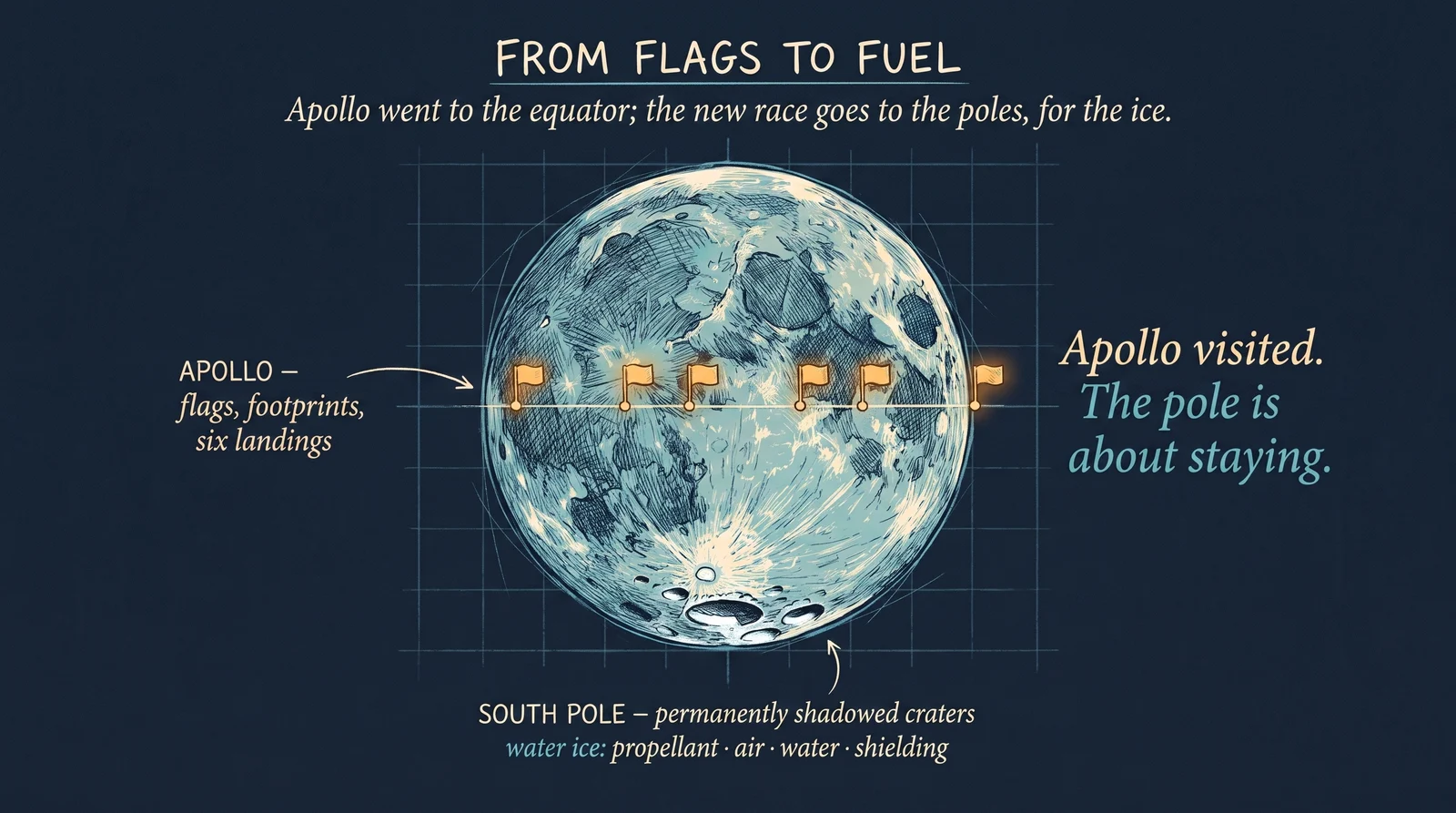
Apollo went to the equator. Six of the seven landings (the seventh, Apollo 13, did not land) touched down within roughly 26 degrees of the lunar equator, in broadly flat terrain with acceptable lighting conditions for the surface stay and a predictable thermal environment. That made sense for a programme whose primary goal was to get there and back safely, prove the technology, and collect samples. The equatorial Moon is the easiest version of the Moon to reach, to land on, and to operate in. It is not, it turns out, the most interesting.
In 2008 and 2009, the Chandrayaan-1 mission and NASA's Lunar Reconnaissance Orbiter produced what amounts to a revolution in lunar science: evidence that the permanently shadowed craters near the south pole contain water ice. Not trace amounts — substantial deposits, likely hundreds of millions of tonnes, accumulated over billions of years from cometary impacts and the solar wind, preserved by temperatures that never rise above −160°C because the sun never reaches those crater floors. Water ice, in the context of a deep-space programme, is not just something to drink. It is hydrogen and oxygen: rocket propellant, breathable air, radiation shielding. The south pole of the Moon holds, potentially, the fuel depot and life-support consumables for everything that comes after it. This is what the phrase "in-situ resource utilisation" means in practice, and it changes the reason for going entirely. Apollo was about visiting. The south pole is about staying.
Staying is a different problem. Staying means surviving the night, repeatedly. It means sourcing power through a fortnight of darkness, which requires either nuclear power (which the US has not sent to a planetary surface since the 1970s Viking landers) or a location near the pole where, on crater rims, the sun is present most of the time. It means managing dust accumulation over months rather than days. It means a degree of infrastructure — power, comms relay, habitat — that Apollo never attempted. The Artemis programme's stated ambition is a sustained human presence at the south pole. That goal is still years from realisation. Artemis II, the first crewed flight (a lunar flyby, not a landing), is planned but not yet flown. Artemis III, the first crewed landing since Apollo, is planned to target the south polar region. "Planned" is doing significant work in both those sentences.
A crowded sky
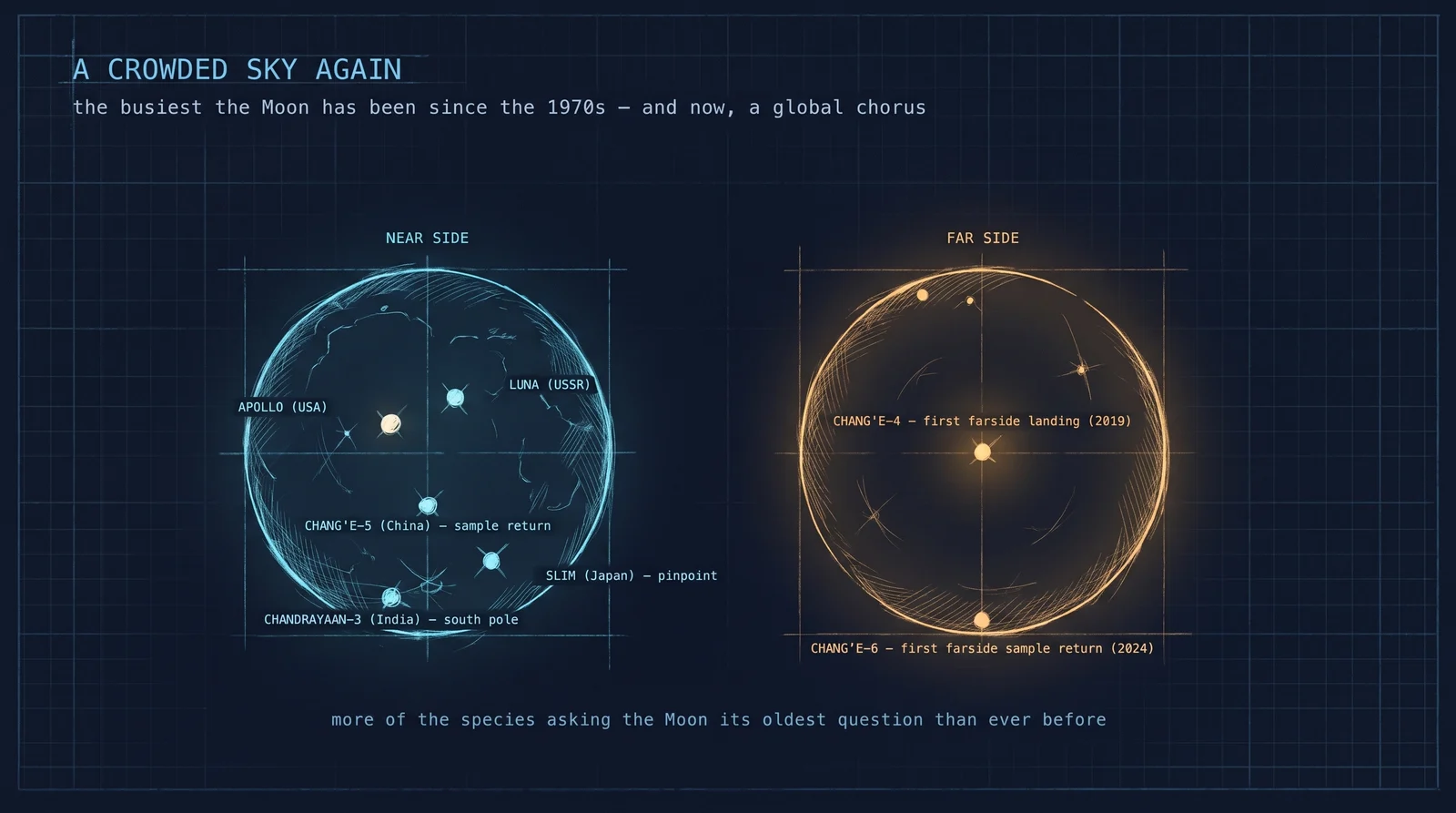
The renewed interest in the Moon is not an American programme. It is a genuine global phenomenon, and it has a history that predates Apollo by nearly a decade. The Soviet Luna programme put the first human-made object on the Moon — Luna 2 impacted the surface in September 1959 — then returned the first photographs of the lunar farside with Luna 3 the same year, and spent the following decade accumulating firsts that are not as well remembered as they should be. Luna 9 made the first soft landing in 1966, settling a genuine scientific controversy about whether the surface was solid enough to support a spacecraft (there was a serious argument, before that, that the Moon's surface might be metres-deep dust in which any lander would simply sink). Luna 16, in 1970, returned the first robotic sample to Earth — proving that you did not need a crewed mission to bring back lunar material. Luna 24, in 1976, was the last Soviet lunar sample return, and it remained the last lunar sample return by anyone for 44 years.
That 44-year gap ended with Chang'e-5, which in December 2020 landed in the volcanic Mons Rümker region, collected 1.73 kilograms of lunar basalt, and returned it to Earth — the first sample return from the Moon since Luna 24. It was a complete success. But the mission that rewrote the frontier of what had been done was Chang'e-4, which in January 2019 became the first spacecraft in history to land on the far side of the Moon — a feat that required a relay satellite in a halo orbit around the Earth-Moon L2 point, because no direct radio link to the farside is possible from Earth. The farside of the Moon had never been visited on the surface by anything. Chang'e-4 landed in the Von Kármán crater within the South Pole-Aitken Basin, the largest impact basin on the Moon. Then, in June 2024, Chang'e-6 went further still: the first mission ever to return samples from the farside, from the same basin. Two historic firsts in five years, from a programme that did not exist at all before 2007.
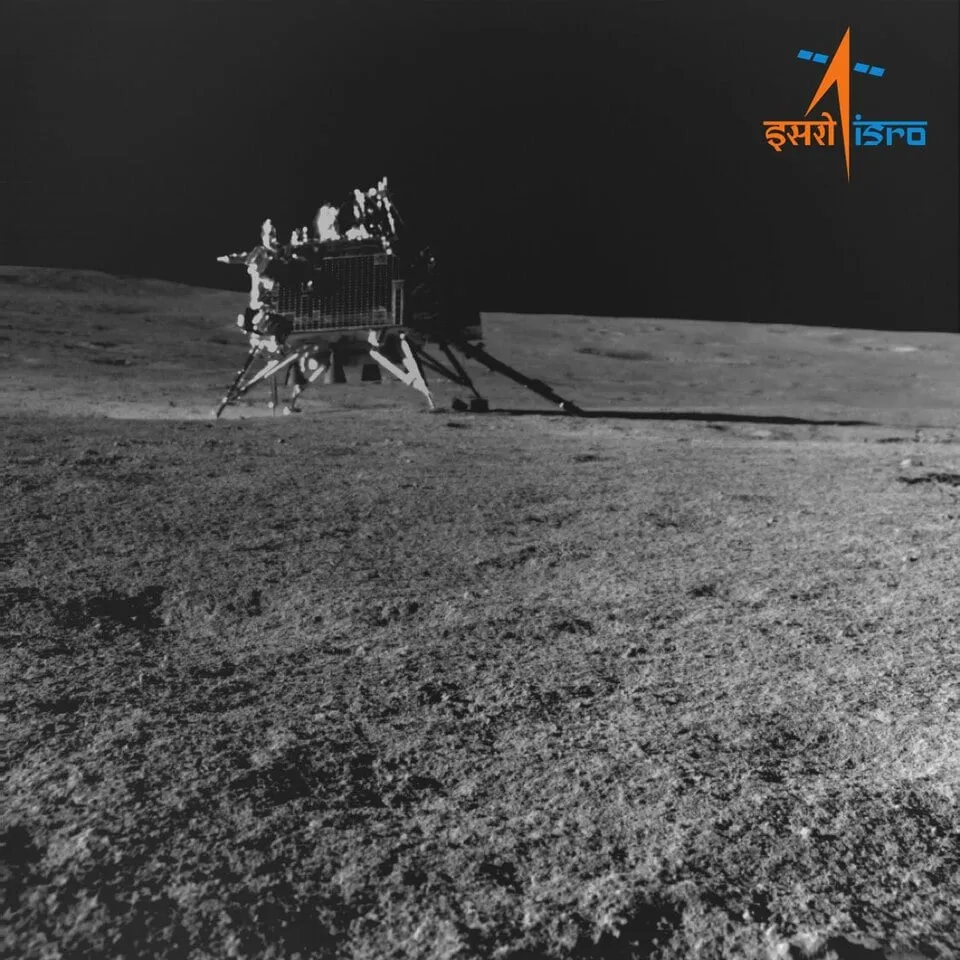
India's Chandrayaan-3 made the first landing near the lunar south pole in August 2023, touching down at approximately 69°S — further south than any previous lander — shortly after Russia's Luna-25 attempt at the same region ended in a crash. The Vikram lander and Pragyan rover operated for one lunar day before the southern winter night claimed them. Japan's SLIM spacecraft landed in January 2024 with a precision that earned it the nickname "Moon Sniper": it touched down within 55 metres of its target, the tightest pinpoint landing yet achieved on the lunar surface, though the lander came down at an angle and spent its first days on the surface operating on its side. It survived. The commercial wave has been less clean: Peregrine Mission One in early 2024, a US commercial lander, suffered a propellant leak shortly after launch and never reached the Moon. Intuitive Machines' IM-1 in February 2024 did reach the surface but tipped on landing. The failure rate of lunar landers — taking the full population of attempts since the 1960s — remains above fifty percent. The Moon does not simply admit visitors.
Dust and the long dark
The Moon's two dominant hazards — regolith and the night — are not dramatic in the way that a launch failure or an EDL disaster is dramatic. They are structural, and they compound over time. Lunar dust is electrostatically charged by the solar wind, which means it clings to everything: visors, seals, radiators, solar panels, instruments. It does not shake off. The Apollo suits that were worn for several EVAs showed visible wear from it; NASA engineers at the time estimated that a six-month lunar stay would likely render spacesuits unusable through abrasion alone. No one has yet had to solve this for a duration mission, because no one has yet conducted one. The south polar ambition will require solutions that don't yet exist at operational maturity.
The night is a simpler problem in principle and a hard one in engineering. Fourteen Earth-days of darkness, with temperatures dropping to −170°C, is enough to kill most battery chemistries through repeated thermal cycling and to deny solar power entirely. The Chang'e-4 mission hibernated its lander and rover through each lunar night and woke them at sunrise; both survived multiple cycles. Chandrayaan-3's Pragyan rover was placed in sleep mode before the night, with the expectation that it would revive in the morning; it did not, and the mission ended there. The difference between a lander that survives lunar nights and one that does not is a narrow margin of thermal engineering, battery chemistry, and heating power that is still being learned in the field. The south pole's crater rims offer a partial reprieve — some locations there are sunlit for more than 80% of the year — but accessing ice in the permanently shadowed crater floors, which is where the resource value lies, means sending systems into terrain that is simultaneously the coldest place on the Moon and the darkest.
Unlike the descent through a Martian atmosphere, lunar landing offers no atmospheric braking at all — you come in on rockets from start to finish, burning propellant at every altitude, committing to a trajectory that cannot be meaningfully corrected in the final seconds if something unexpected appears on the surface below. The Moon is, in the framing of the seven-minutes essay, the purest version of the no-atmosphere case: the problem that has no free deceleration, no heat shield to buy time, no parachute phase. Everything you want to spend on the science payload, you first have to find room for in the fuel budget. And the light-lag that makes the Moon manageable — that 1.3-second round trip — is short enough that humans can remain in the control loop, which means lunar landers do not yet need the fully autonomous terrain-relative navigation that Perseverance used at Jezero. They benefit from it. They do not yet strictly require it. That distinction will not hold at Mars.
The rehearsal
There is a throughline from the Moon to everywhere that comes after it, and it runs through the question of what "staying" actually requires. A flags-and-footprints programme — arrive, explore the vicinity, return — has a known cost structure. You build the hardware, train the crew, execute the mission, come back. Everything is bounded. A presence programme is different: it requires infrastructure that persists, resupply that repeats, systems that must be maintained and eventually replaced on-site. It requires, in short, the development of an economy rather than a series of expeditions. The Moon is the place to build that economy first, because the consequences of getting it wrong are survivable. If a power system fails at the lunar south pole, rescue is three days away and the crew can be reached in near-real-time by radio while they wait. If the same failure happens on Mars, rescue is, at minimum, a year and a half away and every decision the crew makes is their own, communicated to Earth at a lag that precludes any real oversight.
This is what the Moon is, in the long view: a practice ground that you cannot skip, even if you could afford to. The delta-v to reach the Moon is low enough that a serious mistake can be survived. The transfer orbit to Mars — a six-to-nine month coast with no returns — is not survivable in the same way. When the going-to-Mars problem is asked in earnest, the answer requires every lesson the Moon will have taught about sustained human presence in a hard vacuum: how dust is managed across months, how power is generated through prolonged darkness, how hardware is maintained by people in suits, how food and water are produced rather than merely carried. None of that can be learned in simulation with confidence high enough to bet lives on. The Moon is where it gets learned for real.
The long view on the Moon, then, is not triumphalist and it is not pessimistic. It is something closer to sobered. We spent 1969 to 1972 climbing the first rung, then spent fifty years standing on the ground looking at it. We are climbing again now — more slowly, with more partners, with better instruments and worse institutional memory — and this time the reason is not to prove a point to a rival but to find out whether humans can actually live somewhere other than Earth. The south polar ice, if it can be harvested, would change the economics of everything beyond it. The Artemis programme, if it reaches the surface with crews and then sustains a presence, will teach things about deep-space habitation that cannot be learned any other way. And the global cast of landers — Soviet, then Chinese, Indian, Japanese, American, commercial — is proof that the question the Moon poses is not a national one. It is the oldest question spaceflight asks, now asked by more of the species than ever before: what does it actually take to be somewhere else? We are still finding out. The practice ground is open.