The Grammar of Delta-V
Every spacecraft that has ever left Earth carried one thing above all else: a budget. Not money — velocity. The rocket equation meted it out in kilometres per second, gravity was the only free refill, and every engineer who ever planned a mission has been living inside that constraint since 1903.
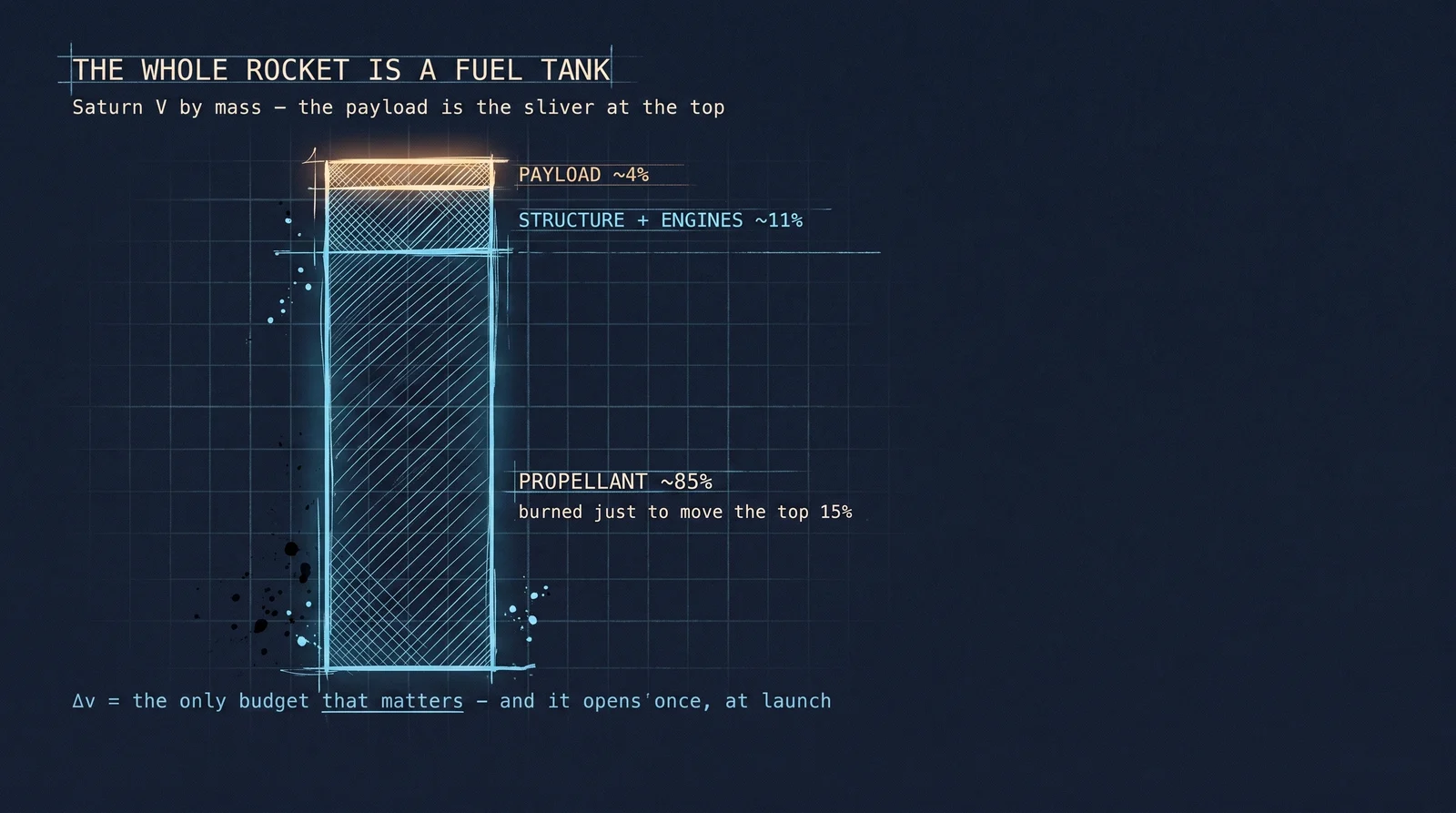
Imagine you are handed a chequebook with a fixed balance. You can spend it however you like — but every purchase is final, there are no deposits, and when the balance reaches zero you are done. That is the situation every spacecraft faces from the moment it clears the launch tower. The currency is not fuel. It is not thrust. It is velocity — more precisely, the change in velocity, measured in kilometres per second, that the spacecraft can accumulate over its entire mission. Engineers call it delta-v, and the account opens, once, at launch.
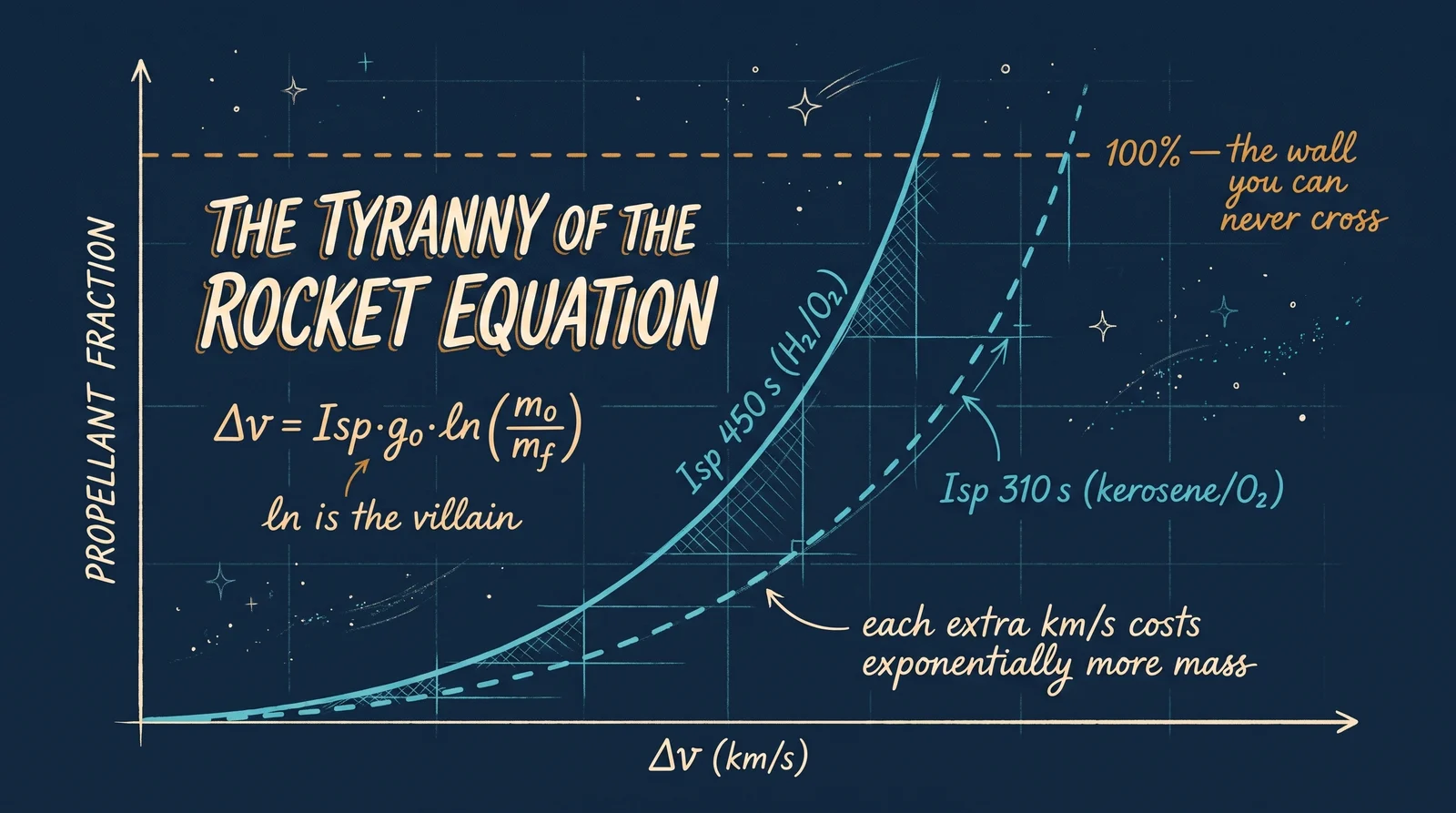
The rule that wrote this constraint was published in 1903, by a self-taught Russian schoolteacher named Konstantin Tsiolkovsky, working alone in a small provincial town. His rocket equation has not been repealed since: ∆v = Isp · g₀ · ln(m₀/mf). Read it in English: the velocity you can buy equals the efficiency of your engine — measured in seconds of specific impulse and multiplied by a gravitational constant of 9.807 m/s² — times the natural logarithm of how much heavier the rocket was at the start than at the end. That logarithm is the villain. Because ln is the slowest-growing function in mathematics, it means that every extra kilometre per second you want to add costs you an exponentially larger bite of propellant mass — and propellant has to be lifted too, which means it needs its own propellant, which has to be lifted too, and so on down a regress that has no floor.
Astronaut Don Pettit called this the tyranny of the rocket equation in a 2012 essay written aboard the ISS, and the word tyranny is exactly right. The Saturn V that carried Apollo astronauts to the Moon stood thirty stories tall on the pad and was 85% propellant by mass; its payload — everything that actually went anywhere — never exceeded about 4% of that wet mass. The rest was a controlled explosion in slow motion, consumed step by step just to get the remainder a little faster, a little higher. Everything else in spaceflight — the missions, the trajectories, the waiting for launch windows, the obsessive trimming of instrument mass — flows from that single, merciless denominator.
The budget
A delta-v budget is what mission planners call the spreadsheet that accounts for every velocity change a mission must perform, from Earth parking orbit to final destination. It is the most consequential document in mission design: it decides whether the mission is possible at all. Getting a spacecraft from a low Earth orbit to, say, a Hohmann transfer toward Mars and into Martian orbit costs roughly 5.6 km/s total — a figure that sounds modest until you remember that every decimal place is paid for in tonnes of propellant, and the rocket equation means the exchange rate gets worse the more you spend.
A Hohmann transfer is the minimum-energy arc between two orbits — the path that costs the least delta-v to get from A to B. It is not straight; it is an ellipse that brushes the inner orbit at one end and the outer at the other, coasting the entire way on nothing but inertia. The trick is that you fire the engine twice: once to leave the departure orbit, once to match the arrival orbit. Between those two burns — typically 259 days in the Earth-to-Mars case — you spend nothing. The solar system's gravity does the carrying for free, as long as you had the sense to aim the right way at the start.
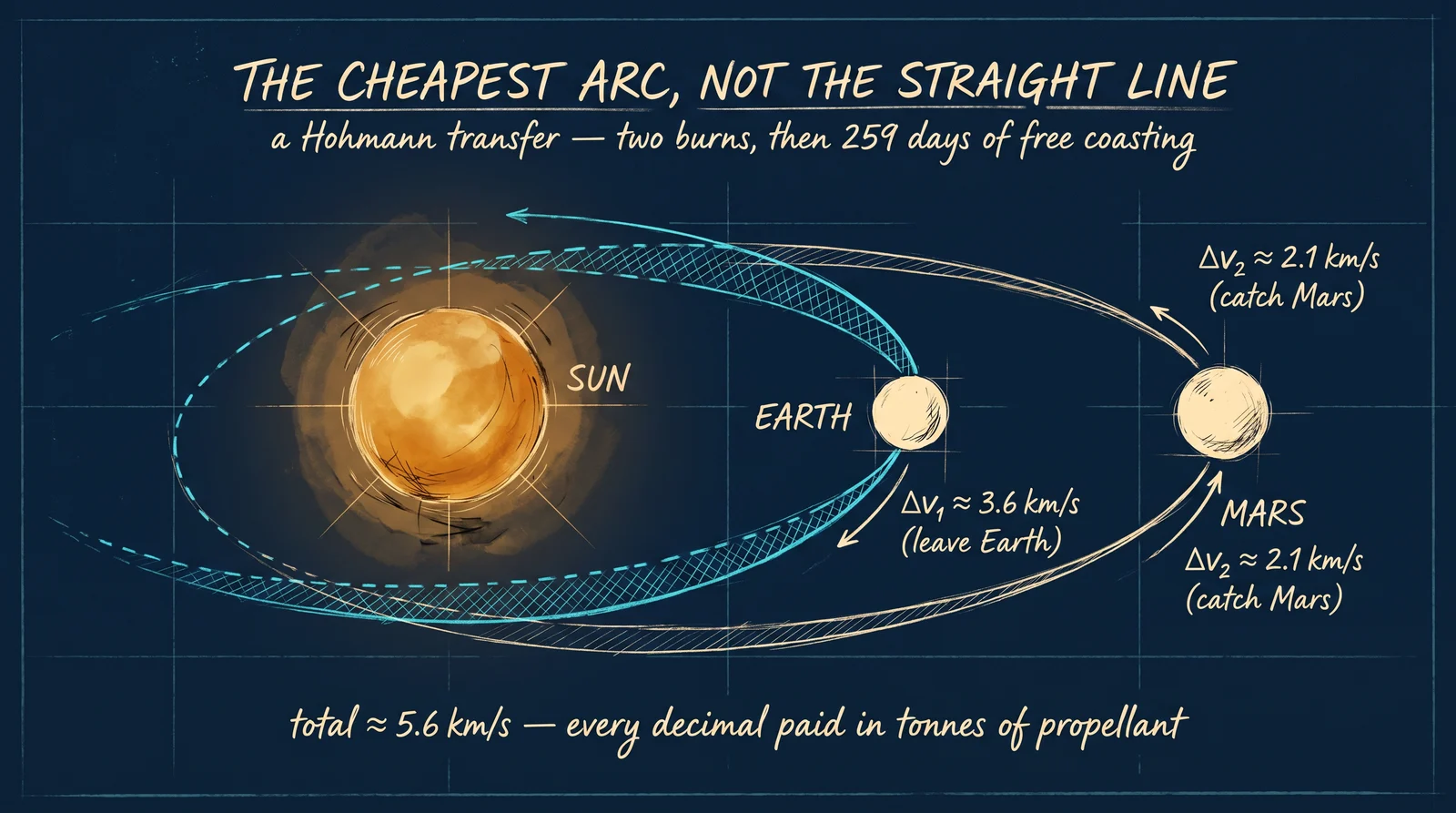
This is what navigation hands off to delta-v planning. The navigation essay opened with the problem of aiming at a moving planet — the Lambert problem, the long arc, the correction burns that close the gap between plan and reality. But choosing that arc in the first place was a budget decision. The Hohmann minimum-energy path was chosen because it spends the least; a faster trajectory exists, but it costs more delta-v than most missions can afford, and delta-v is the one thing you cannot borrow.
The one free refill
Given the equation's tyranny, any trick that adds delta-v for free is not merely useful — it is transformative. There is exactly one: gravity.
A spacecraft that swings close past a planet enters the planet's gravitational field fast, curves around it, and leaves faster than it arrived — because the planet is itself moving, and the craft has stolen a whisper of that motion. The gravity assist costs no propellant at all. The planet loses an unmeasurably tiny amount of its own orbital velocity; the spacecraft gains a great deal. For most interplanetary probes, this is not a bonus — it is the entire business model.
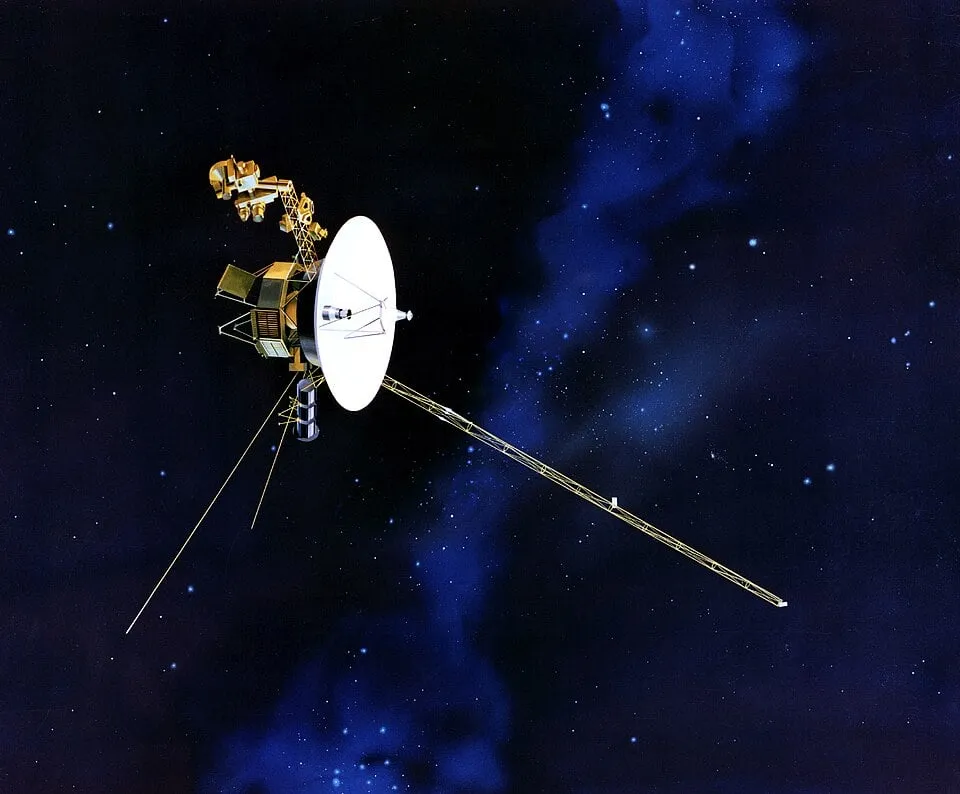
In the mid-1960s, a JPL mathematician named Gary Flandro was doing summer calculations when he noticed something. The outer planets — Jupiter, Saturn, Uranus, Neptune — were drifting toward a once-in-175-years alignment. A probe launched in 1977 and aimed right could use Jupiter's gravity to reach Saturn, Saturn's to reach Uranus, Uranus's to reach Neptune: a four-planet bank shot, each flyby adding delta-v for free and redirecting the trajectory to the next target. The flight time to Neptune would fall from thirty years to twelve. That observation became the Grand Tour — and Voyager 2 made it real, gaining roughly 10 km/s from the Jupiter flyby alone, enough to reach the outer system in the time originally budgeted for a Saturn-only mission. Neptune, today, has been visited once. The reason is that the window closed in the 1980s and won't open again until the 2150s.
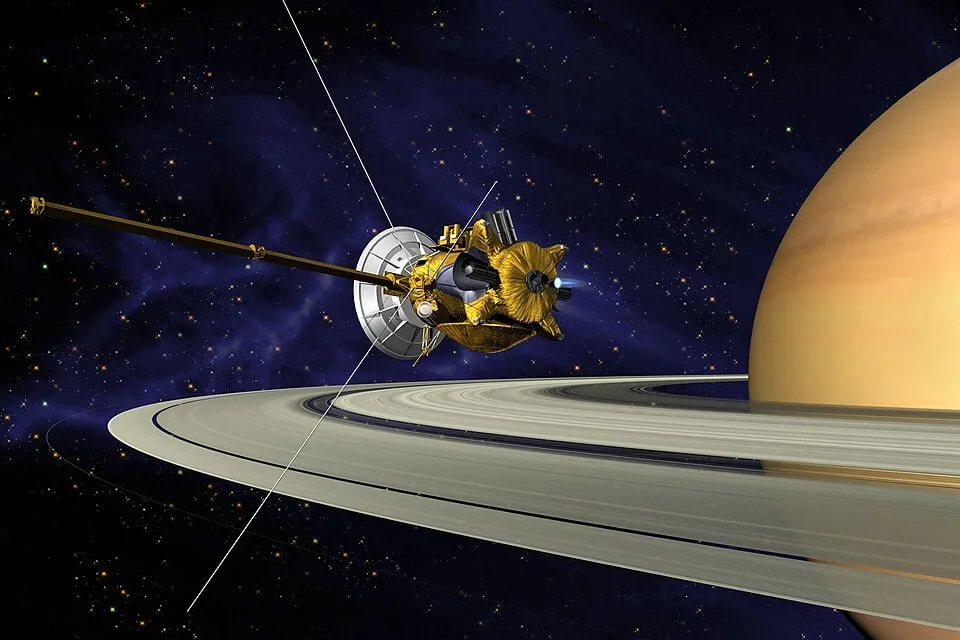
The same arithmetic is why Cassini looped through Venus — twice — and past Earth and past Jupiter before heading outward to Saturn: not the scenic route, but the cheap one. And why Mangalyaan, India's first interplanetary mission, reached Mars in 2014 on a budget of roughly US$74 million — a fraction of what comparable missions have cost — in part because its trajectory was designed to extract maximum value from every kilogram of its 852-kilogram propellant load, the largest single component of a spacecraft that weighed 1,340 kg on the pad. The delta-v budget was 1,350 m/s for the entire mission after escape. Every gram was accounted for.
The Oberth dividend
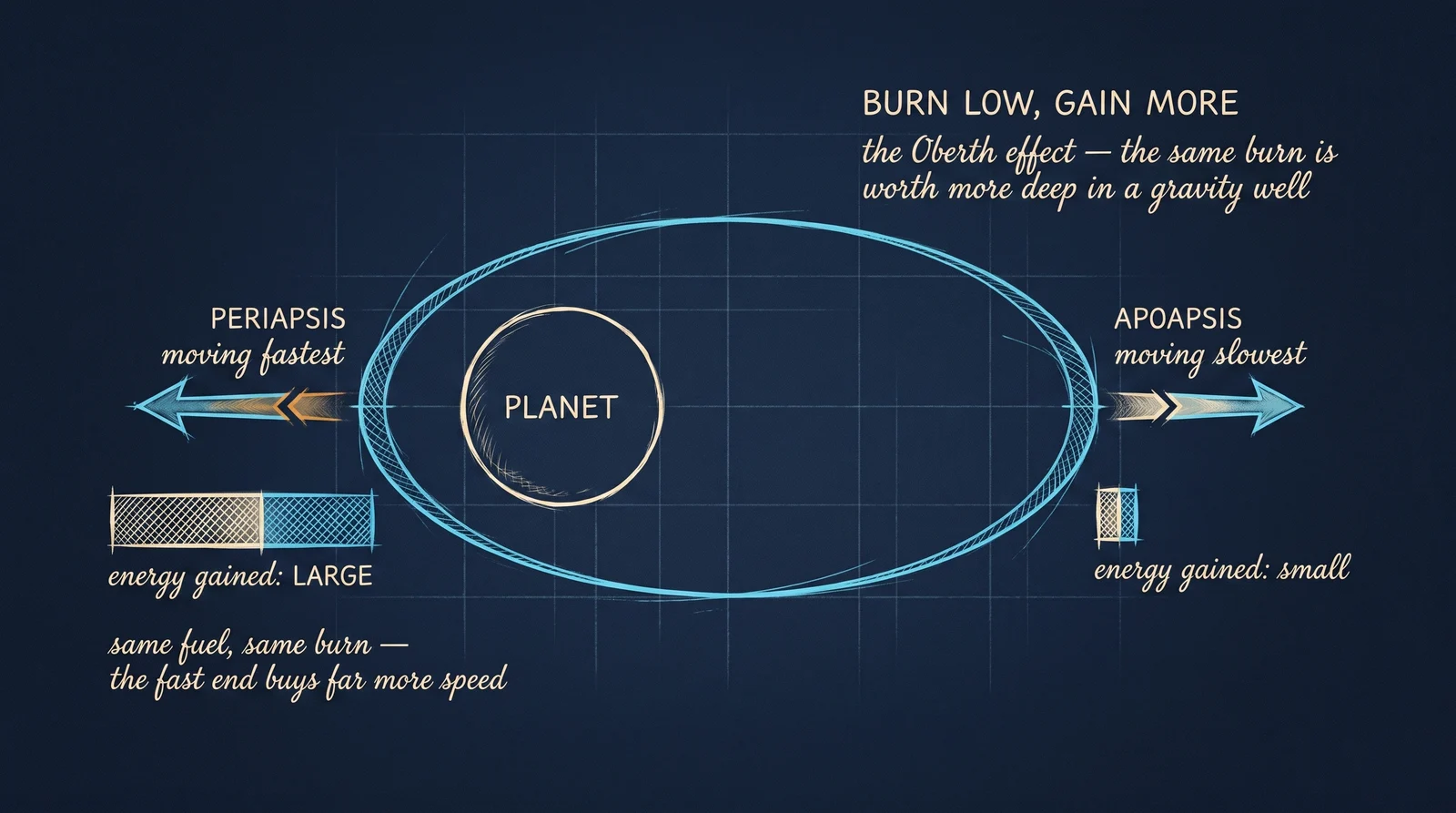
Gravity offers a second trick, subtler than the first. It was described in 1929 by Hermann Oberth, and it turns on a fact about kinetic energy that is not obvious until you write it out: energy grows as the square of velocity. A burn that adds 1 km/s at 10 km/s adds far more kinetic energy than the same burn at 1 km/s — because the work done equals force times distance, and a rocket moving fast covers more distance during the burn.
The consequence, called the Oberth effect, is that burns deep in a gravity well — at the lowest point of an orbit, periapsis, where a spacecraft is moving fastest — are drastically more efficient than burns performed at altitude. The same delta-v, spent at the right moment in the right place, delivers more final energy to the craft. Missions that can arrange to fire their engines at periapsis — arriving planets, close passes, deliberately engineered low-point maneuvers — get, in effect, a multiplier on whatever delta-v they spend. New Horizons used a Jupiter flyby not just for the gravity-assist velocity boost but timed its burn to coincide with closest approach, stacking the Oberth dividend on top of the assist. The combination shaved three years from its flight to Pluto.
These are not hacks or loopholes. They are the mathematics of moving through a gravitational landscape that, if you read it right, is not hostile to motion but is in fact riddled with chutes and ramps. The budget does not disappear — but the skilled reader of that landscape can stretch it, sometimes enormously.
What the equation erases
The delta-v budget is ruthlessly indifferent to almost everything that feels important about a mission — the science, the prestige, the geopolitics. It does not care who built the spacecraft or what flag is painted on it. It cares only about mass, exhaust velocity, and the logarithm.
This creates a discipline unlike any other in engineering. The camera added to a Mars rover, the extra redundancy in a computer, the additional science instrument a team lobbied years for — every one of them comes with a delta-v price. If the instrument is heavier than the margin allows, either something else is removed or the entire mission becomes infeasible. Mission planning is an exercise in continuous, painful arbitrage between what you want and what you can carry, and the equation is the judge of every dispute.
The budget also erases the margin for error in a way that land-based engineering rarely does. A bridge that is slightly overloaded still stands. A spacecraft that runs out of delta-v before completing orbital insertion becomes a piece of uncontrolled debris. There is no partial credit. Every mission in this atlas that succeeded did so because someone, somewhere, kept an honest accounting and never spent more than was there. The anonymous room of people who did that math — who watched the budget, checked the astrodynamics, ran the correction-burn sequences — carried every mission that ever arrived.
The reuse argument, stated plainly
For sixty years, the tyranny of the rocket equation produced a particular answer to the problem of getting to orbit: build a machine optimized for the task, burn it on the way up, throw it away. The structural mass savings from designing a single-use first stage were real, and the delta-v was real, and the math closed. The problem was that you were throwing away an engine worth tens of millions of dollars after using it once.
Landing a rocket stage and flying it again changes the denominator, but not in the way the equation predicts. Structurally, a reusable stage is slightly heavier — it needs landing legs, grid fins, thermal protection, residual propellant reserves for the return burn — which means the specific impulse advantage narrows and the mass ratio shrinks. The equation, strictly read, says reuse costs you delta-v. What the equation doesn't model is that you can fly the stage again next week, at a fraction of the cost of building a new one, which means you can afford to fly more missions, which means the budget that matters — dollars per kilogram to orbit — collapses. The delta-v logic didn't change. The economic logic that runs alongside it did.
This is the tension that has defined the last decade of launch vehicle development, and it is not yet resolved. The rocket equation still sets the hard physical floor. What changes is how much it costs to stand on it. Fly a trajectory in the atlas and watch what happens to the delta-v budget as each stage separates — the mass ratio snapshots at each cut are what the equation is actually enforcing, invisibly, on every flight.
The ledger closes
There is something clarifying about a constraint with no exceptions. The rocket equation does not yield for political reasons or budget increases or engineering heroics. Every mission that has ever left this planet — Voyager, Cassini, New Horizons, Mangalyaan — did so because someone reconciled a column of delta-v requirements against a column of what the propellant could provide, and the second number was at least as large as the first. Every mission that never left — and there have been many, killed quietly in planning — failed that test.
What the equation also does, less obviously, is make gravity precious. Not as a hazard to overcome — every rocket is burning upward against it — but as a free account. A planet's gravity well, threaded correctly, is a source. Jupiter's gravity gave Voyager 2 a velocity it could never have bought with propellant. The Oberth effect makes deep periapsis passes worth engineering deliberately. The solar system's entire orbital architecture is, from a delta-v perspective, a landscape of free refills scattered across a mostly empty map — and every trajectory you can explore here is a record of someone finding one.
Tsiolkovsky died in 1935, nine years before the first ballistic missile flew and a generation before the first spacecraft left Earth. He never saw a rocket in orbit. What he did was write down, in 1903, the grammar that every mission since has spoken — the one rule that turns the aspiration of going somewhere into the arithmetic of whether you can. Everything else is a sentence in that language. The question the atlas keeps answering, mission by mission, is how much you can say within it.
Read next
Sources & further reading
- NASA — The Tyranny of the Rocket Equation (Don Pettit, Ad Astra / NASA, 2012)
- NASA JPL — Basics of Space Flight, Ch. 4: Trajectories
- NASA — Voyager 2 Planetary Voyage (gravity assist sequence)
- Wikipedia — Tsiolkovsky Rocket Equation
- Wikipedia — Oberth Effect
- ISRO — Mars Orbiter Mission (Mangalyaan) technical details