Escape velocity — the speed that never comes back
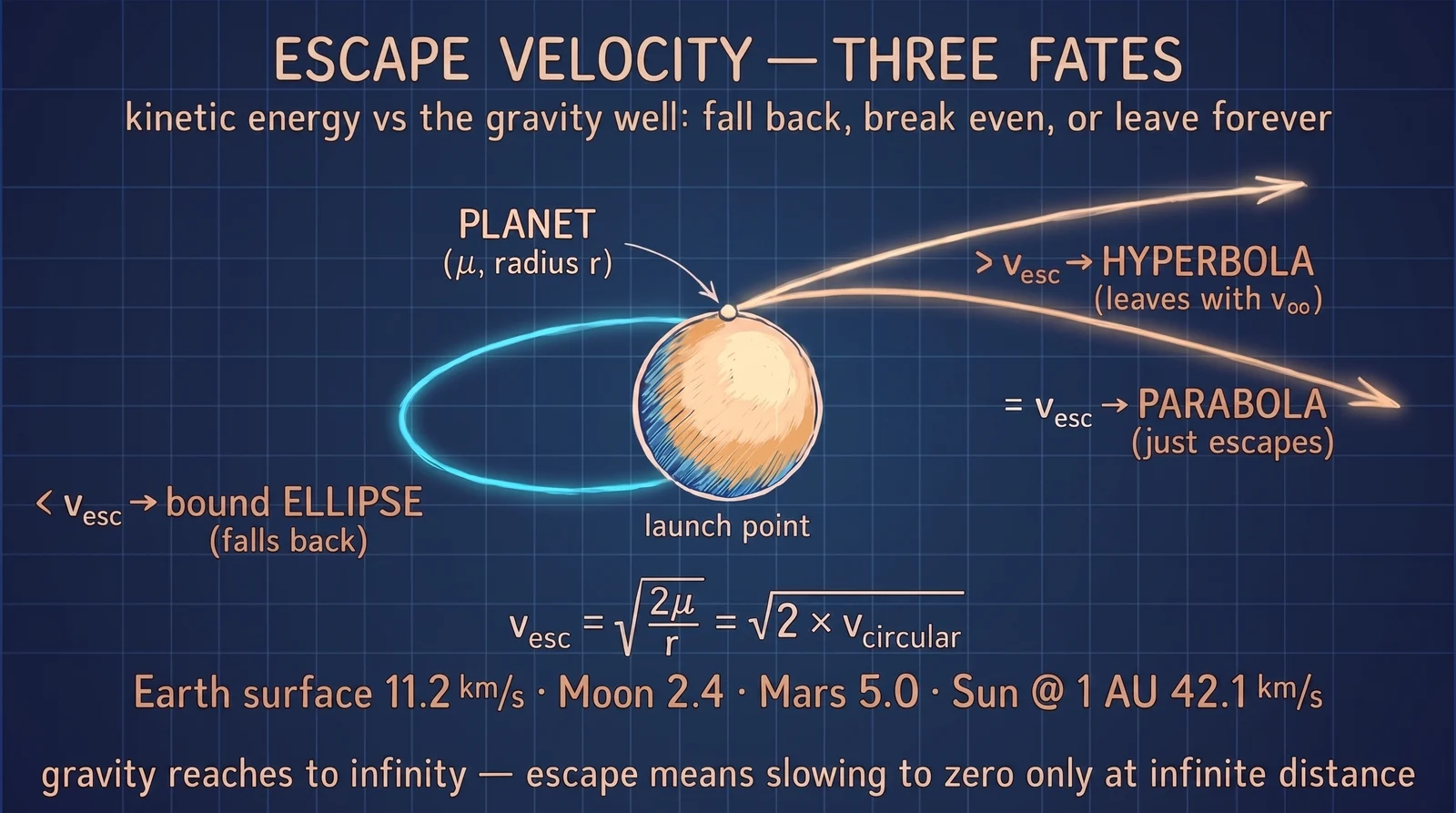
Throw anything upward fast enough and it never falls back — escape velocity is the exact speed at which a body’s kinetic energy just balances the gravity well it is climbing out of.
101 · zoom in
Gravity never quite lets go — its pull reaches to infinity, only getting weaker with distance. So "escaping" a planet does not mean outrunning gravity; it means having exactly enough energy that, as you climb and slow, you slow toward zero speed only as you reach infinite distance. Come up even a hair short and gravity eventually wins, halts you, and pulls you back. Escape velocity is the knife-edge between those two fates.
From Earth’s surface that speed is about 11.2 kilometres a second — roughly 40,000 km/h. It does not depend on which way you throw the object or how heavy it is: a pebble and a spaceship need the same speed. And it is tied to circular orbital speed by a clean factor — escape velocity is exactly the square root of two (about 1.41) times the speed of a circular orbit at the same height. Reach orbit, then go about 41% faster, and you are gone.
The number that matters for leaving the whole Solar System is bigger: escaping the Sun from Earth’s distance takes about 42 km/s. Earth already carries us around the Sun at about 30, so a probe needs only the difference — but that is still more than most chemical rockets can add on their own, which is why the craft leaving the Solar System leaned on gravity assists: decisive for Voyager and Pioneer, and an added boost for New Horizons, which the biggest launcher of its day had already flung onto an escape trajectory.
Escape velocity follows from energy conservation: set total energy (kinetic plus gravitational potential) to zero, and v_escape = √(2μ / r), where μ is the body’s gravitational parameter and r the distance from its centre. Because circular orbital speed is √(μ / r), escape velocity is exactly √2 times it — the same factor at every altitude. A trajectory launched at exactly escape speed is a parabola (orbital energy zero); above it, a hyperbola that arrives at infinity with leftover speed, the "hyperbolic excess" v∞.
The values are worth knowing: ~11.2 km/s from Earth’s surface, ~2.4 km/s from the Moon, ~5.0 km/s from Mars, ~618 km/s from the Sun’s surface, and ~42.1 km/s to escape the Sun from Earth’s 1-AU orbit. Escape speed falls with altitude (larger r), so leaving from a high orbit is cheaper than from the ground — one reason missions build up speed in stages.
Reaching solar escape is why deep-space missions lean on the Oberth effect and gravity assists. Earth’s ~30 km/s orbital motion is a free head start, but the remaining Δv to 42 km/s, applied from low Earth orbit, exceeds a chemical stage’s budget; a planetary flyby donates the rest without propellant. Escape velocity is the target the Physics Lab’s "leave the Solar System" lesson has to clear.