Special orbits — Molniya, Tundra, GTO, frozen
Beyond LEO / MEO / GEO / HEO, a handful of named special orbits do specific jobs: communications above 70° latitude, geostationary transfer, drift-free station-keeping. Each is a clever exploit of orbital mechanics.
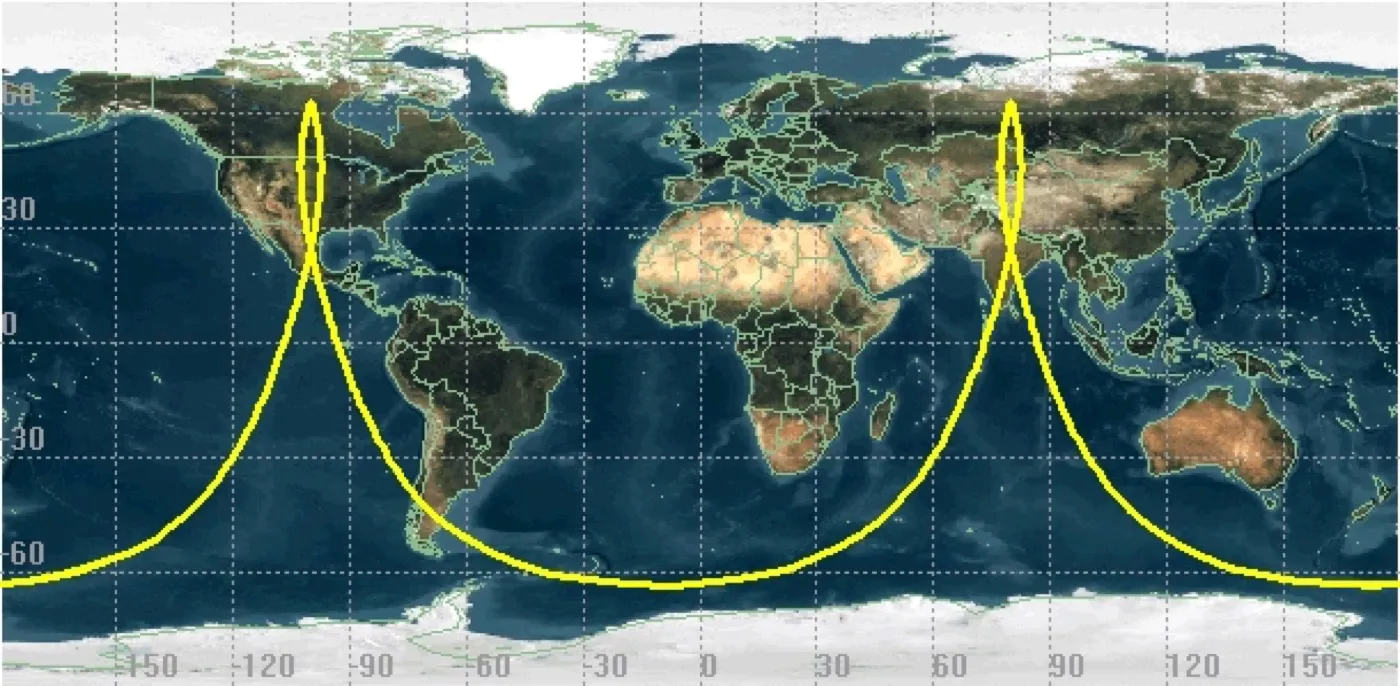
Molniya orbit (Russia, since 1965). High-eccentricity (e ≈ 0.74), low perigee (~600 km), high apogee (~40,000 km), inclination 63.4°, period exactly 12 hours. Two design decisions make it work. First, the 63.4° inclination is the 'critical inclination' at which Earth's J2 perturbation does NOT cause the line of apsides to rotate (at any other inclination the perigee drifts around the orbit over months); apogee stays locked over the northern hemisphere where you want it. Second, with a 12-hour period the satellite spends about 8 hours near apogee, slowly tracing across the northern sky, then races through perigee in 4 hours. A constellation of three Molniya satellites at staggered phase angles provides continuous coverage of latitudes north of 70°, where GEO comsats can't reach because they sit on the equator. Used by Russia for civilian phone + TV (Molniya I/II/III series), military comms (Meridian), and Oko early-warning satellites watching for US ICBM launches.
Tundra orbit. Same critical-inclination + 24-hour-period idea as Molniya but circular-leaning rather than highly eccentric (e ≈ 0.25). Apogee at GEO altitude (~35,786 km), perigee at ~25,000 km. Period exactly 24 hours so the ground track repeats once a day in a long figure-8 shape elongated over the chosen latitude band. Used by Sirius XM Satellite Radio for North American coverage (the figure-8 lets antennas in the continental US see a satellite continuously at high elevation), Russian Yamal-200 and other comsats, and US SBIRS-HEO early-warning sensors that mostly need long dwell over the Arctic. Tundra trades the higher peak elevation of Molniya for full 24-hour repeat (Molniya has two apogees per day, both over the northern hemisphere — one over Russia, one over North America, 180° apart in longitude).
Geostationary Transfer Orbit (GTO). The standard staging orbit for nearly every commercial GEO comsat. Highly elliptical: perigee at ~200-400 km LEO altitude, apogee at GEO altitude (35,786 km), inclination usually equal to the launch site's latitude (28.5° from Cape Canaveral, 5.2° from Kourou which is why Ariane launches dominate commercial GEO). The launch vehicle puts the payload onto GTO; the spacecraft then performs an apogee-kick-motor burn at apogee to circularise at GEO and zero out the inclination. The kick-motor burn is the most fuel-intensive single manoeuvre most comsats ever do — typically 1.5-1.8 km/s of ΔV, consuming most of the spacecraft's hypergolic propellant for that one event. Modern electric-propulsion comsats use weeks-long ion-thruster spiral-up from GTO to GEO instead of a chemical kick burn, trading time for ~40% more usable payload at orbit.
Frozen orbits. Orbits in which the perigee altitude does not drift over time despite the various perturbing forces (J2, J3, atmospheric drag, lunar/solar gravity). The classical frozen-orbit prescription: argument of perigee = 90° (so perigee is at the southern apex of the orbit), eccentricity matched to inclination and altitude per a J2-vs-J3 balance equation. Used by Earth-observation missions that need their imaging altitude to stay precisely fixed for years (ICESat-2 ice altimetry, GRACE-FO gravity field). The freezing is approximate — drag and third-body perturbations eventually deflect the orbit, requiring small station-keeping burns every few months — but the J2-driven drift, which would otherwise dominate, is cancelled.
Other named special orbits worth knowing: Sub-synchronous transfer orbit (SSTO — not single-stage to orbit, but a low-altitude staging orbit used by Soyuz launches to ISS); super-synchronous transfer orbit (apogee above GEO, used on some GEO launches (Ariane, Proton) to minimise inclination-change ΔV); repeat ground-track orbit (altitude tuned to integer ratio of orbit period to Earth's rotation, so the satellite passes over the same patch of ground every N days exactly — used by oceanographic missions like Jason / TOPEX-Poseidon); cislunar orbits (DRO, NRHO, halo — covered separately in /science/orbits/cislunar-orbits).
SEE IN THE APP
- /earth Molniya / Tundra markers — HEO regime — show the lopsided apogee dwell
- /fleet molniya / tundra-sirius / sbirs-heo — three operator fleets sharing the 63.4° critical-inclination HEO family (Russian Molniya 1965-now, Sirius XM Tundra 2000-now, US SBIRS-HEO 2006-now)
- /missions GTO (Geostationary Transfer Orbit) is the staging orbit nearly every commercial GEO comsat passes through