Space debris — Kessler syndrome, ASAT events, and the cleanup attempts
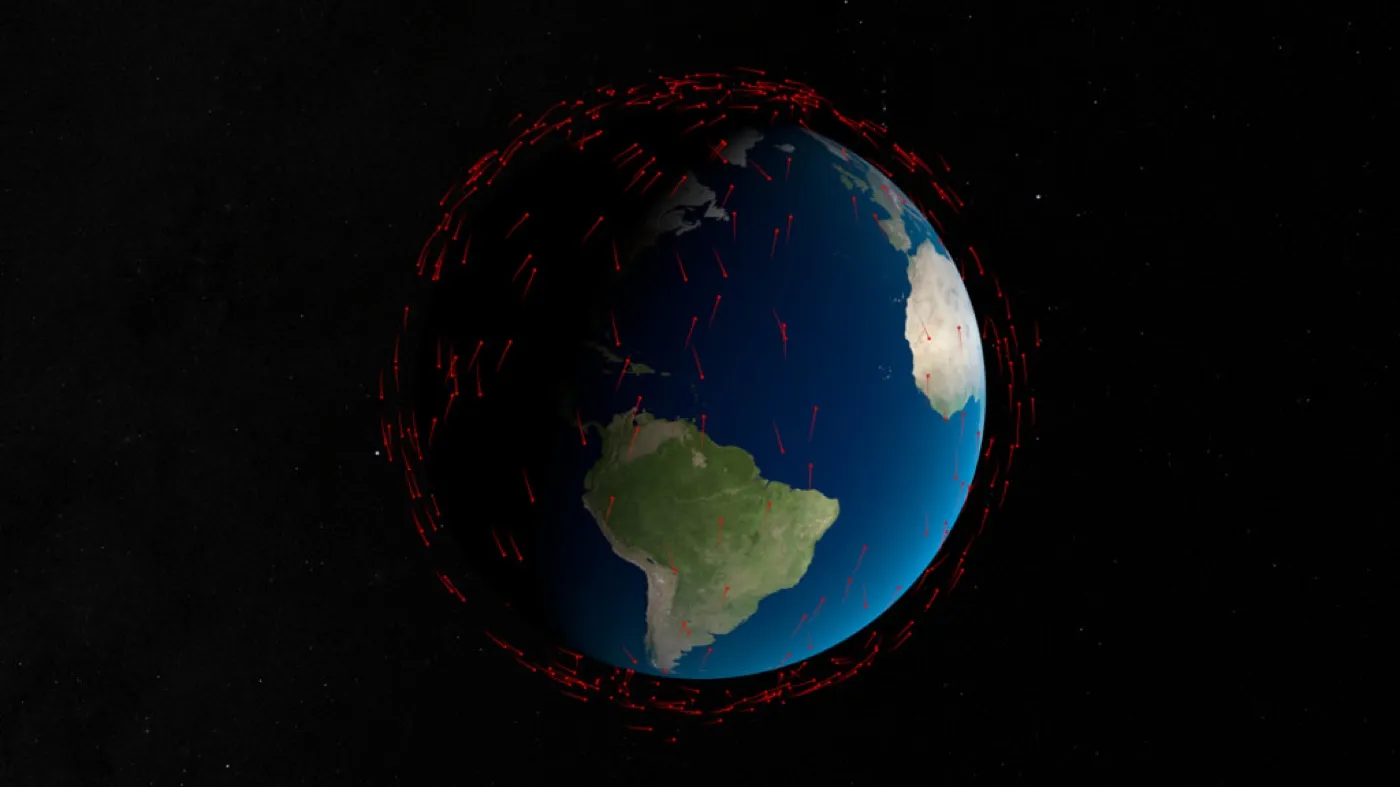
Earth orbit holds ~36,000 tracked debris objects bigger than 10 cm and an estimated 100+ million pieces smaller. Two ASAT events and one accidental collision created most of it. Cleanup is just beginning to ramp.
The numbers are blunt. ESA's Space Debris Office, NASA's Orbital Debris Program Office, and the US Space Force's 18th Space Defense Squadron maintain converging estimates of the orbital population (as of 2024-2025): ~36,000 catalogued objects with diameter ≥10 cm, of which ~9,000 are active spacecraft and the rest are debris. ~1 million pieces estimated between 1 cm and 10 cm, mostly untracked. >100 million pieces between 1 mm and 1 cm, completely untracked but individually capable of disabling a spacecraft on impact (a 1 cm aluminium fragment at 14 km/s closing speed delivers the kinetic energy of a hand grenade). Total mass in Earth orbit: roughly 11,000 tonnes. Of that, perhaps 8,000 tonnes is the debris fraction — derelicts, spent upper stages, fragments from breakups, paint flakes, rocket-engine slag.
Three events account for the majority of the trackable debris population. **Fengyun-1C** (China, January 2007): China conducted an anti-satellite weapon test against its own retired weather satellite at 865 km altitude in a deliberately polar orbit chosen to maximise debris longevity. The kinetic-kill impact fragmented the ~880 kg target into 3,500+ trackable pieces, which will largely remain in orbit for centuries. **Iridium 33 + Cosmos 2251 collision** (February 2009): the first known accidental satellite collision in history. Iridium's operational comsat collided with Russia's defunct Cosmos at 789 km altitude, generating ~2,300 trackable fragments. **Russian ASAT test** (November 2021): Russia kinetic-killed its own retired Tselina-D satellite, producing 1,500+ trackable fragments at ~480 km — close enough to ISS that the crew sheltered in their Soyuz return capsules during the first 24 hours of debris cloud encounter. Combined, these three events generated about 25% of all currently catalogued LEO debris.
Kessler syndrome is the runaway-cascade scenario, named after NASA's Donald Kessler who modelled it in 1978. Once the LEO debris density passes a critical threshold, each collision generates enough new fragments to cause further collisions, and the cascade can take centuries to play out. Above that threshold, the LEO environment effectively becomes inaccessible — even careful launches can't avoid being hit on the way through. The 1978 Kessler model put the critical threshold at roughly 5× the 1978 population; current LEO is approaching that threshold in some altitude shells (especially 750-1000 km, which has the highest collision-cross-section density). The IADC's current operating assumption is that without continued aggressive disposal, certain LEO altitude bands will reach Kessler-critical densities by 2050-2080.
Tracking infrastructure. The US Space Force's Space Surveillance Network (SSN) is the world's primary catalogue source — a fleet of ~30 ground-based radars + telescopes worldwide (Eglin FPS-85 phased-array in Florida, Globus II in Norway, Maui Space Surveillance Site in Hawaii) plus the Space Based Space Surveillance satellite. The SSN tracks every object ≥10 cm in LEO and ≥1 m in GEO, with daily orbit updates publicly available via Space-Track.org. Private competitors (LeoLabs, with its own phased-array radar network at six sites globally, since 2018) and partners (EU Space Surveillance and Tracking consortium, since 2014; China's SSA network at Xinjiang since the 2010s) have added redundant tracking — pre-2010 the world had effectively a single point of failure in SSN.
Cleanup + daily-ops mitigation. Active Debris Removal (ADR) — missions that visit dead spacecraft and deorbit them — is starting to ramp. **ELSA-d** (Astroscale, 2021) demonstrated magnetic-grapple docking. **ClearSpace-1** (ESA, scheduled 2026) will deorbit a ~100 kg Vega Secondary Payload Adapter from 660 km. **ELSA-M** (Astroscale-Japan, 2025-26) and the US National Reconnaissance Office's classified Salvage Series follow. ESA's own analysis suggests removing 5 major LEO objects per year is the minimum to halt growth; current cadence is ~0/year — the Kessler clock is running. Meanwhile, every operator does Conjunction Assessment Risk Avoidance (CARA): SSN publishes daily conjunction warnings 7 days ahead of close approaches within ~1 km. ISS needs only a few avoidance burns a year (32 from 1999 to 2022); Starlink's autonomous system performed over 355,000 across the constellation from June 2025 to May 2026; Tiangong does several per year. Hubble (no propulsion) has been hit by small debris dozens of times and was nearly hit by a Cosmos-1408 fragment in November 2021. Operational debris-avoidance burden is rising fast.
SEE IN THE APP
LEARN MORE
- intro Wikipedia · Space debris
- core ESA Space Debris Office · Annual environment report
- core NASA Orbital Debris Program Office
- core Wikipedia · Kessler syndrome
- deep Wikipedia · 2009 satellite collision (Iridium 33 / Cosmos 2251)
- deep Wikipedia · 2007 Chinese anti-satellite missile test (Fengyun-1C)
- deep ESA · ClearSpace-1 active debris removal mission