End-of-life disposal — graveyard orbits, controlled deorbit, the 25-year rule
Every satellite must have an end-of-life disposal plan to launch — either deorbit into the atmosphere, or boost to a stable graveyard orbit. Mismanaged disposal is what produces the orbital-debris problem covered in the next article.
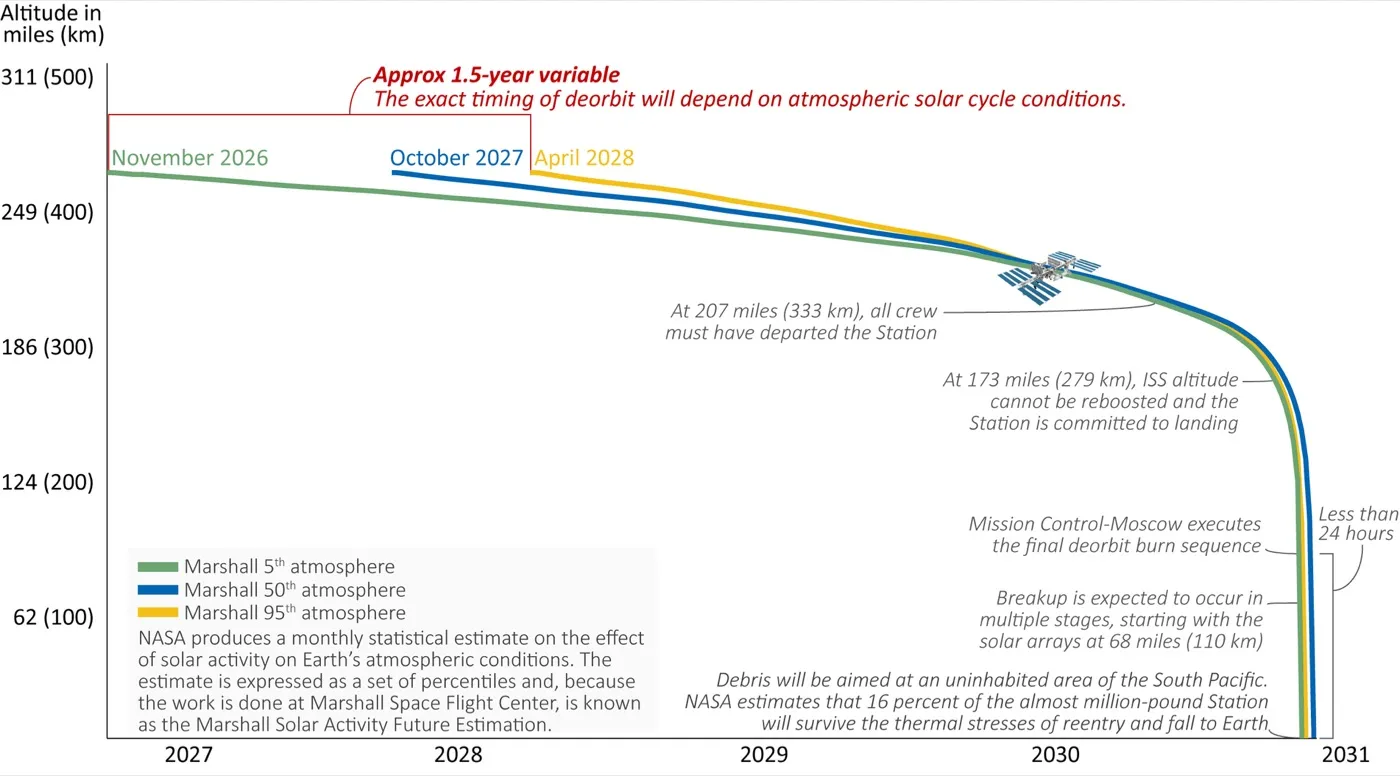
LEO disposal: deorbit. Spacecraft in LEO are dragged down by residual atmospheric density (negligible per orbit, accumulative over years). A satellite at 400 km decays naturally within a year if propulsion fails; at 800 km the natural decay time is ~50 years; at 1500 km it's centuries. The international standard codified by the IADC (Inter-Agency Space Debris Coordination Committee) in 2002 and adopted by every spacefaring nation: LEO objects must be deorbited within 25 years of end of mission. The FCC tightened this for US-licensed satellites to 5 years in 2022. Mechanism: at end of life, the spacecraft uses its remaining propellant to lower perigee into the upper atmosphere (typically 200-300 km perigee), guaranteeing rapid drag-driven decay within months. Large objects (ISS modules, Hubble, retired LEO comsats) are targeted at SPOUA — the South Pacific Ocean Uninhabited Area, a remote stretch of open ocean centred near Point Nemo, the official 'spacecraft cemetery' since the Soviet Salyut deorbits in the 1970s. Mir was deorbited there in 2001 (130 tonnes); the ISS is scheduled for controlled deorbit there in 2031.
GEO disposal: graveyard orbit. GEO satellites can't be economically deorbited because the ΔV cost to drop from GEO (35,786 km) to Earth-impact is enormous (~1.5 km/s) and the satellite would still have to plough through the dense LEO debris belt on the way down. Instead, IADC guidelines (and most national regulators) require GEO operators to boost their spacecraft into a 'graveyard orbit' at least 235 km above GEO before exhausting station-keeping propellant. The 235 km figure combines a 200 km buffer above the protected GEO region with ~35 km of perigee drop a derelict can undergo from luni-solar gravity and Earth's oblateness; solar-radiation-pressure effects, which scale with a satellite's area-to-mass ratio, are added on top via the IADC formula. Boosting clear of that combined altitude guarantees the dead satellite won't drift back into the GEO ring. Each graveyard boost typically consumes 5-10 kg of propellant, equivalent to several months of station-keeping margin. Operators that fail to perform the graveyard burn (typically because the satellite died too quickly to spare the fuel) leave a derelict in or near GEO that will menace operational comsats for the indefinite future — the so-called 'GEO graveyard derelicts'.
MEO and HEO disposal. Harder cases than either LEO or GEO. MEO navigation constellations (GPS, Galileo, GLONASS, BeiDou MEO) at ~20,000 km have very long natural decay times (thousands of years) and no convenient graveyard equivalent above; the current practice is to leave retired satellites in their operational orbit and rely on careful constellation phasing to avoid collisions. As MEO populations grow this is becoming a known forward-looking problem. HEO (Molniya, Tundra) satellites typically have a perigee low enough that atmospheric drag will eventually deorbit them — Molniya satellites with 600 km perigee decay within decades. Higher-perigee HEOs need explicit deorbit burns.
Cislunar disposal. No formal regulations yet, but emerging practice for Artemis-era spacecraft: end-of-life Lunar Reconnaissance Orbiter, Chang'e-1, Chandrayaan-1 all eventually impacted the lunar surface (sometimes deliberately for science — LCROSS impacted Cabeus to look for water; sometimes incidentally from station-keeping exhaustion). The Lunar Gateway's planned disposal at end of life is controlled deorbit into the lunar surface, similar to Mir's SPOUA disposal but on the Moon. Several proposals exist for parking retired cislunar assets at Earth-Moon L4 / L5, which are extremely stable and would tolerate derelict satellites indefinitely — but this hasn't been formalised in international agreement.
Disposal is no longer optional. Until ~2015, end-of-life disposal was technically required but laxly enforced. Multiple regulatory shifts since then have changed the calculus: FCC's 5-year LEO rule (2022) requires all US-licensed satellites to deorbit within 5 years of mission end; ESA's Zero Debris Charter (2023) commits signatories to leave no debris in orbit; the UN's Long-Term Sustainability Guidelines (2019) make disposal a precondition for licensing. Modern satellite designs now include disposal propellant as a hard mass-budget item, with margin reservation enforced by mission-design reviews. The orbital-debris article covers what happens when disposal fails.