Cislunar orbits — DRO, NRHO, halo, lunar frozen
Between Earth and the Moon's surface lies a zoo of carefully-engineered orbits — none of them obvious from two-body physics, all of them exploited by the modern lunar architecture from Gateway to robotic probes.
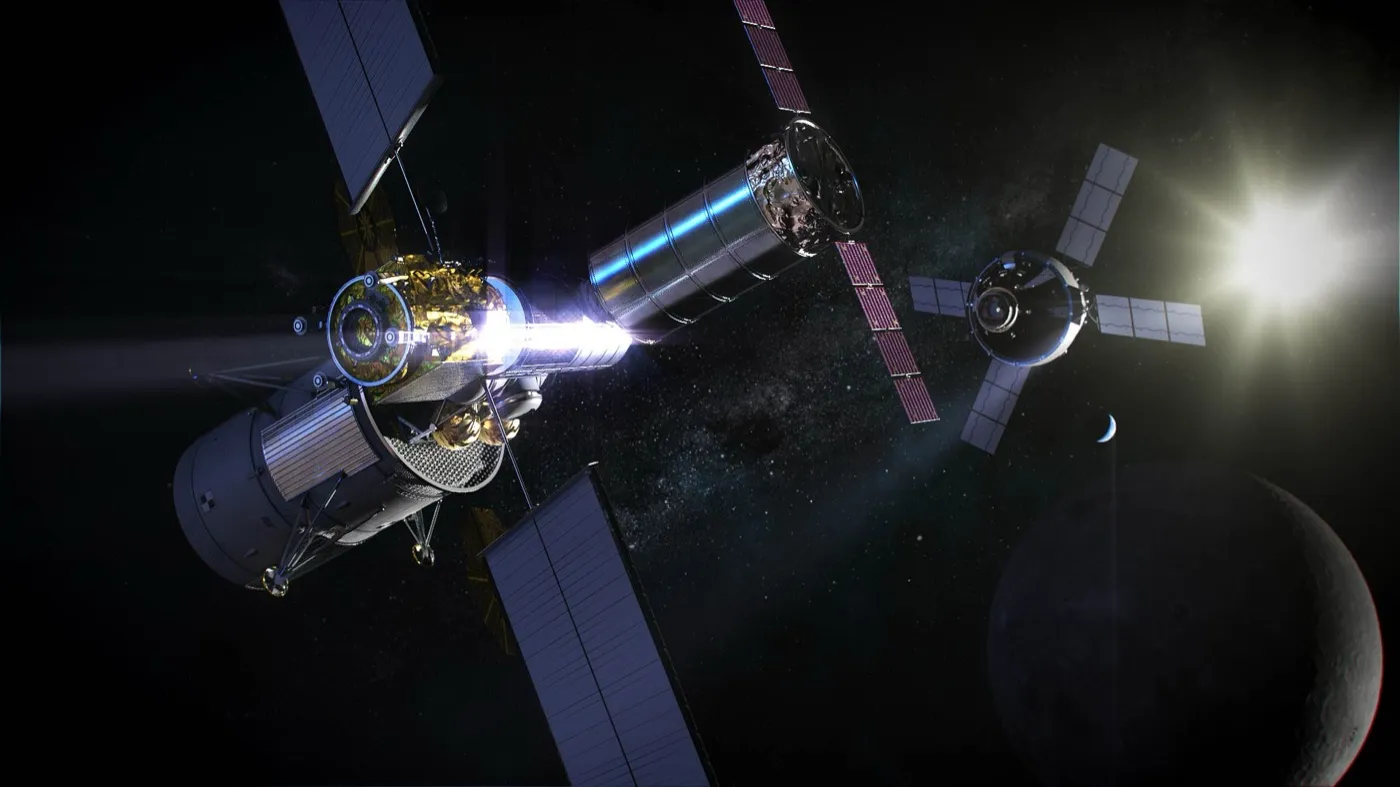
Near-Rectilinear Halo Orbit (NRHO) is the orbit class NASA chose for the Lunar Gateway. Geometrically: a six-day-period halo orbit around the Earth-Moon L2 Lagrange point, with perilune ≈1,500 km altitude (perilune radius ~3,200 km) over the lunar north pole and apolune ≈70,000 km over the lunar south pole. The 'near-rectilinear' name comes from the orbit's shape in the Earth-Moon rotating frame — it sweeps a long, narrow loop perpendicular to the Earth-Moon line, almost like a rectangle. Three properties made it the winning choice for Gateway. First, station-keeping ΔV is extraordinarily low (~5 m/s/year) compared to lunar low orbits (>100 m/s/year). Second, Earth communication is unobstructed because the orbit stays out of the Moon's radio shadow. Third, the long dwell near apolune over the south pole gives near-continuous coverage of the Artemis south-polar sites at Shackleton crater rim. The trade is that descent from NRHO to lunar surface is harder than from a low circular lunar orbit (~2.5 km/s vs ~1.8 km/s) — but for a programme that needs an enduring staging point, the trade is worth it.
Distant Retrograde Orbit (DRO). A large, circular-leaning orbit around the Moon in retrograde direction relative to the Moon's orbit around Earth. Distance: typically 60,000-80,000 km from the Moon. The retrograde motion plus the large radius makes DROs unusually stable — there's no station-keeping ΔV required (essentially zero, on multi-year timescales), because the orbit exploits a quirk of the three-body problem where the Earth's gravity acts as a restoring force when the spacecraft tries to drift. The Artemis-1 Orion (uncrewed flight test, November 2022) inserted into a DRO around the Moon for a 6-day stay before returning to Earth, demonstrating both the manoeuvre stack and the orbit's stability. DROs are the long-term-storage parking orbit of choice for cislunar architecture — you can park a propellant depot or a backup vehicle there and not worry about it drifting for years.
Halo orbits at EML1 and EML2. Halo orbits are periodic 3-D families around the collinear Lagrange points (L1, L2, L3) — and around the Sun-Earth collinear points too (JWST, Gaia, Euclid all sit in Sun-Earth L2 halos). EML1 halos (between Earth and Moon) are useful for lunar gateway concepts that need continuous Earth visibility from the front side. EML2 halos (beyond the Moon from Earth's perspective) are useful for far-side observation; the proposed Lunar Crater Radio Telescope and the Chinese Queqiao relay satellite (supporting Chang'e-4 farside landing) both used variations on EML2 halo orbits. Compared to NRHO, traditional halos require more station-keeping ΔV but offer geometrically simpler orbits.
Lunar frozen orbits. The Moon's gravity field is highly non-spherical because its crust is uneven (mascons — mass concentrations under the maria) and the Moon has no atmosphere to damp orbital perturbations. A satellite in a circular low lunar orbit at most inclinations will see its orbit get progressively more eccentric over months until it crashes into the surface. Lunar Prospector (1999) was deliberately deorbited at end of mission because mission planners couldn't keep it stable. The 'frozen' lunar inclinations — 27°, 50°, 76°, and 86° — are the ones where the various perturbations cancel and a satellite can stay in approximate circular orbit for years without station-keeping. The Lunar Reconnaissance Orbiter (LRO, 2009-) uses a near-frozen polar orbit at ~50 km altitude that requires only modest station-keeping. The Chinese Queqiao-2 relay satellite (2024) uses a frozen elliptical orbit at L2.
Why this matters operationally. The 1960s-style 'circular lunar orbit at 100 km' approach used by Apollo Command Modules was acceptable because crews were only there for days and re-entry was guaranteed. Modern multi-mission cislunar architecture (Artemis, ILRS, multiple crewed and robotic missions over decades) demands orbits that are cheap to maintain and don't require constant attention. NRHO + DRO + frozen lunar are the carefully-engineered solutions to that constraint. The 'cislunar economy' (DARPA's term for the projected commercial activity in Earth-Moon space) lives or dies by these orbital choices — and 5 m/s/year station-keeping vs 100 m/s/year is the difference between a viable commercial venture and a money pit.