The Magellanic Clouds — LMC and SMC, our nearest galactic neighbours
The Large and Small Magellanic Clouds are the closest galaxies large enough to see with the naked eye — irregular dwarf galaxies trailing the Milky Way's south-galactic pole, ~50 and ~62 kpc away.
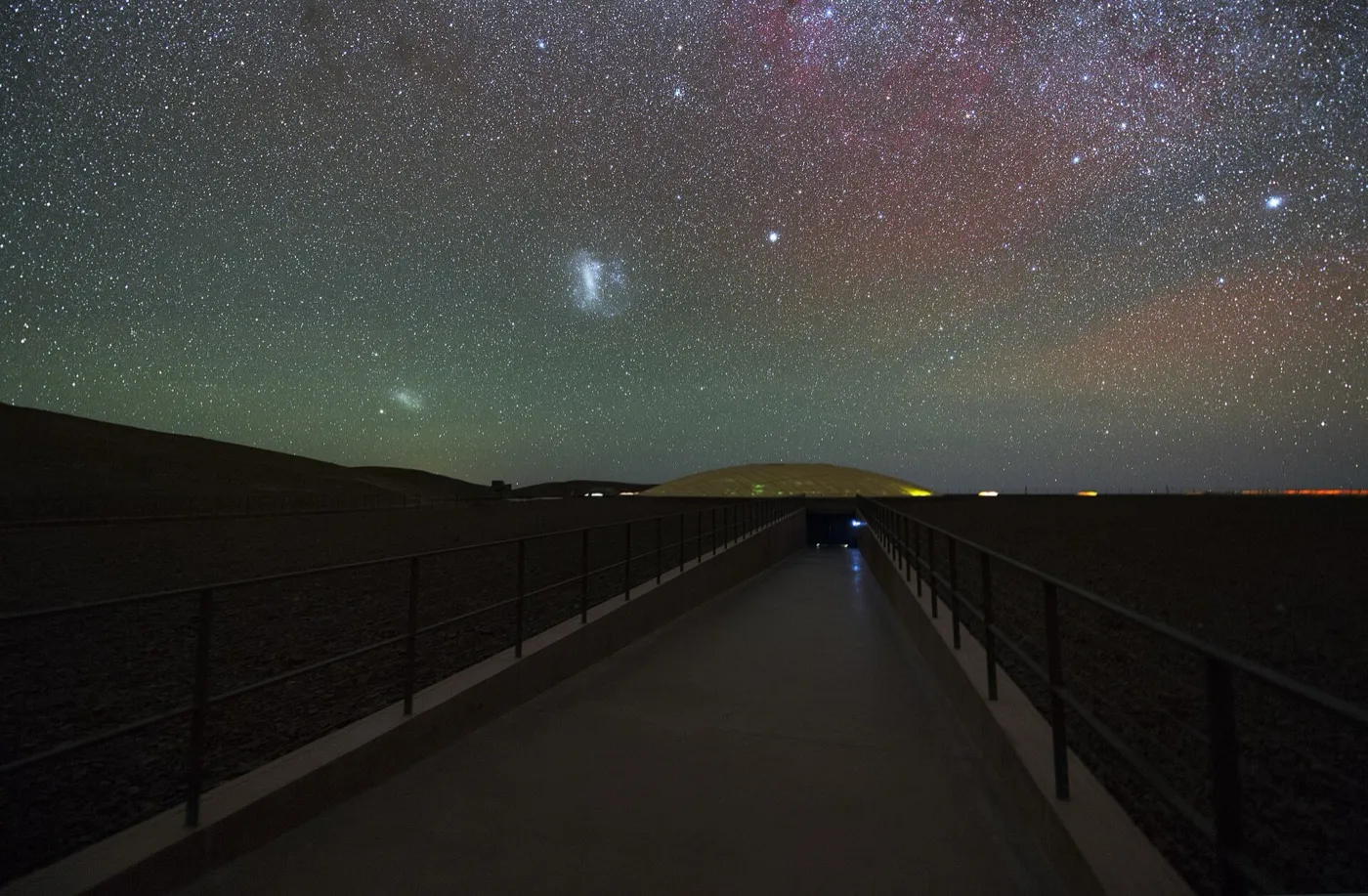
The Magellanic Clouds dominate the southern hemisphere sky from any reasonably dark site below about +20° latitude. They look exactly as they sound — two detached fuzzy patches in the night sky, the LMC about 5° across and the SMC about 3°. They are catalogued under several names, but Magellanic comes from Ferdinand Magellan's 1519-1522 circumnavigation, during which the clouds were the most reliable navigation reference his crew had in the South Atlantic. The clouds have been continuously observed by humanity for as long as humans have lived in the southern hemisphere; rock art and oral traditions from Aboriginal Australia, the Khoisan, and Andean cultures reference them by name in ways that long predate European contact.
Both are irregular galaxies rather than spirals — chaotic, dust-rich, actively forming stars. The LMC has about 10 billion solar masses (about 1% of the Milky Way), the SMC about a tenth of that. The LMC hosts the Tarantula Nebula (30 Doradus), one of the most prolific star-formation regions in the Local Group and the site of supernova 1987A — the brightest supernova since Kepler's in 1604 and the first visible to the naked eye since SN 1885A in Andromeda, and the first supernova whose neutrinos were detected (Kamiokande, IMB, Baksan detectors caught about 25 neutrinos within seconds of each other, hours before the optical light arrived). The Tarantula's central star cluster R136 contains some of the most massive known stars (R136a1 is around 200 solar masses).
Until recently it was assumed the Clouds were long-term gravitationally-bound satellites of the Milky Way, on bound orbits that had taken them around our galaxy multiple times. Hubble Space Telescope proper-motion measurements (Kallivayalil et al. 2013, refined with Gaia DR2/DR3) overturned this picture: the Clouds are moving too fast to be bound on a long-term orbit, suggesting they are on first-passage — falling in toward the Milky Way for the first time from the Local Group's outer regions, having only recently arrived in the last ~1-2 Gyr. This re-frames a great deal of Magellanic Cloud research: their star-formation histories, their gas content (the Magellanic Stream — a vast hydrogen tail trailing behind them — was being torn out by Milky Way tides during the recent close passage), and their long-term fate (probably eventual merger with the Milky Way, but on Gyr timescales).
Observing the Clouds requires being in or visiting the southern hemisphere. From mid-southern latitudes (Sydney, Cape Town, Santiago, Auckland) they are circumpolar — never set, visible every clear night. From the equator they rise low in the south during southern summer. From the northern hemisphere they are invisible: even from Hawaii at 19°N latitude, the SMC barely clears the horizon. Astronomers historically had to travel south to study them — the major southern observatories at Cerro Pachón, Paranal, La Silla, Sutherland, and Siding Spring were sited specifically to give continuous access to the Magellanic Clouds plus the galactic centre. The Vera C. Rubin Observatory at Cerro Pachón, which started science operations in 2025, will image the LMC and SMC every few nights for the duration of its decade-long LSST survey.
SEE IN THE APP
- /explore LMC + SMC sprites in the Local Group overlay, clickable, deep-link here