Galaxy types — spirals, ellipticals, irregulars, dwarfs
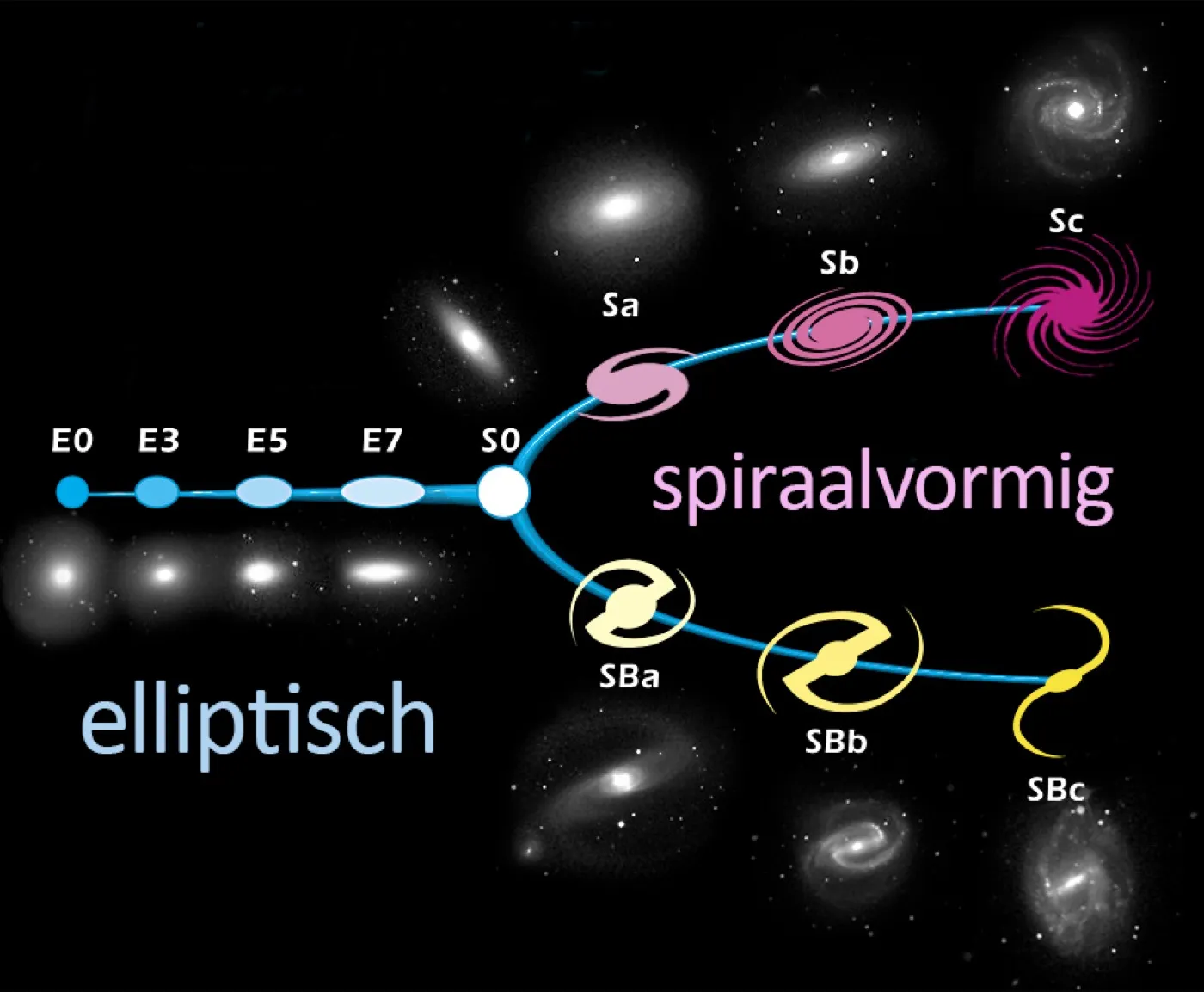
Galaxies fall into a handful of structural families: spirals (Milky Way, Andromeda), ellipticals (M87, NGC 4889), irregulars (Magellanic Clouds), and dwarfs of several sub-classes. The taxonomy is Hubble's 1936 framework, refined.
Spiral galaxies are flat rotating discs of stars and gas surrounding a central bulge, with one or more prominent spiral arms wrapping outward. The arms are not rigid structures — they are density waves where star formation is currently elevated, plus young blue stars and pink HII regions that make the arms look brighter than the inter-arm disc. About two-thirds of bright nearby galaxies are spirals. The Milky Way is a barred spiral (SBbc — its central bulge is elongated into a bar 'cigar' shape that funnels gas inward, fuelling central star formation and feeding the supermassive black hole). Andromeda's bar status is unsettled: the formal RC3 classification is SA(s)b (unbarred), though kinematic and photometric studies point to a weak inner non-axisymmetry. The Triangulum Galaxy M33 in the Local Group is an unbarred spiral. The third Hubble category — Sc / SBc — has loose, well-separated spiral arms; the Milky Way is type SBbc or SBc.
Elliptical galaxies are dispersion-supported balls of mostly old stars with little gas, little dust, and almost no ongoing star formation. They range from small (M32, the compact dwarf elliptical companion to Andromeda) to enormous (M87 at the heart of the Virgo Cluster, the host of the first imaged supermassive black hole; cD-class brightest cluster galaxies like NGC 4889 in Coma which contain trillions of stars). Most ellipticals are the products of past major mergers — when two spirals collide, the disc structure is disrupted, gas is consumed in a starburst, and the merged remnant settles into an elliptical. The Milky Way is destined to become an elliptical once it merges with Andromeda. There are essentially no ellipticals in the Local Group except M32, M110, NGC 147, and NGC 185 — small companions to M31. The big ellipticals all live in dense cluster environments.
Irregulars are everything that doesn't fit. The Magellanic Clouds are the prototypes — gas-rich, actively star-forming, no clear spiral arms or central bulge, often elongated or distorted by tidal interactions with larger neighbours. Most low-mass star-forming galaxies are irregular. Many were once classified as spiral-like but have been so tidally disrupted that the structure is no longer recognisable; others are too small to have ever developed a self-supporting disc. Irregulars dominate the count of galaxies at the low-mass end of the galactic mass function — there are far more dwarf irregulars than spirals, but they are individually faint so spirals dominate the night sky and the historical record.
Dwarf galaxies subdivide further. Dwarf spheroidals (Sagittarius, Fornax, Sculptor) — gas-poor, ~elliptical, dark-matter-dominated, see the separate /science article. Dwarf irregulars (NGC 6822, IC 1613, WLM in the Local Group) — gas-rich, star-forming, no defined morphology. Dwarf ellipticals (M32 is the type example) — small versions of large ellipticals, often companions to large galaxies. Ultra-faint dwarfs — discovered only since 2005 via deep SDSS / DES / LSST surveys, with luminosities below 10⁵ solar luminosities and stellar masses comparable to a single globular cluster but with mass-to-light ratios in the hundreds (i.e., still dominated by dark matter, not by stars). These ultra-faints are probably the dimmest galaxies in existence — at lower masses, no galaxy is detectable because there are no stars at all, only dark-matter halos.
Beyond the Hubble framework. Modern surveys have added several galaxy types that didn't fit Hubble's 1936 scheme: starburst galaxies (M82) where star formation is many times higher than normal due to a recent merger or tidal interaction; AGN-hosting galaxies (Seyferts, quasars, radio galaxies) where the central black hole is actively accreting and dominating the light output; ring galaxies (Hoag's Object) formed by head-on bullet-collisions; and the ultra-diffuse galaxies (NGC 1052-DF2, Dragonfly 44) discovered in the 2010s, with sizes of full-sized galaxies but stellar densities so low you can almost see through them. The classification scheme keeps being extended as observations improve; Hubble's tuning fork remains the backbone of how astronomers talk about morphology, even when individual galaxies refuse to fit.
SEE IN THE APP
- /explore All Local Group sprites are labelled by type (spiral, irregular, dwarf-spheroidal) — this article explains what each type is