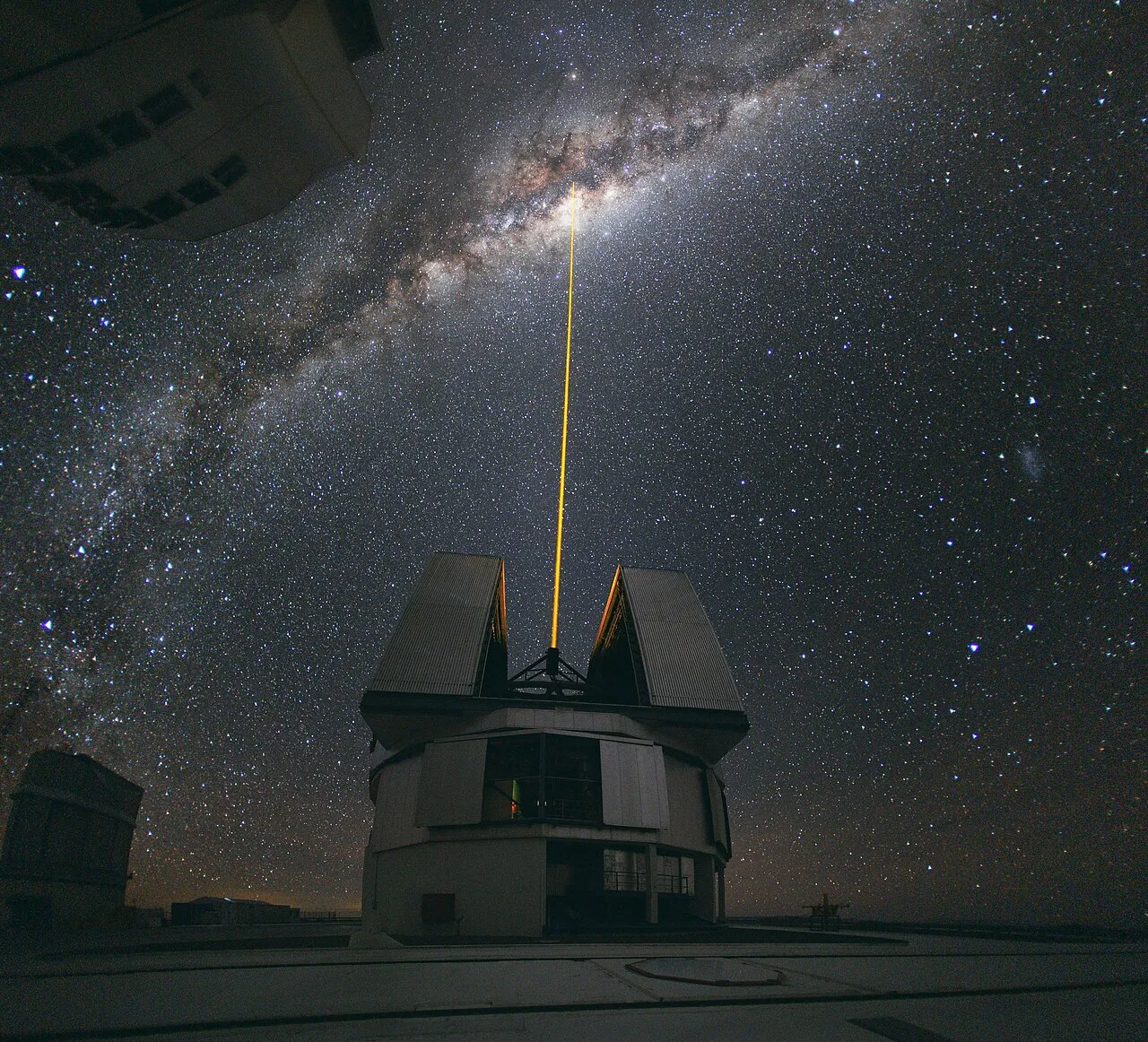
Adaptive optics
Ground-based telescopes measure the atmosphere's distortion in real time with a laser guide star, then bend a deformable mirror to cancel it out — sharpening images by a factor of 10 or more.
Earth's atmosphere is a mess of moving cells of warm and cold air, each cell with a slightly different refractive index. Starlight passing through gets jumbled — that's why stars twinkle and why a 10-metre ground telescope without correction sees no better than a backyard 20 cm scope on a steady night. The atmospheric "seeing" limit is around 1 arcsecond. Hubble's diffraction limit is 0.05.
Adaptive optics closes that gap by measuring the distortion at hundreds of points across the aperture and counter-bending a deformable mirror — often a thin glass with hundreds of piezoelectric actuators behind it — at 1000 Hz. The reference for "what perfect should look like" is either a bright natural star near the science target (rare to have one close enough) or a **laser guide star**: a sodium-resonance laser fired into the upper atmosphere to make an artificial glow at the right altitude.
Keck, VLT, Gemini, Subaru, and the upcoming ELTs all rely on AO. The technique is what made ground-based exoplanet imaging possible — without it, the host star's PSF would drown the planet's signal. JWST and Hubble are in space partly to skip AO entirely; ground-based AO is the alternative when the atmosphere is the only obstacle and the budget can't fund a launch.
AO doesn't work at every wavelength: visible-light AO is harder than infrared because the atmosphere's coherence time is shorter at short wavelengths. The longest-wavelength bands (mid-IR, sub-mm) can be done from the ground with AO and rival space telescopes. Optical/UV remains a strong case for space.