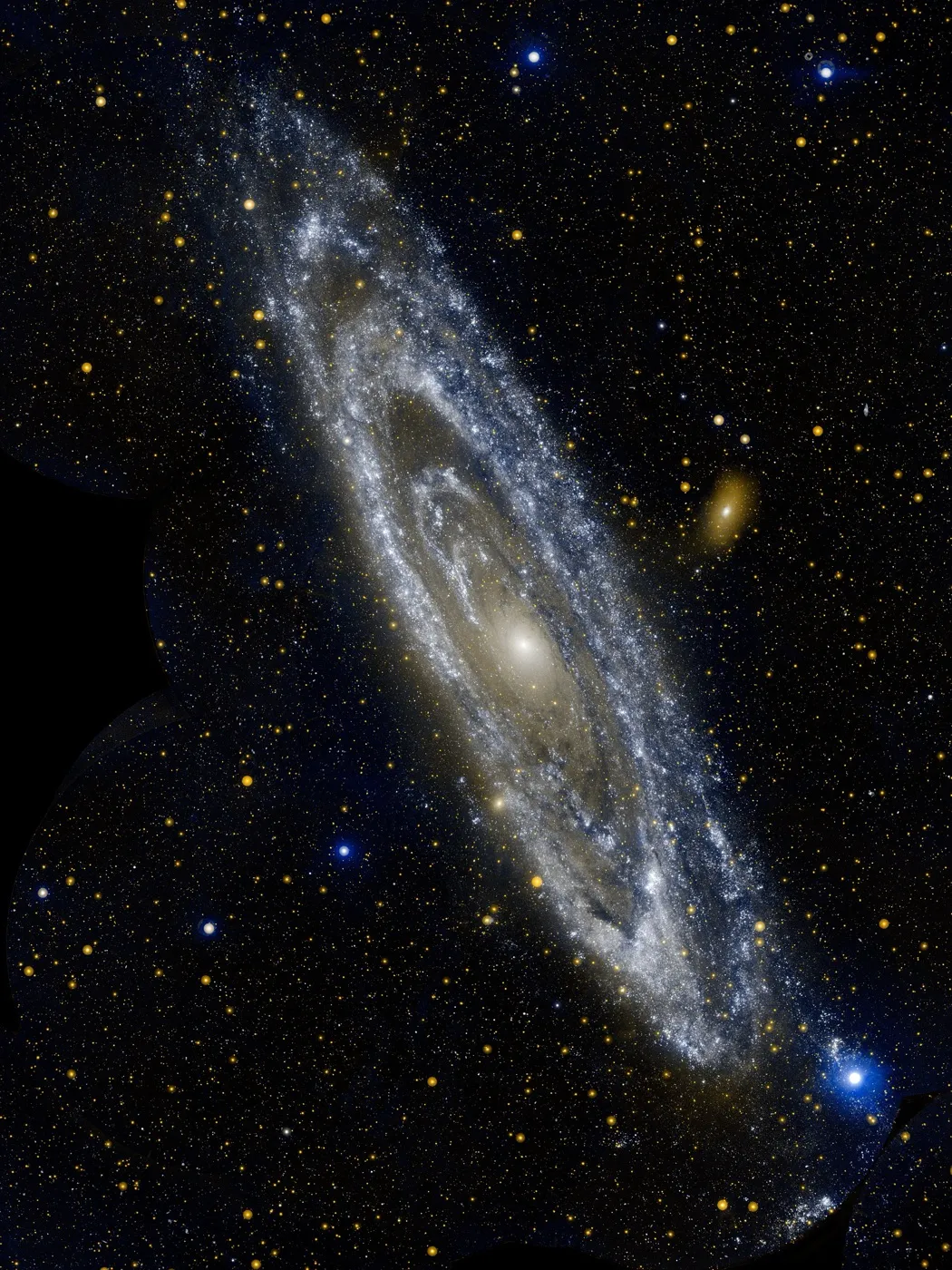
Andromeda Galaxy (M31) — the closest large spiral
Andromeda is the closest large galaxy to the Milky Way at 2.5 million light-years. One of the most distant objects the naked eye can see, it is approaching us at 110 km/s — and may collide with the Milky Way in several billion years.
Andromeda — catalogued as M31 (Messier 31) and NGC 224 — is a spiral galaxy (formally classified SA(s)b — unbarred, though kinematic evidence points to a weak inner bar) slightly larger than the Milky Way. Mass estimates from Gaia DR3 stellar dynamics put it at about 1.5 × 10¹² solar masses, comparable to or slightly more massive than the Milky Way. It hosts an estimated trillion stars, has a structurally similar central bar and disc, two prominent spiral arms, and a quiescent supermassive black hole at its centre (M31's nucleus is a 1.4 × 10⁸ solar-mass black hole; the Milky Way's Sagittarius A* is 'only' 4.3 × 10⁶ solar masses). To the naked eye from a dark site, Andromeda is a small smudge in the constellation that gives it its name — one of the most distant objects the human eye can perceive without instruments, at about 2.5 million light-years. The light arriving on Earth tonight left Andromeda when Homo habilis was first making stone tools.
Andromeda is approaching the Milky Way at 110 km/s in the radial direction. This was known from Doppler-shift measurements since Vesto Slipher's 1912 work at Lowell Observatory — Andromeda was the first galaxy ever measured to have a blueshift (most galaxies are receding due to cosmic expansion; Andromeda's mutual gravitation with the Milky Way overrides the Hubble flow at our distance). Until Hubble Space Telescope's high-precision proper-motion measurements in 2012, it was unclear whether Andromeda's transverse velocity would steer it past us or into us. HST measurements (2012) and Gaia DR2/DR3 (2019) suggested a near-head-on trajectory. However, a 2024 analysis by Sawala et al. (Nature Astronomy, 2025) — one of the first to include M33 and the LMC in the orbit integration — found only roughly even odds of a merger within the next 10 Gyr, with less than a 2% chance within the originally predicted ~4–5 Gyr window. If the merger does happen, tidal disruption would begin around 4.5 billion years from now, with the central coalescence taking another ~2 billion years to settle into an elliptical remnant nicknamed 'Milkomeda'.
Andromeda has its own satellite system. The most prominent members are M32 (a compact elliptical companion, possibly the stripped core of a once-larger galaxy disrupted by tidal interaction with M31), M110 (a dwarf elliptical companion), and a population of about 20 known dwarf spheroidals and irregulars (M31's group). M32's high central stellar density and the existence of stellar streams in Andromeda's halo are evidence of past accretion events — Andromeda has eaten dwarfs in the past, the same way the Milky Way is eating Sagittarius today. The two great spirals plus M33 plus their dwarf retinues are the heart of the Local Group.
Observing Andromeda. Bortle-class-3 or darker skies make Andromeda visible to the naked eye as a smudge slightly elongated north-northeast. The standard pointing trick: find the Great Square of Pegasus, then trace the chain of stars eastward (β-And, μ-And, ν-And) and look just south-west of ν-And. Binoculars show the bright nuclear bulge clearly; a 4-inch telescope at low power shows the elongated disc and the brightest companion M32 as a small fuzzy patch. The dust lanes that show so clearly in long-exposure photography are visible to the eye only in larger telescopes (>8 inch). Andromeda is best observed in autumn (September-December) in the northern hemisphere, when it climbs nearly overhead at mid-northern latitudes.
SEE IN THE APP
- /explore Andromeda sprite in the Local Group overlay — clickable, deep-links here