Skip entry — surfing back out of the atmosphere
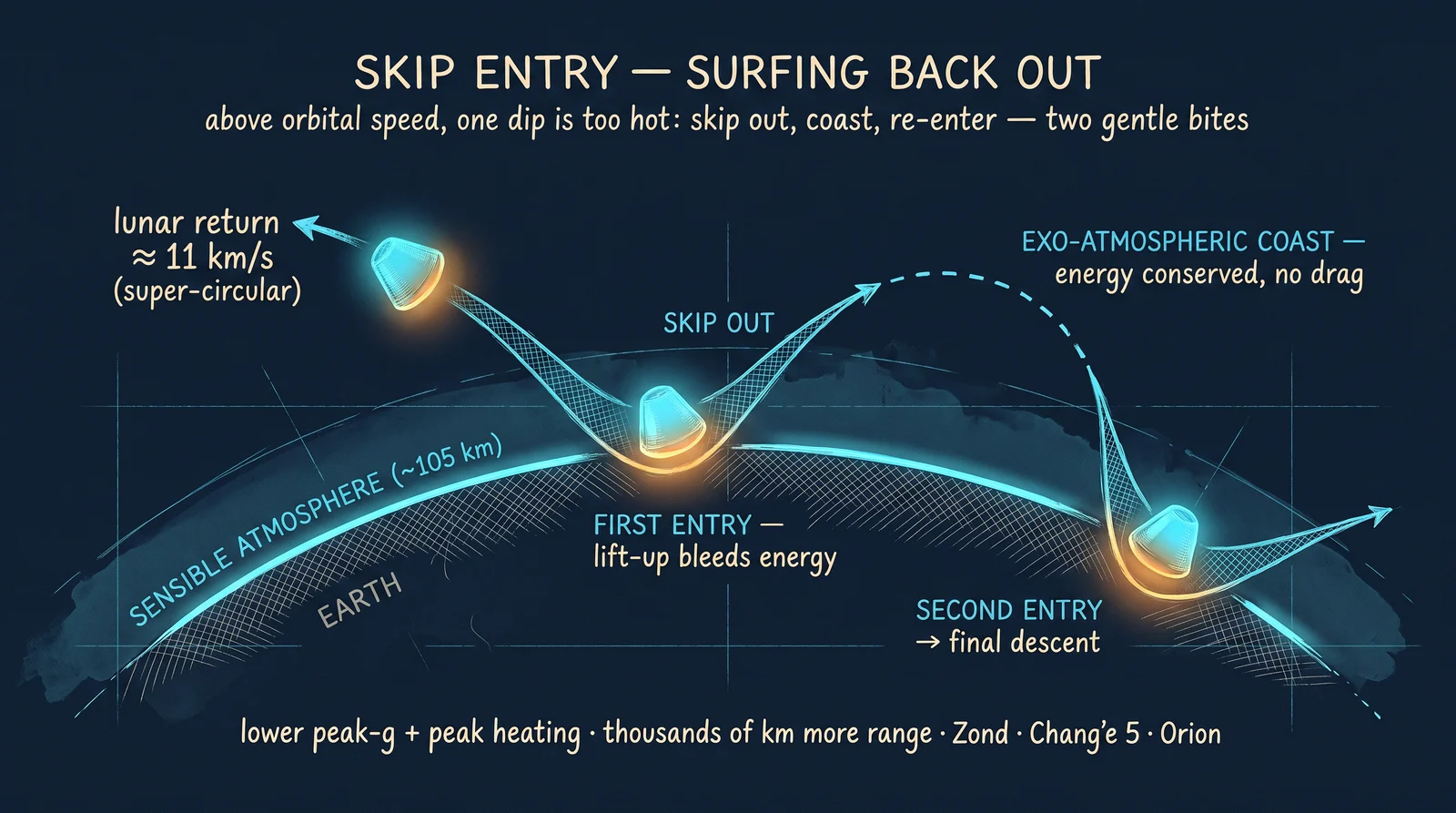
Rather than lose lunar-return speed in one plunge, the capsule skips out, coasts and re-enters — two milder peaks of heat and g instead of one.
101 · zoom in
Something falling back from low Earth orbit arrives at about 7.8 kilometres a second. Something falling back from the Moon arrives at about 11 km/s. That extra speed is a huge amount of extra energy, all of which has to become heat, and dumping it all in one pass means a sharper peak of heating and deceleration. Apollo crews came home from the Moon in a single pass, so it can be survived, but some of the fastest returns do something that sounds like a mistake: they deliberately skip.
The capsule dips into the upper atmosphere, uses its lift to bleed off just enough speed, then pulls back up and coasts — briefly — back above the sensible air, a long ballistic arc through near-vacuum, before dropping in a second time for the final descent. It is the same physics as skipping a stone across water, except the goal is not to stay up but to spread the punishment of re-entry across two gentler bites instead of one savage one.
Crewed Apollo flights did not skip, but the uncrewed Soviet Zond probes (Zond 6 and 7) demonstrated a double-dip guided entry, China’s Chang’e 5 sample-return skipped to bleed off lunar-return speed before landing in Inner Mongolia, and NASA’s Orion flies a skip-guidance entry on Artemis — the skip also stretches the reachable range by thousands of kilometres, so the capsule can reach a recovery zone near the fleet from a wider range of arrival conditions.
A skip entry is designed for returns faster than the speed of a circular orbit at that altitude (~7.9 km/s low down) — a "super-circular" return. During the first dip the vehicle uses lift-up to arrest the descent and bleed off enough speed that it leaves the dip suborbital, rising on a ballistic arc back out of the sensible atmosphere. That exo-atmospheric coast — energy conserved, no drag — carries it until it falls back for the second, final entry.
The payoff is twofold. Peak heating and peak deceleration are lower, because the energy is shed in two passes rather than one. And the reachable downrange grows dramatically — the coast between dips can span thousands of kilometres — which lets mission planners target a specific recovery zone from a wide range of arrival conditions. The total heat soaked into the shield is not necessarily smaller: a skip stretches the entry out in time, so the shield must still be sized for the whole, longer exposure.
The cost is guidance difficulty: the vehicle must judge the first dip precisely, because too little energy bled and it skips too high or fails to come back down usefully, too much and it never leaves the atmosphere. Modern skip guidance (as on Orion) solves this in closed loop, modulating bank angle through the first entry to place the exit conditions — and therefore the second entry and the landing point — exactly where they need to be.