Lifting entry — steering with a capsule’s lift
A blunt capsule is not just a falling rock. Offset its centre of mass and it flies with a little lift — and that lift, pointed by rolling the capsule, becomes a steering wheel that turns a knife-edge re-entry into a survivable one.
101 · zoom in
Coming home from the Moon, an Apollo capsule hits the top of the atmosphere at nearly 11 kilometres a second — half again as fast as something dropping back from low orbit. Enter too steep and the deceleration crushes the crew and the heat is unsurvivable; enter too shallow and you skip off the atmosphere like a stone off a pond and sail back into space with no second chance. The band of entry angles that is both survivable and captured is the "corridor", and at lunar-return speed it is heartbreakingly narrow — under a couple of degrees wide.
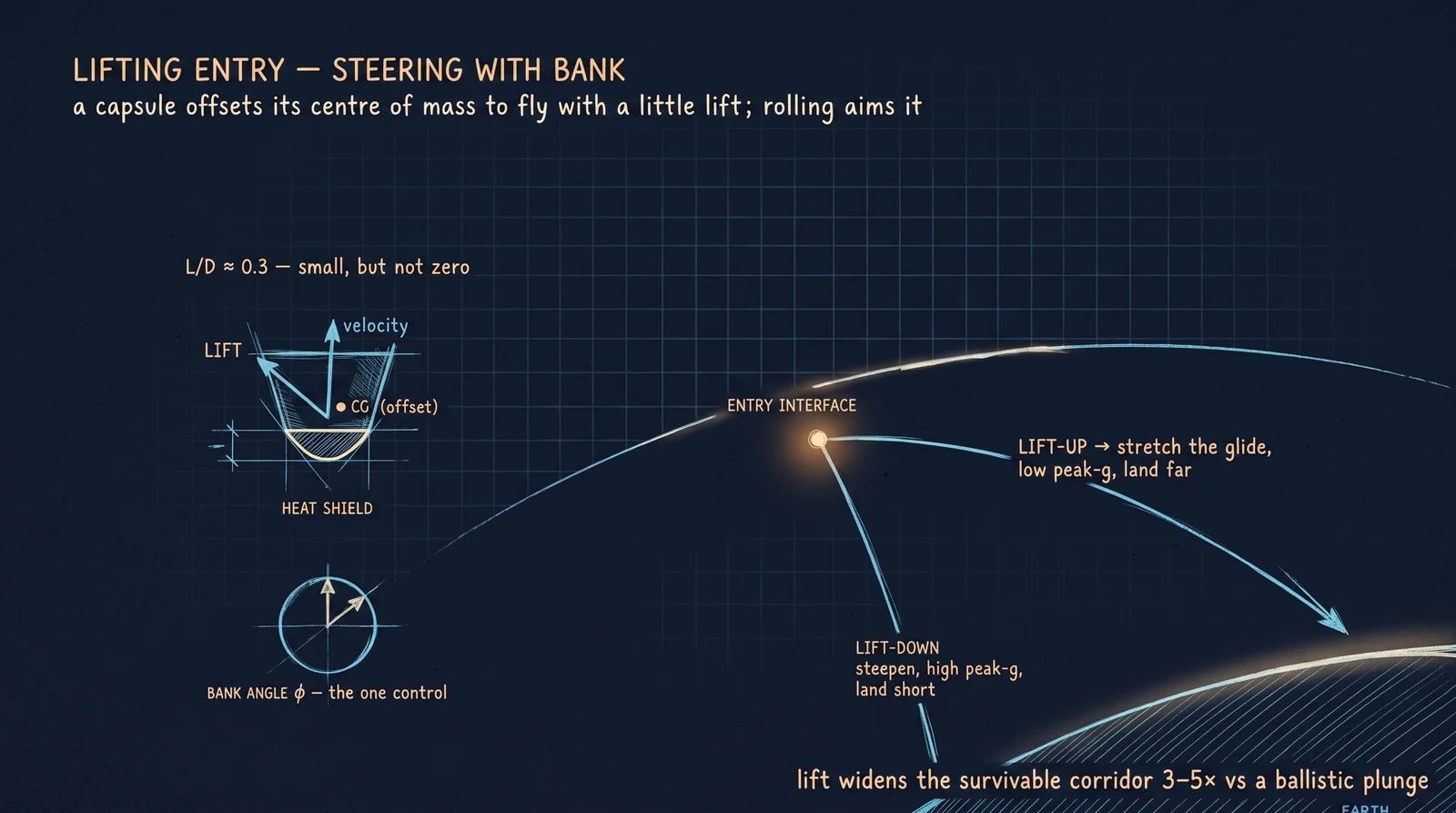
The trick that saves the crew is lift. A capsule looks like a symmetric cone, but its heat-shield is deliberately hung off-centre so it flies tilted, meeting the air at a slight angle and generating a small amount of lift — not much, a lift-to-drag ratio of only about 0.3, but enough. And the capsule has exactly one control to aim that lift: bank angle. Roll so the lift points up and the capsule stretches its dive, staying higher and shedding speed gently. Roll so the lift points down and it bites deeper into the air. Roll to the side and it steers left or right.
That single lever widens the survivable corridor several-fold — roughly three to five times — compared with a pure ballistic plunge, and it is why every crewed return from the Moon — Apollo, and now Orion on Artemis — flies a lifting entry, its guidance computer rolling the capsule back and forth to hold the deceleration inside human limits and still touch down where the recovery ships are waiting.
The physics is drag doing the braking and lift doing the aiming. A capsule’s lift-to-drag ratio (L/D) is small — about 0.3 for Apollo and Orion, near 0.24 for a Mars aeroshell, versus 4+ for an airliner — but it is not zero, and at hypersonic speed even a small L/D moves the trajectory a long way. Because the capsule cannot pitch (it has no wings or elevators), the ONLY way to redirect that fixed-magnitude lift is to bank: rolling about the velocity vector points the lift vector up, down, or sideways without changing how hard the air pushes.
The survivable corridor is bounded on both sides. Too steep and peak deceleration and heating spike past limits — a purely ballistic lunar-return entry can pull well over 10 g (the uncrewed Zond ballistic returns reached ~15 g), whereas Apollo’s guided lifting entry held its peak near 7 g; too shallow and the vehicle fails to capture and skips back out. Lift lets the guidance fly the middle: commanding lift-up early flattens the descent and holds the g-load down, and modulating bank through the entry keeps the whole profile inside the corridor. The published result is that lift widens the survivable angle band several-fold — roughly three to five times — over a ballistic entry.
A guidance computer flies it in closed loop. It knows the target range and the g and heating limits, and it rolls the capsule — full lift-up, part lift-down, reversals left and right to null out cross-range drift — updating many times a second off the sensed deceleration. Apollo’s entry was flown this way; Orion’s is too. The same bank-angle lever also aims the landing point, which is the subject of the entry-footprint page.