The landing footprint — where a capsule’s lift can take it
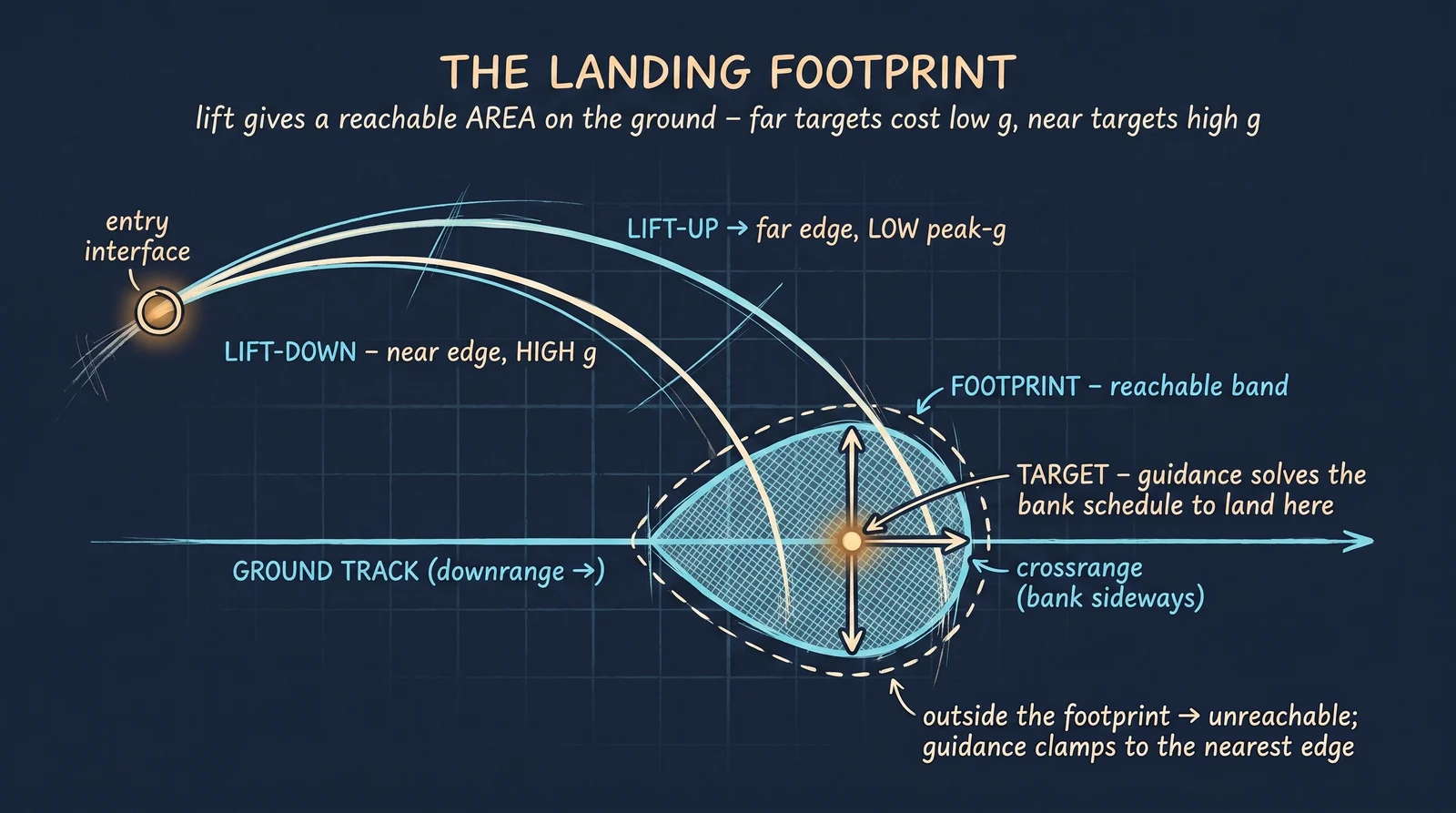
A re-entering capsule is not aimed like a dart at one point — its lift gives it a whole reachable area on the ground, the "footprint", and the guidance computer picks a landing site inside it by deciding how to spend that lift.
101 · zoom in
Once a capsule commits to re-entry it cannot add energy — no engines, no go-around. But it is not helpless about WHERE it comes down. By rolling to point its lift up it stretches the glide and flies far; by rolling lift-down it dives and lands short; by banking left or right it moves sideways. The set of all the places it could reach, given its speed and its lift, is a patch on the ground shaped like a stretched teardrop — the landing footprint.
Reaching the far edge of that footprint costs something: flying lift-up to go long means a shallower, gentler descent and a lower peak-g, while diving short means a steeper, harsher one. So there is a trade written into the footprint — the farther targets are the low-g ones, the near targets the high-g ones — and the guidance has to find a bank schedule that lands on the chosen spot without ever breaking the g or heating limits along the way.
This is exactly why Apollo could splash down near its recovery carrier and why Perseverance could hit a landing ellipse under 8 kilometres across (about 7.7 by 6.6 km) on Mars from millions of kilometres away. The computer is not steering to a point so much as choosing a point inside the footprint and then flying the lift to reach it.
The footprint is the reachable set in downrange–crossrange space. Downrange is set mostly by how the vehicle spends vertical lift: full lift-up maximises range (the capsule "floats", decelerating slowly and travelling far), full lift-down minimises it (a steep, fast arrival). Crossrange comes from banking the lift sideways, and its extent grows with L/D. For a low-L/D capsule the footprint is modest; for a lifting body or a winged vehicle it is huge.
The trade between range and g-load is the load-bearing fact. Because a long, lift-up trajectory sheds speed high in thin air over a long time, its peak deceleration is low; a short, lift-down trajectory concentrates the braking and peaks higher. A footprint diagram therefore doubles as a menu: each reachable range comes with the peak-g it costs, and the target must sit inside both the range band and the g limit.
A range-control guidance loop closes this. Given a target range it solves for the bank angle (really a bank schedule) that lands there, then flies it, reversing bank left/right to cancel crossrange error. If the target lies outside the footprint the honest answer is that it cannot be reached — the guidance clamps to the nearest edge — which is why mission design chooses entry conditions that keep the target comfortably inside the footprint.