Ascent guidance — the computer that flies a rocket to orbit
Getting to orbit is not a fixed script you can write in advance — it is a boundary-value problem solved anew every second, which is why spaceflight had to wait for the digital computer.
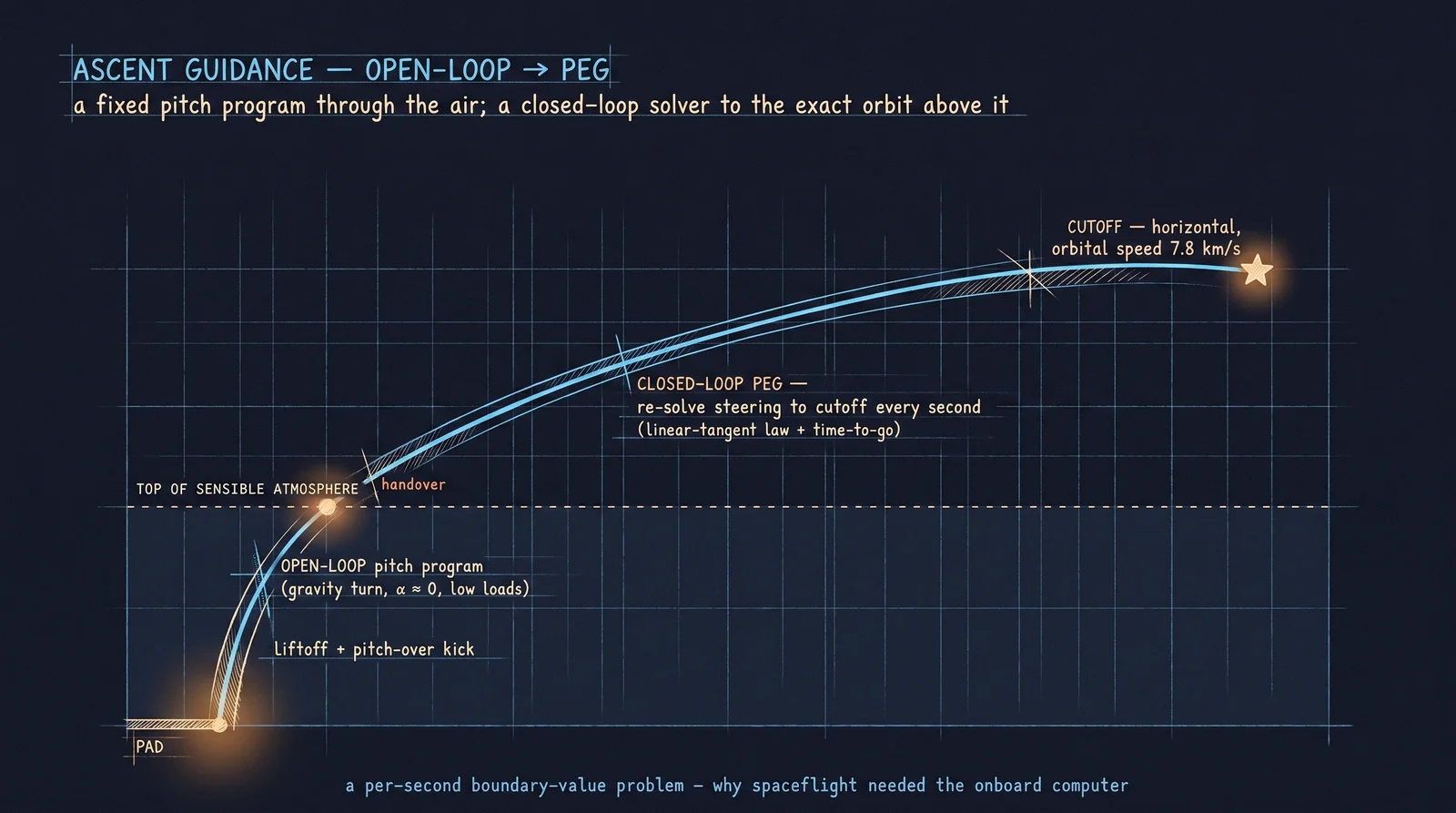
101 · zoom in
A rocket climbing to orbit has to satisfy an exact end condition: at engine cutoff it must be at the right altitude, moving horizontally, at precisely orbital speed. Miss the speed by a little and the orbit is wrong or the vehicle falls back. But the rocket is getting lighter every second as it burns propellant, the air thins, gravity pulls, winds shove — so the "right" way to point the engine is different at every instant and depends on everything that has happened so far. No fixed pitch schedule can hit the target exactly.
Early in flight, low in the atmosphere, the rocket does follow a pre-planned open-loop program: a gentle pitch-over just after liftoff starts a gravity turn, and the vehicle holds a smooth pre-computed attitude to keep aerodynamic loads low through the dense air. But once it is above the atmosphere the guidance switches to closed loop — it measures where it actually is and how fast, computes the steering that will thread the exact cutoff condition, and updates that answer many times a second all the way to orbit.
That closed-loop scheme has a name — Powered Explicit Guidance (PEG) — and a predecessor on the Saturn V, the Iterative Guidance Mode (IGM) — and it is the reason a low-thrust upper stage can loft its trajectory below the horizon and still arrive at orbital velocity on time. It is, quite literally, why spaceflight needed onboard computers: a human cannot re-solve the problem every second, but the flight computer does.
Ascent guidance is a two-phase affair. In the atmospheric first phase the vehicle flies open-loop: a small pitch-over kick just after tower clear initiates a gravity turn, and thereafter it holds a pre-computed pitch program that keeps the angle of attack near zero so aerodynamic and structural loads stay bounded through max-Q. There is little freedom here — the air dictates the path.
Above the atmosphere the guidance goes closed-loop and explicit. Powered Explicit Guidance treats the remaining burn as a boundary-value problem: given the current state (position, velocity, mass, thrust) and the desired cutoff state (target altitude, flight-path angle, orbital speed), it computes the optimal steering — essentially a linear-tangent pitch law — and the time-to-go, then re-solves the whole thing every guidance cycle. As the burn proceeds the solution converges and the commands smooth out; the stage can even loft (pitch above the local horizontal) early to bank altitude, then pitch down to trade it for speed.
This is the flight computer’s job, and it is unforgiving of a low thrust-to-weight upper stage, where the burn is long and the boundary condition is a moving target the whole way. The Saturn V flew IGM; the Space Shuttle and SLS fly PEG, and most modern upper stages use PEG-class guidance (SpaceX has not published Falcon 9’s exact algorithm). The Physics Lab’s "flying computer" lesson runs exactly this — an open-loop program handing over to closed-loop PEG lofting the arc to orbit.