Louder Than a Whisper
The Deep Space Network was built for a handful of probes. It is about to face the traffic of a solar-system civilisation. The fixes — antenna arrays, laser links, a store-and-forward internet — are real, and they are already being built. None of them beats the speed of light.
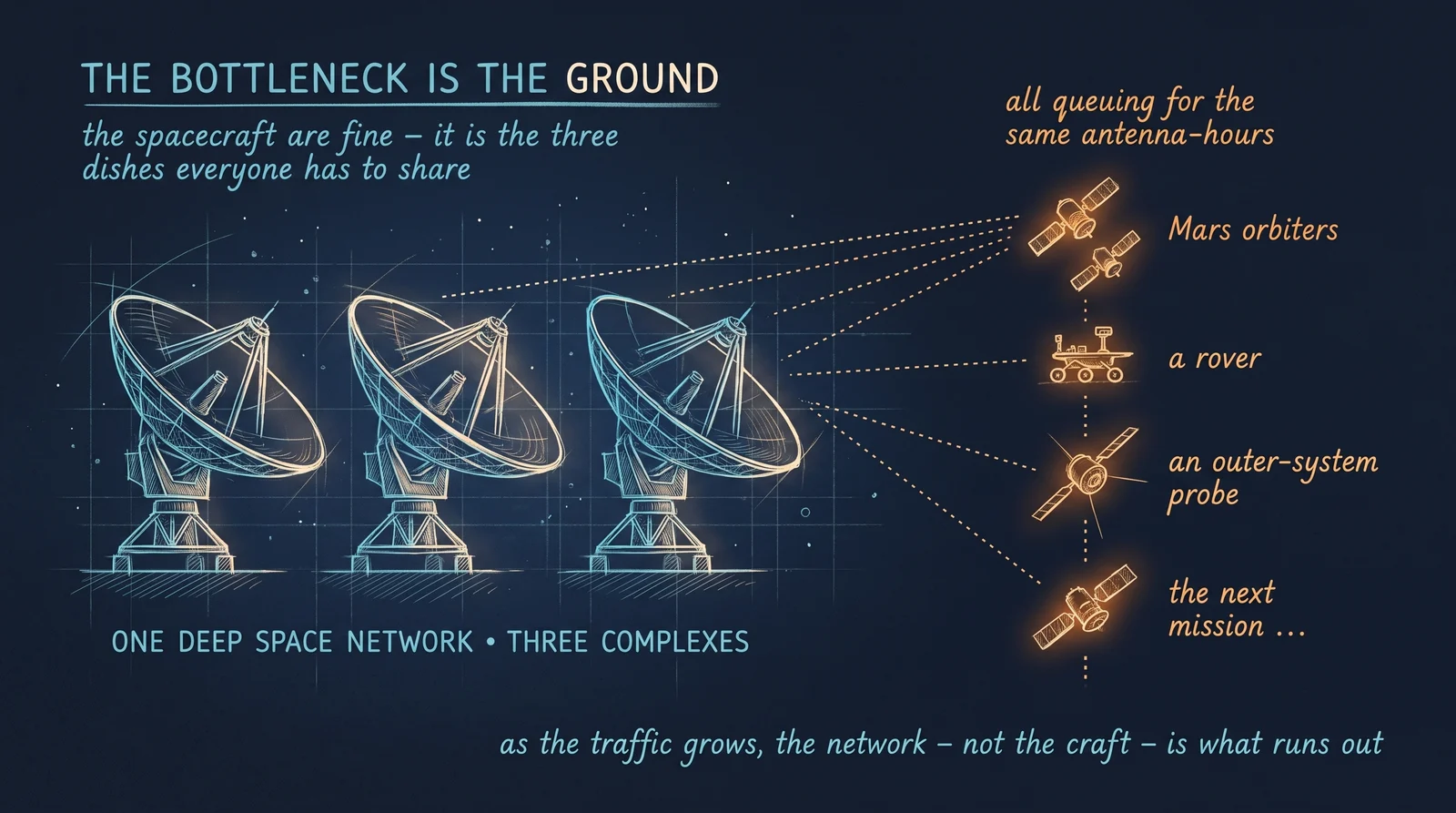
The comms essay ended on a quiet note: three patches of desert, roughly forty antennas, a 22-watt whisper crossing billions of kilometres, and the recognition that this threadbare infrastructure carries everything humanity has ever learned about the outer solar system. The miracle, that essay argued, wasn't how much the Deep Space Network had lost — it was how little. Three sites, one frequency band per mission, a schedule overbooked by forty percent, an upgrade programme running five years late. By any engineering standard, the DSN should have broken under the load years ago. It hasn't, mainly because the load has grown slowly enough, and the engineers patient enough, that the cracks could be papered over one antenna track at a time.
That arithmetic is about to stop working. The 2020s and 2030s are set to deliver a wave of missions — crewed Artemis flights with their appetite for continuous high-rate data, science probes to the ice giants, commercial operators who have been promised DSN time without anyone fully accounting for where it will come from, and eventually a sustained human presence on the Moon that will require something closer to a broadband connection than a telex line. NASA's own projections, published in successive DSN strategic reviews, show demand growing by a factor of ten before 2035. The current infrastructure was not designed to absorb a factor of ten. The bottleneck, it turns out, has never been the spacecraft. It has always been the ground.
Three approaches are being built in parallel. Stop building bigger dishes and instead combine many smaller ones in software — arraying. Replace radio with laser light for the high-rate downlinks, which concentrates orders of magnitude more data into the same transmitted power. And accept that the solar system will never have a real-time network, building instead an architecture designed for that fact: a store-and-forward internet whose packets spend hours in transit and arrive anyway. Each has been demonstrated. None of them changes the one thing that cannot be changed.
The ground is the bottleneck
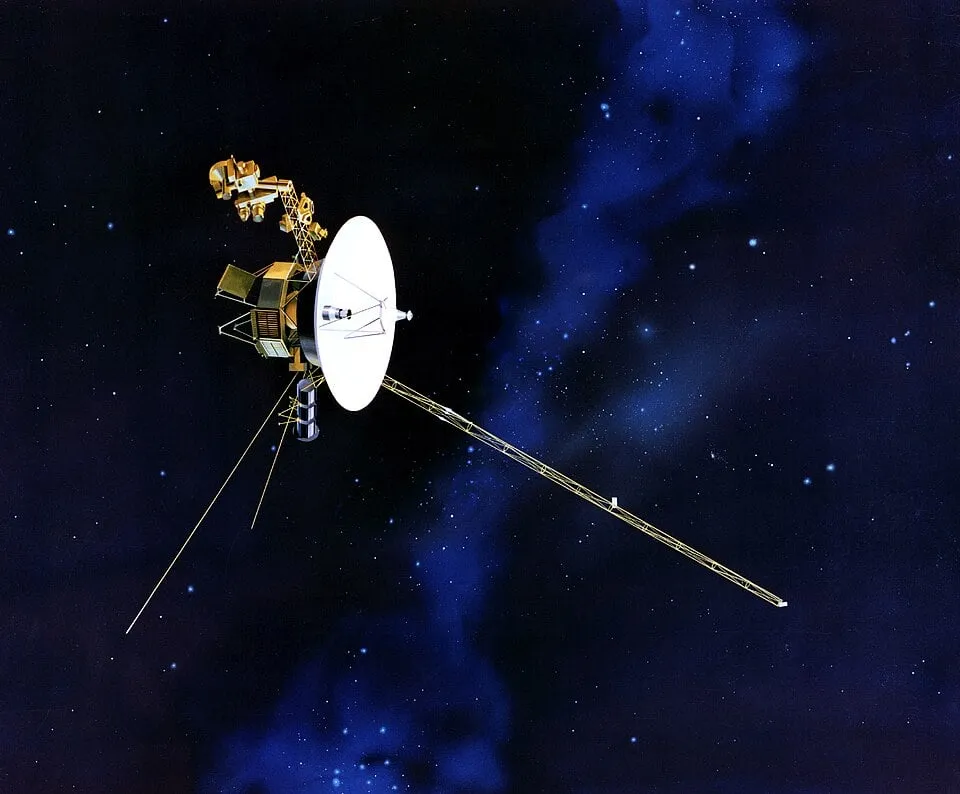
The comms essay worked through the link budget: Voyager 1's 22.4-watt transmitter, the inverse-square loss across tens of light-hours, the femtowatt signal arriving at a 70-metre dish after more than twenty-three light-hours of travel. That loss is real, and it is why data rates from the outer planets are measured in bits per second. But it is not the binding constraint for the missions launching right now. At the Moon and Mars, spacecraft can transmit faster than the ground can schedule time to receive. The DSN allocates antenna time in blocks called tracks — typically eight to ten hours per mission per day — fought over by a queue of dozens of active spacecraft. MAVEN, the Mars atmospheric orbiter that relays data for surface missions, can generate and forward data faster than the DSN can absorb it on any given day. The spacecraft is not the problem. The three sites, with their fixed number of dishes and finite receiver chains, are the problem. The traditional answer was to build a bigger dish: the 70-metre giants at each complex were expanded from 64 metres specifically to support Voyager 2's Neptune encounter in 1989 — a civilisational upgrade to the global network, for one flyby, of one planet. That kind of expenditure is not repeatable, and a 70-metre dish is near the practical limit of what can be steered as a single structure anyway. The era of the bigger dish is over.
Many ears instead of one
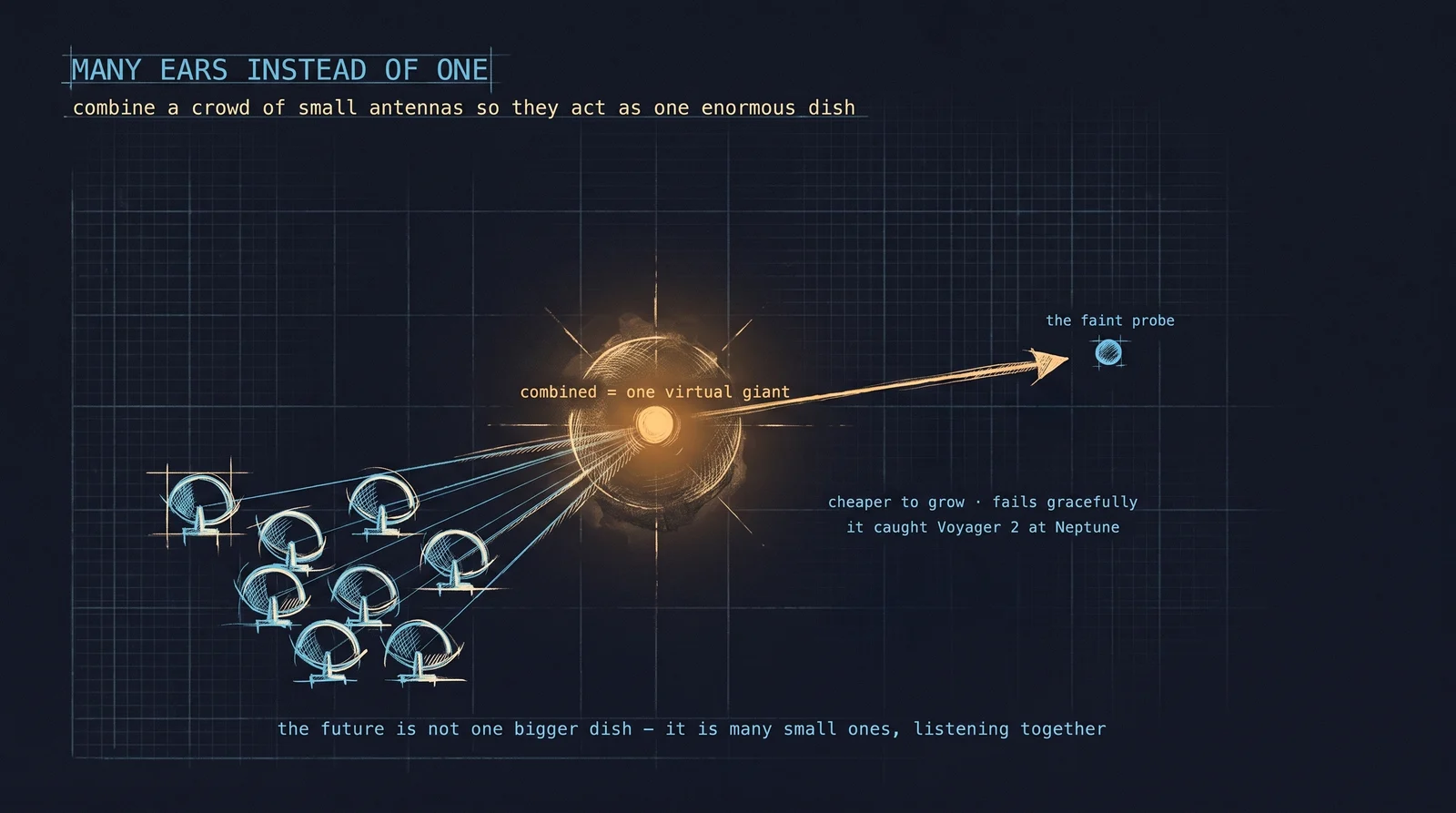
The principle behind antenna arraying is straightforward, though the engineering is not. Take a signal arriving simultaneously at multiple separate antennas. Combine their outputs — accounting precisely for the tiny difference in arrival time at each dish, caused by their different positions on the ground — and the combined system behaves like a single dish whose collecting area is the sum of all the individual dishes. Eight 34-metre antennas combined coherently produce roughly the sensitivity of a single 96-metre dish, which is larger than anything the DSN has ever built. The signal-to-noise ratio improves as the square root of the number of antennas; the cost of each additional dish is a fraction of the cost of upgrading the primary to match the same gain.
The DSN demonstrated arraying as early as the 1980s, combining Goldstone with the Very Large Array in New Mexico during Voyager 2's Neptune encounter. What is new is the intent to make it the default rather than an emergency measure. NASA's aperture enhancement programme is building additional 34-metre dishes at each complex specifically to be arrayed — adding capacity incrementally, with the resilience that a single dish going dark for maintenance no longer silences the site. And arraying is not only an American concern. ESA operates deep-space antennas at New Norcia, Cebreros, and Malargüe; JAXA runs the Usuda and Uchinoura networks; ISRO has a deep-space station at Byalalu near Bengaluru. The emerging picture is not a three-site American monopoly but a global patchwork of national assets — a commons that missions from any agency will negotiate across.
The turn to light
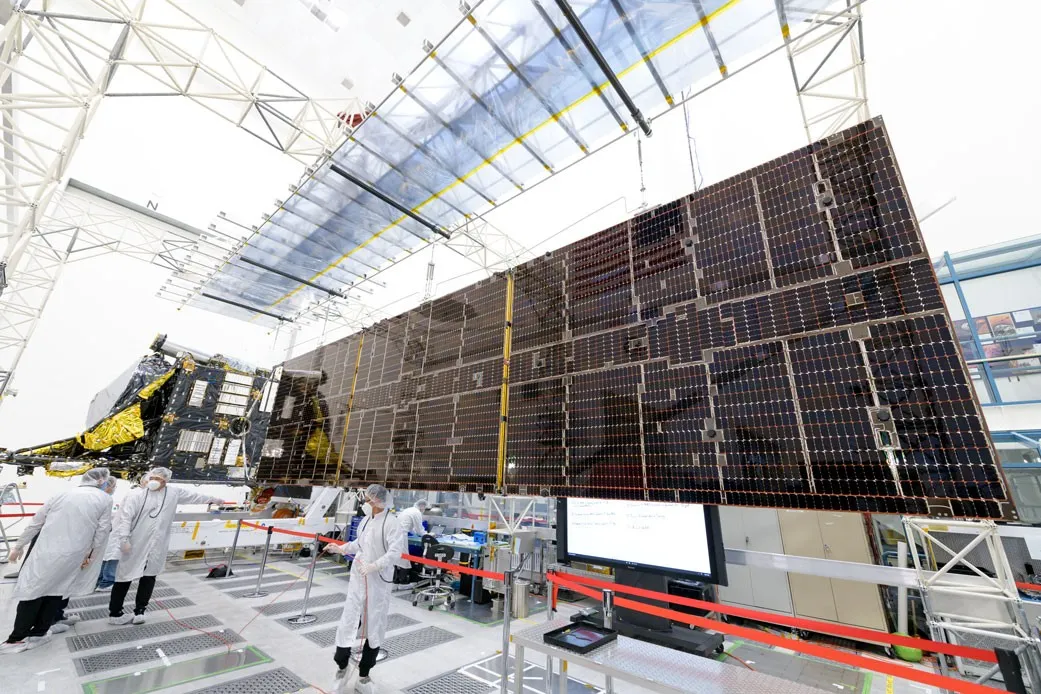
The comms essay described the first demonstration of deep-space optical communications: the DSOC experiment riding aboard the Psyche spacecraft, which launched in October 2023 and achieved something radio cannot match on equivalent power. By April 2024, DSOC had transmitted at 25 megabits per second from 140 million miles — faster than most household broadband, from a distance greater than the Earth-Sun separation. By December 2024, it had set a distance record: downlinking at useful rates from 307 million miles, 494 million kilometres out. In both cases, the comparison to the radio link on the same spacecraft is bracing: DSOC achieved ten to a hundred times the throughput for the same electrical power and roughly the same mass.
The physics behind the advantage is geometry. Radio waves spread in a cone; the cone widens with distance, and most of the transmitted power misses the target. A laser beam is a pencil. The same power that radio sprays across millions of square kilometres at Mars distances can be concentrated, with optical comms, into a spot just tens of metres across at the ground station. More power per square metre arriving at the receiver means more signal; more signal means higher data rates for the same transmitter power, or the same data rate from a smaller, lighter transmitter. For a spacecraft where every kilogram of mass costs thousands of dollars to launch, that trade is attractive.
The catch — and there is always a catch — is pointing. A beam narrow enough to land in a spot tens of metres wide at a target millions of kilometres away requires the transmitting telescope to be pointed with an accuracy measured in nanoradians. A spacecraft vibrating slightly from reaction wheel noise, thermal expansion, or the micro-impulse of cosmic ray hits must track a target on Earth that is itself moving, as the planet rotates and orbits the Sun, to a precision that strains the best attitude-control systems ever built. DSOC solved this with a fast-steering mirror and a feedback loop that tracks a beacon laser sent up from the ground — the spacecraft hunts the uplink beam and points its downlink accordingly. It works. The complexity is real.
The second catch is weather. Radio waves pass through clouds. Laser light does not. A ground station receiving an optical downlink from Mars goes blind whenever clouds pass overhead — which at any given site on Earth happens roughly a third to half the time. The architecture for a reliable operational optical deep-space network therefore requires geographically distributed ground terminals: the Optical to Orion (O2O) facility at White Sands in New Mexico, the Haleakala telescope in Hawaii, planned sites in the Canary Islands and in the Asia-Pacific. If one site is clouded out, another takes the downlink. The same strategy the DSN already uses for radio — three sites, 120 degrees apart — applied to optical, but with finer geographical texture and a stronger dependence on local meteorology. NASA's follow-on to DSOC, the Deep Space Optical Relay, is intended to demonstrate exactly this multi-site handoff for operational missions in the late 2020s.
The longer-term vision is a network that uses optical links for the high-rate downlinks — science data, imagery, video — while retaining radio for the low-rate, all-weather uplink and for emergency commanding. The scales-of-distance lesson still applies: DSOC is not a communications revolution in the sense of making distances irrelevant. From Psyche's location during the December 2024 record, the one-way light travel time was about 27 minutes. The laser arrived 27 minutes after it left. No amount of bandwidth engineering changes that number.
An internet with a light-hour of lag
Radio and optical communications both solve the same problem: how to move bits faster. Neither solves the structural problem the solar system imposes on any network: links go up and down as planets rotate, nodes are separated by light-minutes to light-hours, and the latency between any two endpoints is not milliseconds but tens of minutes. The internet protocol that carries all of Earth's network traffic — TCP/IP — was designed for a world where a packet gets an acknowledgement in under a second. TCP's core mechanism is a handshake: send, receive acknowledgement, send the next. At Mars distances, a sender would transmit a packet, wait forty minutes for an acknowledgement, transmit the next, and so on. Throughput: approximately zero. TCP was built for a planet.
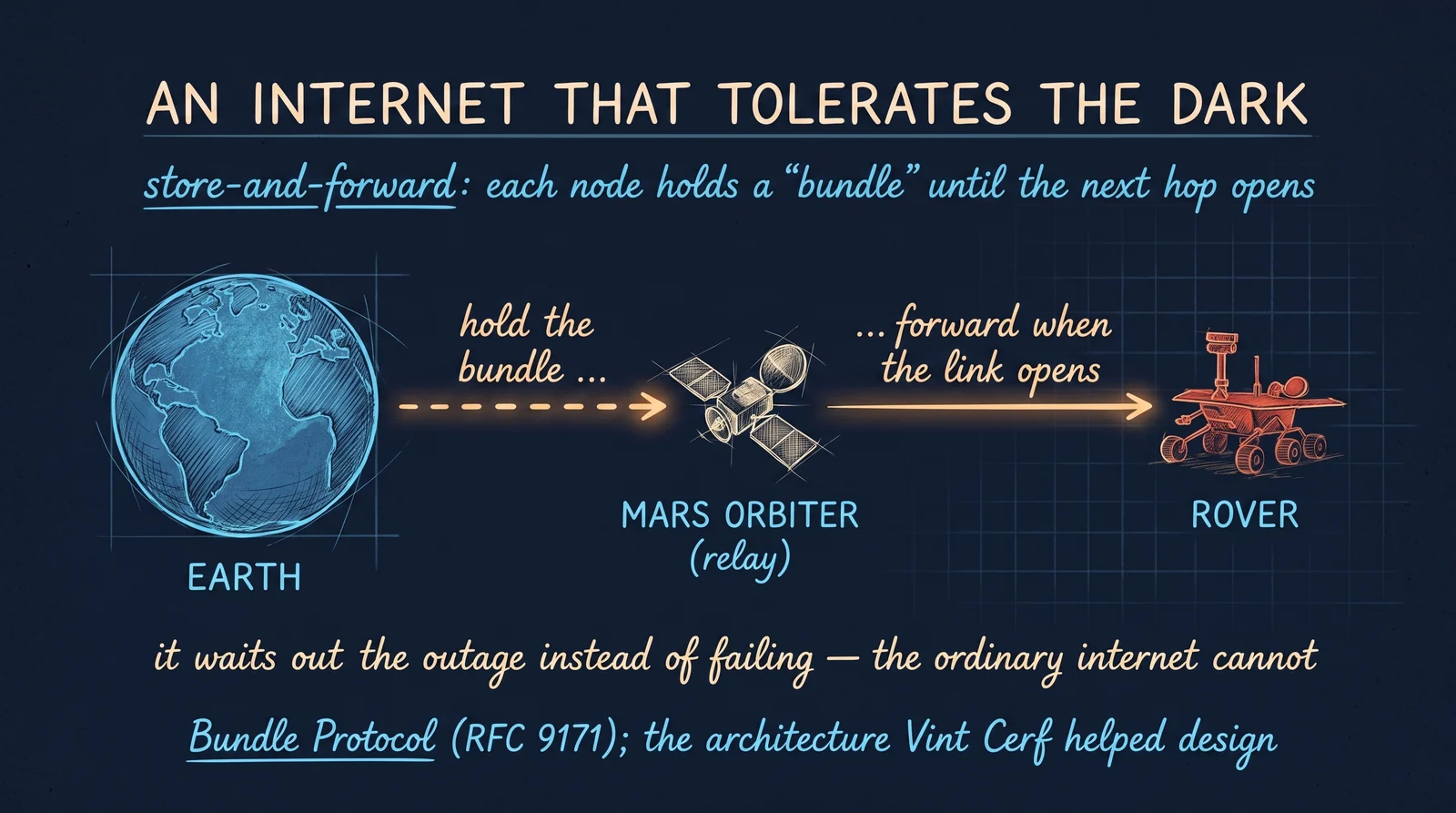
The answer, developed in the late 1990s by a working group that included Vint Cerf — one of the original architects of the internet — is called Delay/Disruption-Tolerant Networking, or DTN. Its governing idea is store-and-forward: a DTN node receives a bundle of data, holds it locally, and forwards it when the next link in the chain becomes available. A bundle from a Martian rover travels first to a Mars orbiter — MAVEN already relays surface-mission data this way — which stores it and forwards it to Earth during its next ground contact. The bundle takes hours to traverse the chain. It arrives complete, without requiring simultaneous connectivity at any point along the route. DTN has been running as an operational experiment aboard the International Space Station since 2008. The Mars Relay Network — the informal coordination between Mars orbiters ensuring surface missions always have a relay overhead — is DTN's architectural premise made practical. The remaining work is standardising the Bundle Protocol across all agencies, so that a rover, an orbiter, and a ground station from three different nations can hand a packet between them the way any two devices on Earth exchange an email.
What it still cannot do
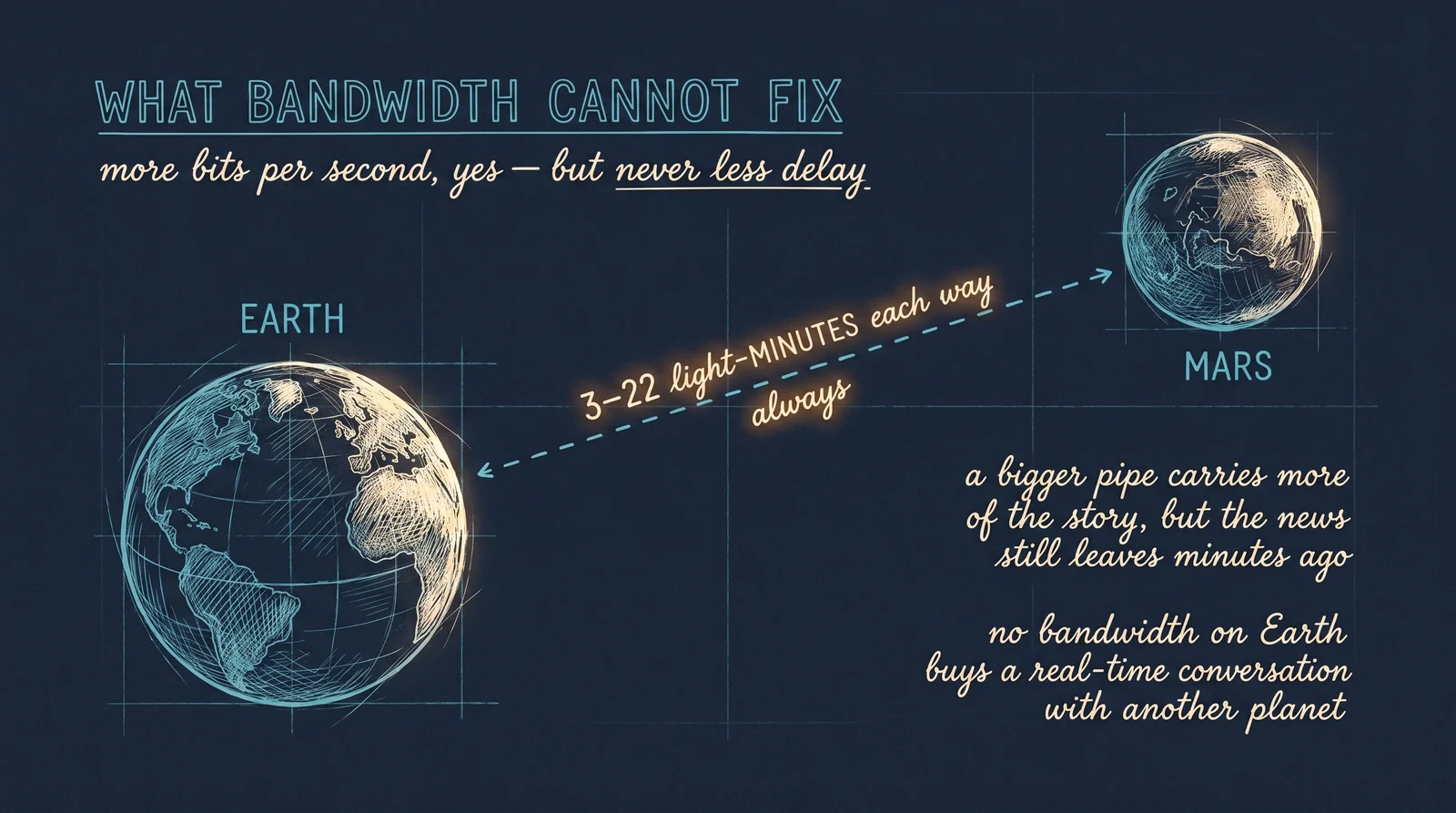
There is a temptation, reading the capabilities above, to hear them as solutions to the deep problem — the isolation, the distance, the silence. They are not. They are improvements to the plumbing. The structure of the solar system is not a plumbing problem; it is a geometry problem, and the geometry is fixed. Mars is between three and twenty-two light-minutes from Earth depending on orbital position. No technology changes that number. A laser beam and a radio wave both travel at the speed of light, which is the speed of causality in this universe and which has nothing to say about bandwidth or encoding. More bandwidth means more data crosses the gap per minute. It does not mean the gap shrinks. You cannot have a real-time conversation with a crew on Mars — not a voice call, not a video link, not a command-and-acknowledge loop. A crew member facing a medical emergency cannot wait twenty-four minutes for a reply, nor six minutes at closest approach. They decide with the knowledge they have, in the time they have. The arrays, the lasers, the DTN internet all make it easier to send more information in advance and receive more in debrief. None of them puts a flight surgeon's hand on a patient's shoulder across thirty million kilometres.
The outer solar system is quieter still. New Horizons during its Pluto encounter was four and a half light-hours from Earth. Voyager 1, now more than twenty-three light-hours out, receives a command on Tuesday that was sent on Sunday. These numbers will not improve. The relevant trajectory for the interstellar-exploration problem is an order of magnitude beyond even that: the nearest star system, Alpha Centauri, is four and a third light-years away — a signal sent today would arrive in 4.3 years. The bandwidth innovations described in this essay are necessary and useful for everything within the solar system. For anything beyond it, they are irrelevant. At interstellar distances, the delay is not a communications engineering problem. It is a civilisational one.
The nervous system of a multi-world species
Step back from the engineering and consider what is actually being built. The Deep Space Network was designed in 1963 for a solar system that contained, at any given time, perhaps a dozen active spacecraft. It has been stretched, upgraded incrementally, and kept running through a combination of engineering ingenuity and institutional stubbornness. What replaces it — the arrays, the optical links, the interplanetary internet, the globally distributed ground stations — is something qualitatively different: a permanent communications infrastructure for a species that intends to be somewhere other than Earth.
For the first time since the 1970s, the intent to be somewhere other than Earth is backed by hardware being built and launched. The Artemis programme has committed to a lunar communications architecture supplemented by commercial relay satellites in lunar orbit. The Mars Relay Network is a functioning multi-agency infrastructure. DSOC proved optical links work at planetary distances. The Bundle Protocol is running on operational spacecraft today. These are not research programmes awaiting maturation. They are the first version of an infrastructure that will be running, in some form, for the rest of this century.
The historical analogy that sits most naturally here is not the telephone network or the internet, though those are the structural parallels. It is the switchboard. Before long-distance telephony, every town that wanted to communicate with the next town negotiated its own arrangement — a telegraph line, a mail route, a courier. The switchboard, and the exchanges it connected, transformed those bilateral arrangements into a network: every node that joined could reach every other node, through a shared and standardised infrastructure, without needing to build its own private link to each destination. What is being assembled now — slowly, expensively, internationally — is the switchboard for a solar system. Not a metaphor for it. The literal thing, in the domain where it has not previously existed.
The analogy also clarifies what the switchboard cannot do. The early telephone network did not collapse the distance between continents — it made the connection routine rather than exceptional, a regular feature of how business and family and governance worked, rather than a rare and expensive interruption. That is what the interplanetary network is working toward: not the elimination of the distance but the routinisation of talking across it. Not the conversation in real time, but the expectation that messages sent will arrive, that queries will be answered, that the nodes out there in the dark are nodes in the same network as the ones down here. The comms essay closed with an image of letters sent between people who have both moved on by the time any answer arrives. That will remain true at Mars, at the moons of Jupiter, everywhere the species spreads. The nervous system being built is one that works with that physics rather than pretending otherwise — a network that stores and forwards, routes around weather and the slow rotation of a planet, holds every packet in custody until the next link opens. It is the right architecture for a solar system. The whisper was never going to be enough. The arrays and the lasers and the interplanetary protocols are how it gets louder. What they cannot do — what nothing can do — is make it faster. The light still takes the time it takes.