The Wrong Treasure
The headline says asteroids contain quadrillions of dollars of gold and platinum. The headline is wrong — not about the metal, but about the money. The real argument for asteroid resources runs in the opposite direction entirely.
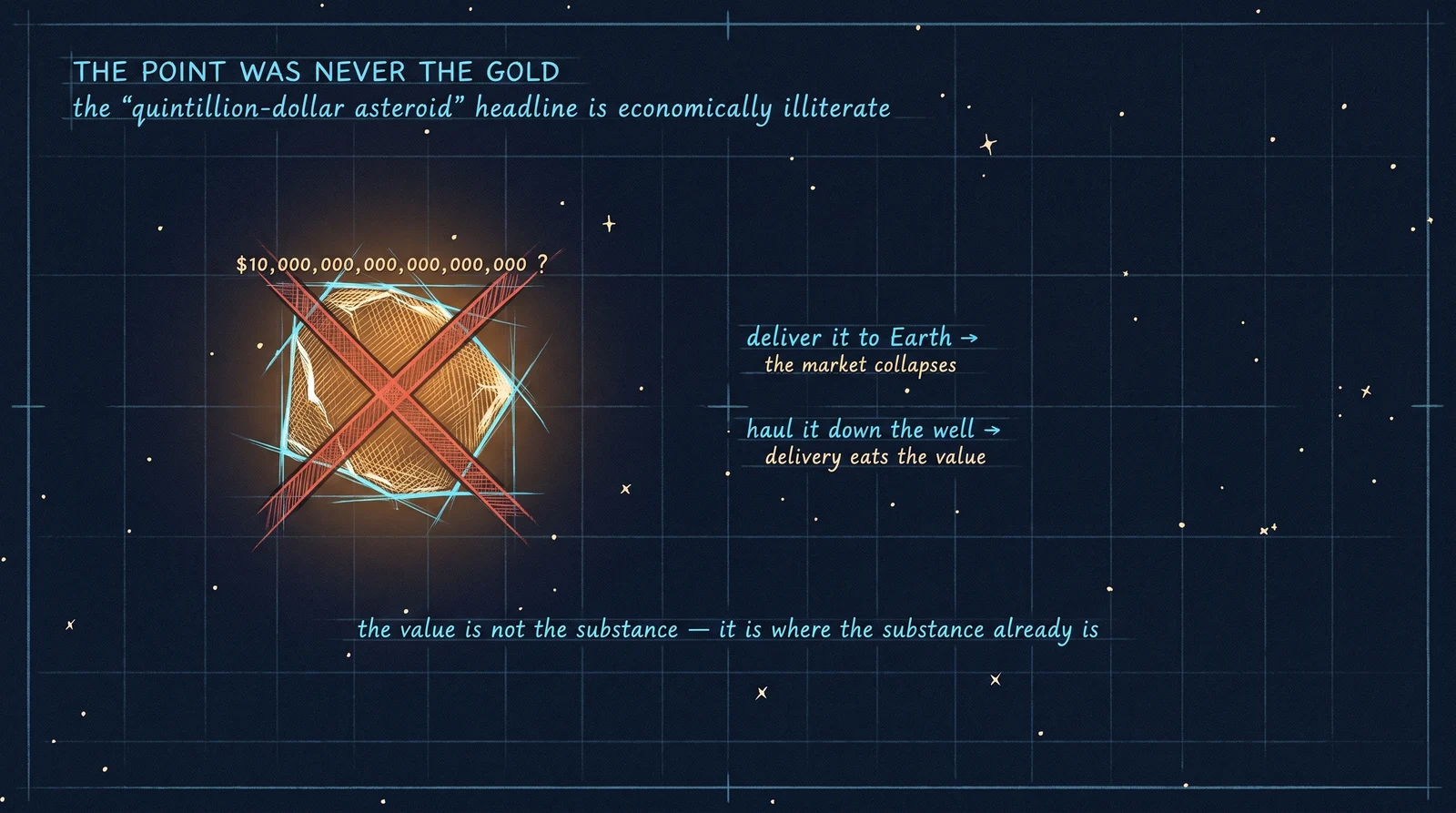
Every few years, someone does the arithmetic on asteroid 16 Psyche and announces, in a breathless press release, that the metal-rich body orbiting in the asteroid belt contains iron, nickel, and precious metals worth something in the range of ten quintillion dollars. The figure is always staggering. It is also, in any meaningful economic sense, meaningless — and understanding why it is meaningless leads directly to what the genuine argument for asteroid resources actually is, which is almost the opposite of the headline version.
Start with the number itself. The global platinum market is worth, in a given year, roughly $5 billion. If you could deliver the platinum-group-metal content of even a modest metallic asteroid to Earth and sell it tomorrow, you would not make a fortune. You would collapse the market. The price of platinum derives entirely from its scarcity; remove the scarcity, and you remove the price. Value, for a commodity, is set at the margin — by the last unit sold, not the total volume in existence. The $10-quintillion asteroid, successfully mined and delivered to Earth's surface, would be worth roughly what iron ore is worth: not much per kilogram. But this market-collapse argument is almost beside the point, because it assumes delivery to Earth — and delivery to Earth is where the arithmetic goes wrong long before the market enters the picture. This is where the rocket equation closes the discussion.
Gravity is the accountant
The delta-v budget for a mission from Earth to a near-Earth asteroid is, for a favourable target, somewhere around 6 km/s — comparable to reaching Mars. Getting material back from that asteroid to Earth orbit costs more still, and getting it from Earth orbit to Earth's surface requires surviving the atmosphere. This is all before you have done any mining. The rocket equation does not grade on a curve: every kilogram of payload you want to return home from deep space must be matched, at launch, by enough propellant to carry it back, which must itself be matched by propellant to carry that propellant, and so on down the regress the equation describes. The Tsiolkovsky constraint, which has not been repealed since 1903, makes the numbers brutal.
Put plainly: you are pulling material out of a gravity well — not Earth's, but the solar system's. The asteroid is, admittedly, tiny, with a surface gravity a thousandth of Earth's. Getting off it costs almost nothing in delta-v. But you are then in interplanetary space, and Earth is at the bottom of a very large gravity well, and arriving there with any significant velocity means spending fuel to slow down, or accepting the violence of aerobraking, or both. The economic cost of transporting mass across interplanetary distances and then decelerating it safely is, at current and foreseeable propulsion technologies, so far above the market value of any commodity that the business case for returning bulk materials to Earth cannot close. This is not a pessimistic reading. It is what the specific impulse numbers say when you run them honestly.
This is also why the first generation of commercial asteroid ventures — Planetary Resources, founded in 2012, and Deep Space Industries, founded in 2013 — failed within a decade, not because the asteroids aren't there, but because the market for Earth-delivered asteroid platinum does not exist at any price that the delta-v economics can support. The logic of hauling wealth down to Earth's surface was broken from the start.
The well is the problem
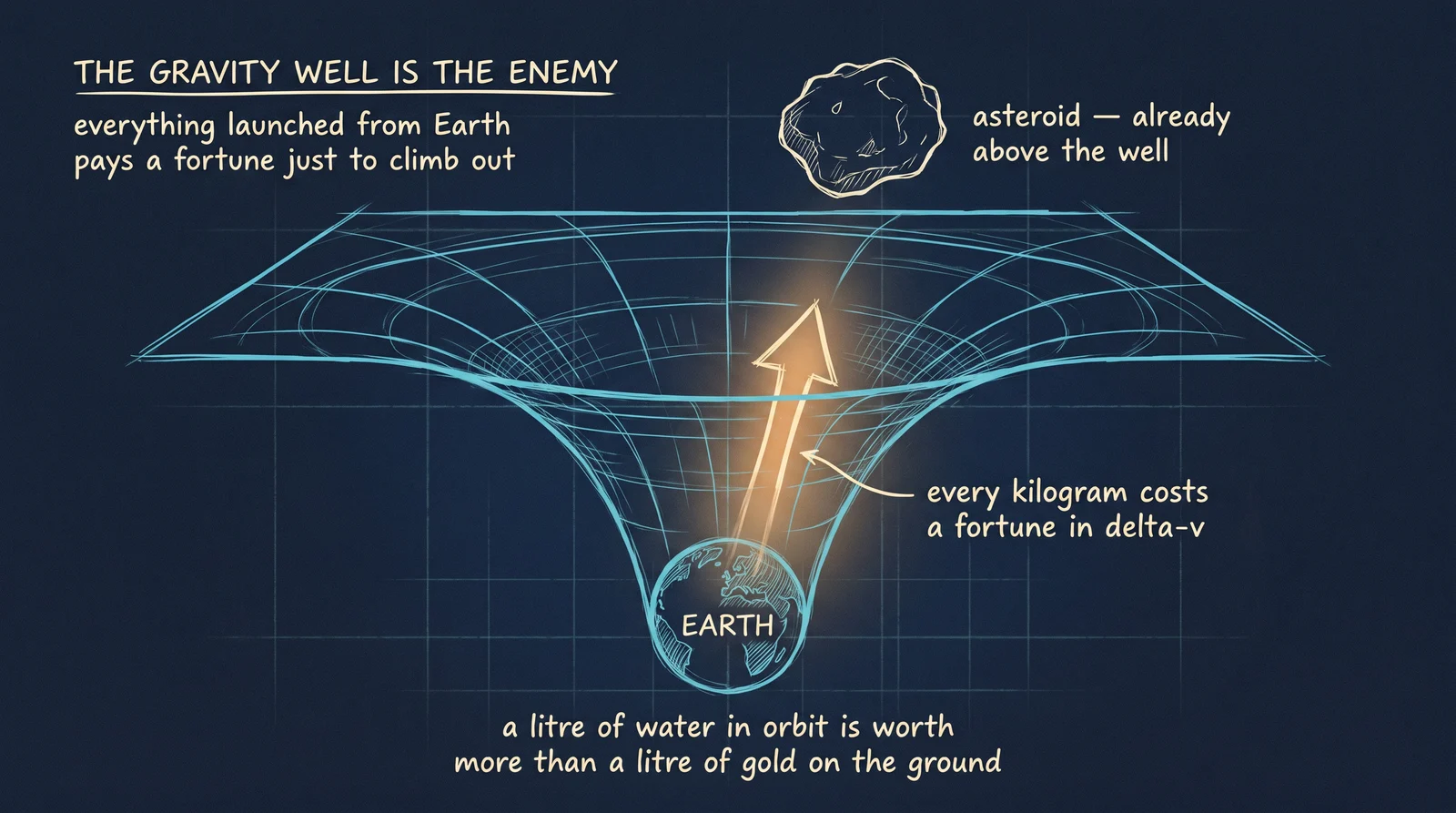
Now invert the question. Instead of asking what it costs to bring material from space to Earth, ask what it costs to bring material from Earth to space. The answer is the same rocket equation, running the other direction, and it is just as brutal. Getting one kilogram to low Earth orbit on a reusable launcher costs, at best, a few thousand dollars today — down dramatically from the tens of thousands it cost a decade ago. Getting that kilogram further, to a lunar transfer orbit or to a Mars-bound trajectory, costs more still, because you are climbing higher out of Earth's gravity well and the Oberth arithmetic that makes deep burns efficient cannot fix the fundamental mass-ratio problem.
This is what the gravity-well framing clarifies. Earth's surface sits at the bottom of a well that costs roughly 9.4 km/s of delta-v to escape entirely. Every kilogram of food, fuel, water, air, structural material, or radiation shielding that a crewed spacecraft carries above low Earth orbit has paid that toll. The toll is not a surcharge that clever engineering can avoid; it is a physical consequence of being on Earth, which is a large planet with a deep gravitational field. If you want to build and operate spacecraft above low Earth orbit — for a lunar base, for Mars transit, for anything sustained in deep space — the dominant cost is not your hardware. It is the propellant burned to lift your hardware and its consumables out of the well every single time.
The genuine economic argument for asteroid resources begins exactly here, and it runs in the direction opposite to the headline. Instead of bringing material from asteroids to Earth, the question is: can we use material that is already above Earth's gravity well to avoid lifting it from the surface? Can we, in effect, find a fuel depot and a hardware store already in orbit — or close enough that the delivery cost is measured in fractions of a km/s rather than ten km/s — and stop paying the launch toll on every kilogram of material a deep-space economy needs? The answer, if the recon missions are to be believed, is yes. But not for gold. For water.
Water is the ore
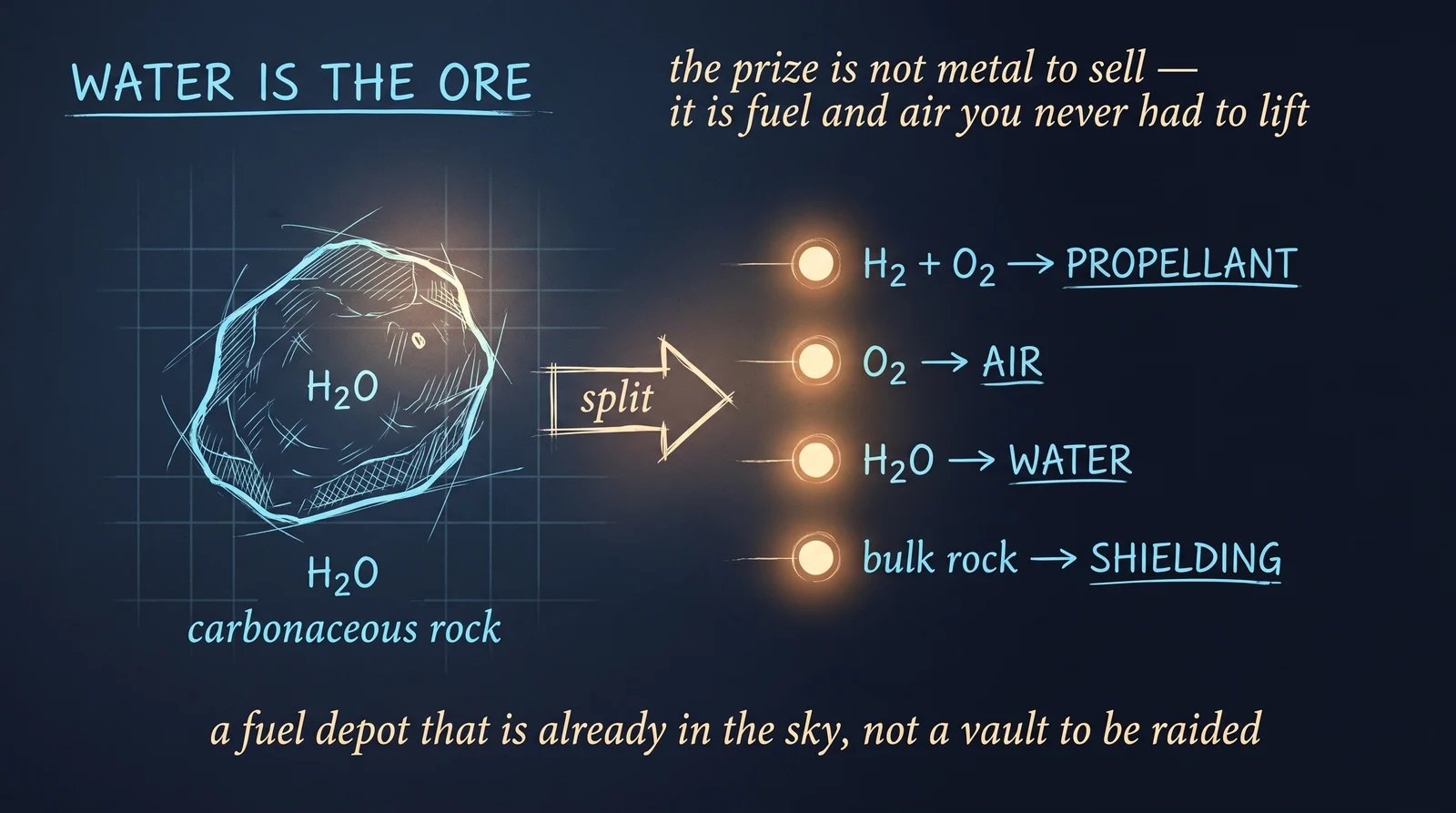
Carbonaceous chondrite asteroids — the C-type and related classes that represent the majority of near-Earth objects — contain significant quantities of hydrated minerals: clays and phyllosilicates that hold water molecules in their crystal structure at levels ranging from a few percent to more than twenty percent by mass. Some also contain organics. The water is not sitting in puddles; it is chemically bound, and extracting it requires heating the material to drive off the water vapour and then condensing it. But the energy to do that can, in principle, come from solar concentrators in space. The result is water — and water, in the context of a deep-space programme, is not primarily a thing to drink.
Electrolysis splits water into hydrogen and oxygen: the most energetic chemical propellant combination ever flown. Hydrogen and oxygen, liquefied and stored, are rocket propellant. The delta-v budget for a Mars transfer is approximately 3.6 km/s from low Earth orbit; a propellant depot at a convenient Lagrange point or in a near-Earth orbit, stocked from asteroid-derived water, would dramatically change the mass that needs to be launched from Earth for any beyond-LEO mission. The fuel is the dominant mass fraction of any spacecraft — the Saturn V that carried Apollo astronauts to the Moon was 85% propellant by mass. A depot that supplies propellant without requiring it to be lifted from Earth's surface is not a logistical convenience. It restructures the entire economics of deep space.
Beyond propellant, water provides oxygen for breathing. The same carbonaceous material provides carbon and nitrogen. The bulk mass — rock, in most cases, not metal — provides radiation shielding: a spacecraft transiting to Mars is outside Earth's magnetosphere for six to nine months, and lifting enough mass to shield a crew from cosmic rays costs enormously if every kilogram has to be launched from Earth's surface. None of this has the glamour of platinum. All of it is more valuable to a space-based economy than platinum is. The argument is not about treasure. It is about in-situ resource utilisation — the only approach that makes sustained human presence beyond Earth physically feasible — and the resource that matters most is not the rarest or most expensive one, but the one that is most expensive to launch from Earth: propellant mass. The going-to-the-moon essay makes the same case at the lunar south pole, for the same reasons. The Moon and carbonaceous near-Earth asteroids are the same argument in two different places.
We have already touched them
The recon that would support any of this is not theoretical. It has been done, twice, by Japan, and once by the United States — and what it found was both more interesting and more humbling than the headline version suggested.
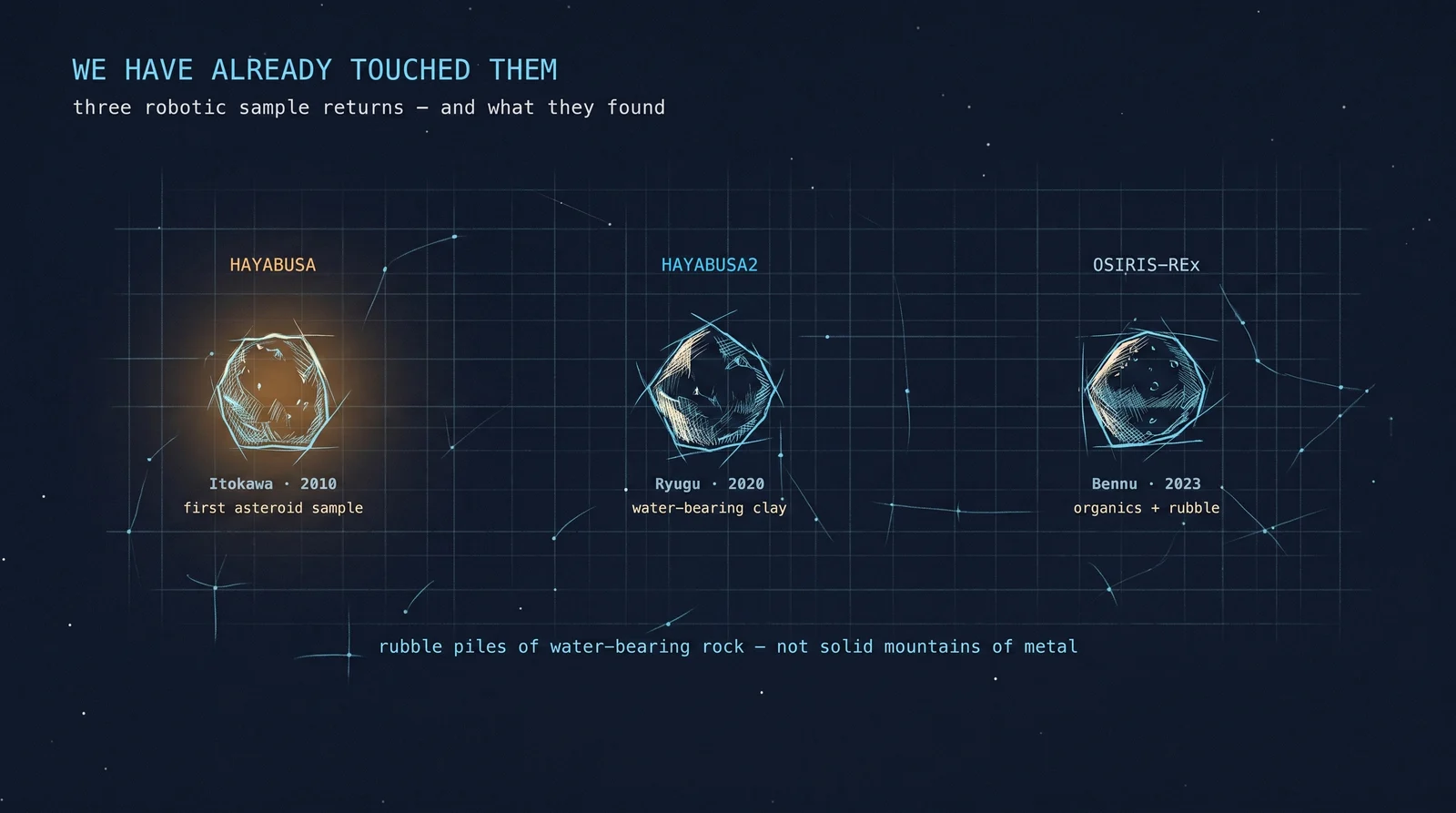
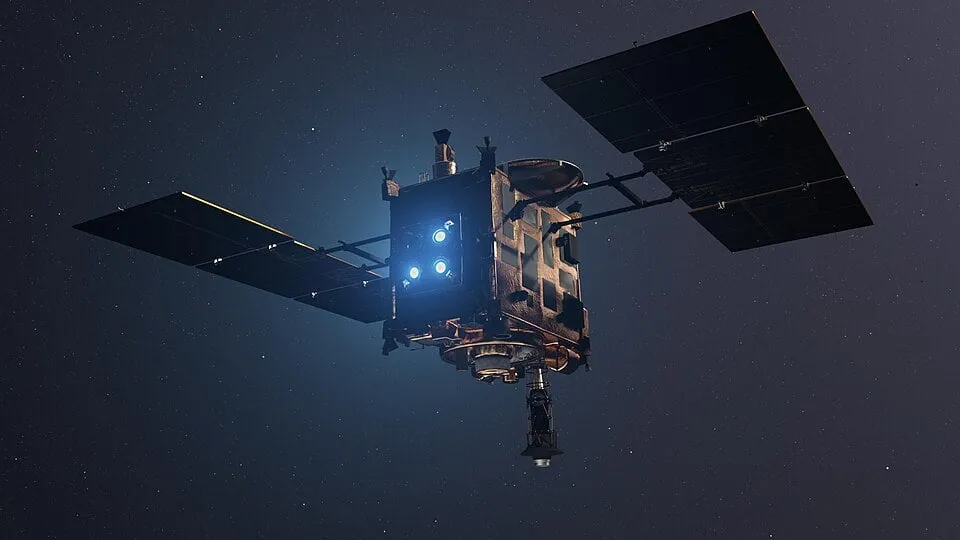
Japan's Hayabusa reached the S-type asteroid Itokawa in September 2005. Its sample collection mechanism had malfunctioned, but the spacecraft returned to Earth in June 2010 carrying approximately 1,500 sub-millimetre particles — the first samples ever returned from an asteroid. The analysis confirmed ordinary LL chondrite mineralogy: not the water-rich carbonaceous target the ISRU argument needs, but proof of concept that you can reach an asteroid, touch it, and bring pieces back.
Hayabusa2, launched in December 2014, was designed to go further. Its target was Ryugu, a C-type near-Earth asteroid — the carbonaceous variety that hydration models predicted should contain water-bearing minerals. The spacecraft arrived at Ryugu in June 2018 and spent a year and a half studying it before performing sample collection in February and July 2019. In July 2019, it also deployed a small impactor that blasted a crater in Ryugu's surface, then collected material from the exposed subsurface — material that had not been altered by space weathering. The capsule returned to Earth in December 2020. The analysis confirmed what the models predicted: Ryugu's material is rich in hydrated minerals, contains organics including amino acid precursors, and in chemical composition is closely related to CI chondrites — the most primitive and water-rich class of carbonaceous chondrites. The ore that the ISRU argument needs is there. Ryugu is not a unique body; C-type asteroids represent roughly 75% of all asteroids in the main belt and a significant fraction of near-Earth objects.
NASA's OSIRIS-REx reached the carbonaceous asteroid Bennu in December 2018 and spent almost two years mapping it before performing its Touch-And-Go sample collection in October 2020. The capsule returned to Earth in September 2023 with approximately 120 grams of material — the largest sample ever returned from an asteroid. Analysis confirmed hydrated clay minerals and carbon-rich compounds: the same ingredients the Hayabusa2 team found at Ryugu, on a different body, reached by a different nation, via a different trajectory. The result was the same. This is not a coincidence. It is confirmation that the C-type carbonaceous composition — water-bearing, organic-rich — is the rule for these bodies, not the exception.
Rubble, not rock
Here is what the missions also found, and what the headlines about asteroid mining consistently understate: Bennu and Ryugu are not solid bodies. They are rubble piles.
A rubble pile is an aggregate of loosely consolidated material — boulders, pebbles, dust — held together by gravity so weak that walking on the surface would require careful consideration of whether you might bounce off entirely. Bennu's surface gravity is approximately 6 micronewtons per kilogram. An astronaut standing on its equator would weigh less than a milligram in Earth terms. Trying to anchor a mining system — to drill, to excavate, to push against the surface with any force — generates a reaction that could push the mining equipment off the asteroid. The TAG (Touch-and-Go) event that OSIRIS-REx used to collect its sample lasted approximately six seconds of surface contact; during those six seconds, the spacecraft's sample head sank deeper into the surface than expected, because Bennu's material is less consolidated than a sandcastle. The mission team later said the spacecraft would have sunk entirely if the thrusters hadn't fired to pull it back. This is not a hostile environment in the way that Mars is hostile. It is a hostile environment in the way that a bag of loose sand floating in zero gravity is hostile: fundamentally different from every assumption that terrestrial mining engineering makes.
Hayabusa2's impactor experiment confirmed the same picture from a different angle. Its 2-kg copper impactor created a crater roughly 14 metres in diameter and 2 metres deep — larger than predicted, because the surface was more porous than expected. The DART mission, which in September 2022 redirected the asteroid Dimorphos by deliberately crashing a spacecraft into it, produced an ejecta plume and an orbital period change both larger than solid-body models predicted — consistent, again, with a loosely bound aggregate. Working in that environment is not a matter of scaling up terrestrial mining and adding vacuum suits. Anchoring against a surface you cannot push against, excavating material that floats away at centimetres per second, containing ejecta in microgravity — these are unsolved engineering problems unlike anything in the history of extraction industry. The science is confirmed. The engineering has not yet begun in earnest.
The economy above the well
The question the long view has to answer is: where does this go? The ISRU argument is logically sound. The recon confirms the resources exist. The engineering challenges are real but not in principle insoluble. The economics, however, require something that does not yet exist: demand for resources in space.
This is the timing problem that killed the first commercial wave. Planetary Resources and Deep Space Industries were building supply chains for a customer base that didn't exist yet — specifically, for the propellant-hungry beyond-LEO economy that a sustained lunar programme and eventual Mars operations would create. In 2012, when Planetary Resources was founded, the reusable launcher revolution was not yet proven, the Artemis programme did not exist, no commercial space stations were under development, and the idea of regular human Mars missions was firmly in the speculative future. The companies were, in infrastructure terms, building fuel stations before the highway. Infrastructure almost always has to wait for the traffic before it becomes viable, and space resource extraction is no different.
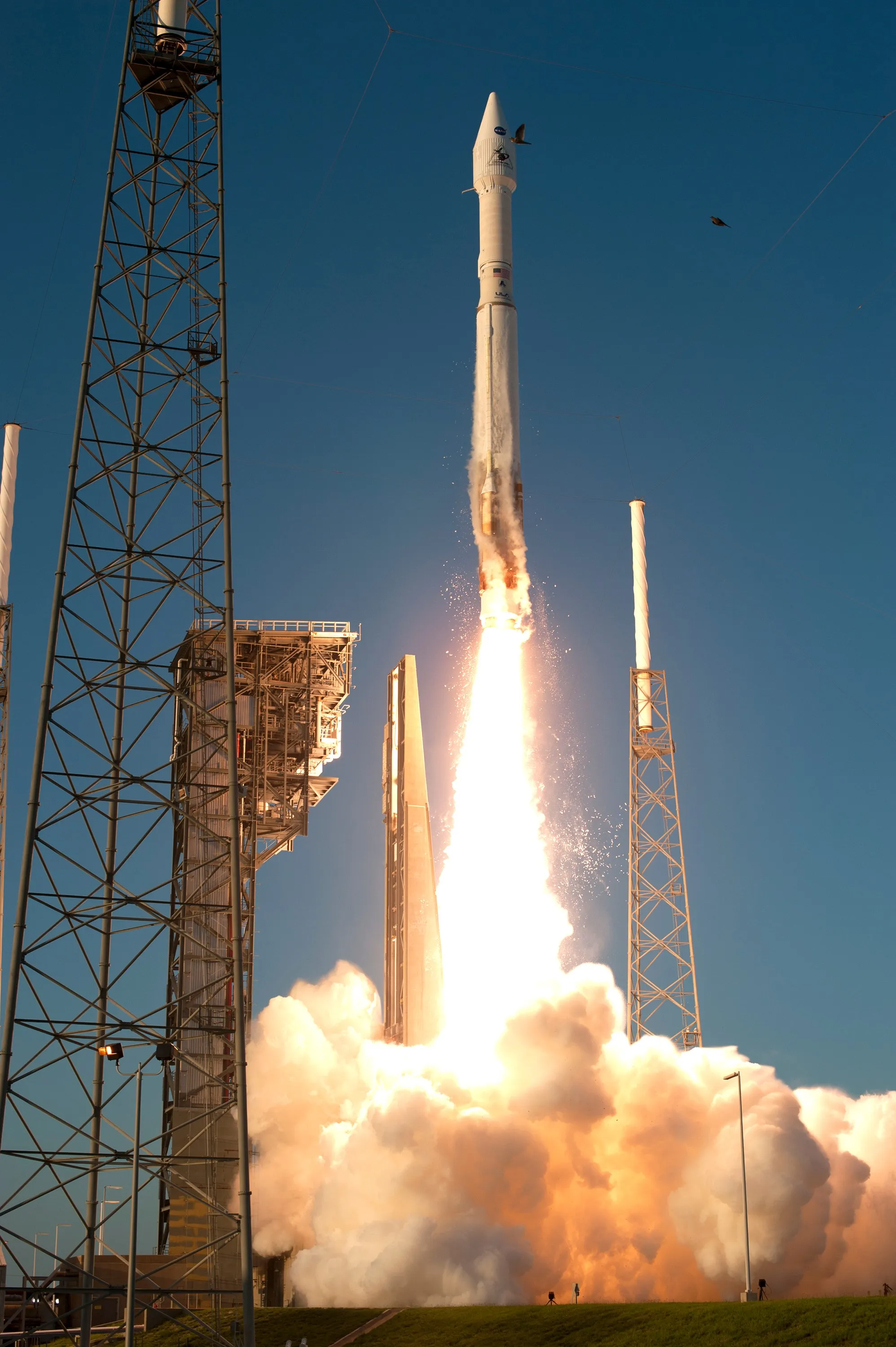
The situation in the mid-2020s is different in one respect: the traffic is closer. Reusable launch vehicles have changed the economics of reaching orbit. Commercial station programmes are under development. The Artemis programme, however delayed, has placed crewed lunar operations back on planning horizons. NASA's Psyche mission, launched in October 2023 and en route to the metallic asteroid 16 Psyche, will deliver the most thorough remote characterisation of a metallic asteroid ever attempted. The supply chain's potential customers are no longer purely hypothetical. But closer is not here. A propellant depot servicing Mars-bound spacecraft is, at minimum, a decade away from operational reality — and that estimate is optimistic, contingent on a pace of lunar development that has consistently slipped. The honest reading: asteroid resources become economically viable when, and only when, there is sustained human activity beyond low Earth orbit at a scale that makes fuel, air, and shielding the binding constraint. That constraint is approaching. The gap between approaching and here has swallowed businesses before.
What remains, after the hype has been deflated and the market-collapse fallacy disposed of, is something more durable and less exciting to press release: a structural argument that the long-term economics of human presence beyond Earth cannot be made to work without drawing on resources that are already above the gravity well. The solar system contains more water, more carbon, more structural material than the entirety of human civilisation has ever consumed, distributed across millions of bodies whose surface gravity costs almost nothing to overcome, sitting above the one thing that makes spaceflight expensive. The argument is not about quintillions of dollars. It is about the rocket equation and the direction it is pointing.
Tsiolkovsky's constraint has an escape. It is not clever chemistry or radical new propulsion — though new propulsion helps at the margins. The escape is not launching the consumables in the first place. It is finding them already above the well and using them there. Hayabusa2 brought 5.4 grams of Ryugu back to Earth. OSIRIS-REx brought 120 grams of Bennu. The next missions in this sequence won't be bringing material home. They will be learning how to leave it where it is — and use it there. That is the point the headline never reaches. Explore the small bodies in the atlas and what you are looking at is not a storehouse of Earth-deliverable treasure. It is the hardware store for a civilization that hasn't arrived yet.