NASA · USA · 1977–now

Voyager
Two probes launched in 1977 to tour the outer planets — and never came back. Half a century on, they are still flying, and still calling home from between the stars.
Robotic campaign ACTIVE
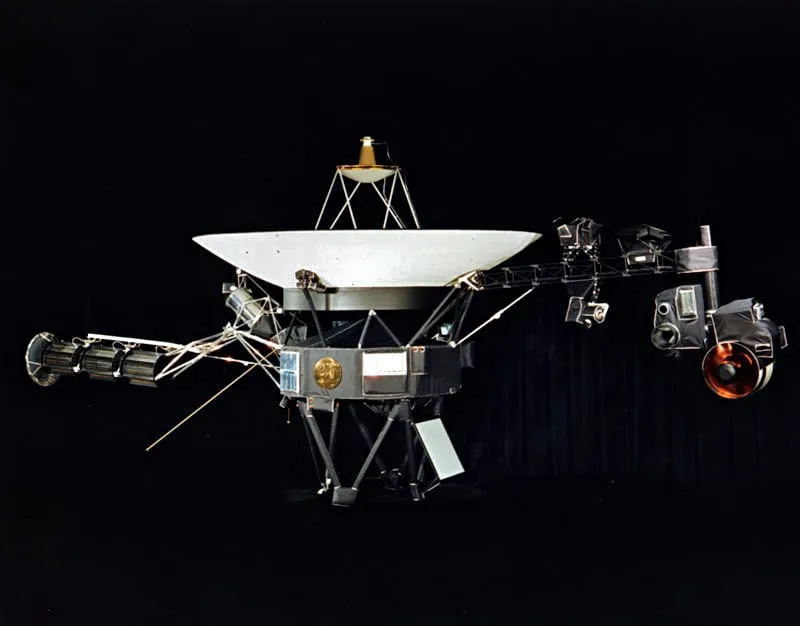
The land
Once every 176 years, the four giant planets line up on the same side of the Sun. In the mid-1960s a young engineer at NASA's Jet Propulsion Laboratory, Gary Flandro, worked out what that alignment made possible: a single spacecraft could swing past Jupiter, use the planet's gravity to fling itself on to Saturn, then Uranus, then Neptune — visiting all four in one flight that would otherwise take decades of separate missions. The catch was the calendar. The window opened in the late 1970s. Miss it, and the next chance would come in the 2150s.
The outer solar system was, at that point, almost entirely unexplored. The Pioneers were only just reaching Jupiter; Uranus and Neptune had never been anything but points of light in a telescope. NASA seized the alignment and built two nearly identical robots to fly the tour — rugged, nuclear-powered, and carrying the best cameras and instruments of the day, aimed at worlds no one had ever seen up close.
Goals
The goal was reconnaissance on a scale never attempted: a first close look at Jupiter and Saturn, and — if the machines survived long enough — the only close look anyone was likely to get at Uranus and Neptune for generations. Two spacecraft flew so that a failure of one would not lose the whole tour, and so that between them they could cover trajectories no single probe could fly.
There was a second, stranger goal, added by a committee led by the astronomer Carl Sagan: each craft would carry a message. Bolted to its side was a gold-plated phonograph record holding the sounds of Earth — music, greetings in dozens of languages, a baby's cry, birdsong — sealed for whoever, or whatever, might find it in the deep future. It was a scientific mission that also, deliberately, reached toward eternity.
Outcome
The tour delivered beyond its brief. At Jupiter in 1979 the Voyagers found active volcanoes on the moon Io — the first ever seen beyond Earth — and the smooth ice of Europa hiding what looked like an ocean. At Saturn they resolved the rings into thousands of intricate strands and swept close past the haze-wrapped moon Titan. That Titan flyby bent Voyager 1's path up and out of the plane of the planets, sending it climbing toward the edge of the solar system.
Voyager 2 flew the full Grand Tour. It reached Uranus in 1986 and Neptune in 1989 — the only spacecraft ever to visit either world — finding a planet tipped on its side, a deep-blue giant with the fastest winds in the solar system, and a moon, Triton, with geysers of nitrogen erupting into space. To this day, everything humanity knows from close range about the ice giants was gathered in those two brief flybys.
Then the mission simply kept going. In 1990, from beyond Neptune, Voyager 1 turned its camera back and photographed the Earth as a single point of light. In 2012 it crossed the heliopause — the boundary where the Sun's wind gives way to the gas between the stars — and Voyager 2 followed in 2018. Nearly fifty years after launch, both are still transmitting, their power fading, their instruments switched off one by one to stretch the signal a little longer.
The story
The story of Voyager is of machines that outlived their makers' every expectation. They were designed for a four-year flight to Saturn on 1970s electronics — computers with less memory than a modern key fob — and they have run for nearly half a century, reprogrammed across billions of kilometres by engineers patching code into a spacecraft so distant that a command takes almost a day to arrive. The mission's defining quality is endurance: a bet on ruggedness and margin that paid off far past anyone's plan.
Its most remembered moment carried no science at all. As Voyager 1 left the planets behind, Carl Sagan argued that it should turn around and photograph the Earth one last time — not for data, but for perspective. The image it returned showed home as a pale blue dot, a mote of dust in a sunbeam, and Sagan's words about it — that everyone who ever lived did so on that speck — became one of the most quoted passages in the literature of space. A reconnaissance probe had, almost by accident, taken the definitive portrait of human smallness.
And there is the record. Each Voyager carries a message with no realistic hope of ever being found — the odds of either craft passing close to another star in any meaningful timeframe are vanishingly small. But the point was never really the aliens. The Golden Record was a mirror: an attempt to say who we are, addressed to the future and to ourselves, sent out on the only two craft yet to cross into interstellar space.
What it gave back
Voyager's first legacy is the map itself. Its flybys turned Jupiter, Saturn, Uranus and Neptune and their moons from points of light into places, and the Uranus and Neptune encounters remain — decades later — the only close data humanity has ever gathered on the ice giants. Every proposal to return to those worlds is still built on what two 1977 spacecraft saw in a few hours.
Its second is the frontier it reached. By crossing into interstellar space, the Voyagers became the first instruments to measure the boundary of the Sun's influence from the outside — data no other mission has ever returned, and none will for decades. They are, right now, the most distant human-made objects in existence, and still reporting.
Its third legacy is cultural. The Pale Blue Dot and the Golden Record gave the space age two of its most durable images of what Earth is and what it is worth — a reframing of the planet as a single, small, shared thing that has outlived every specific discovery the mission made.
What we can learn
The lesson of Voyager is to seize the window when it opens. The planetary alignment that made the Grand Tour possible would not wait, and would not come again for 176 years; the program's success began with the decision to be ready to launch in 1977, on that specific tide, rather than a decade later when it would have been easier. Some opportunities are set by the sky, not the schedule — and they are taken or lost.
The deeper lesson is to build with far more margin than the plan requires. The Voyagers were designed for a mission a tenth as long as the one they have flown, and they endured because their makers over-built them — redundant systems, reprogrammable computers, power to spare. Ambition that plans only for the expected mission ends with the expected mission; the ones that keep going are the ones built for more than they were asked to do.
Missions
- 1977
 the only spacecraft to visit all four giant planets, and the only close look humanity has ever had at Uranus and Neptune
 - 1977
 flew Jupiter and Saturn, turned to photograph the whole solar system, and became the first human-made object to reach interstellar space
 - 1977 The Golden Record a gold-plated phonograph record bolted to each craft — sounds, music, and greetings from Earth, aimed at whoever might find it in a billion years
- 1990 The Pale Blue Dot on 14 February 1990, from beyond Neptune, Voyager 1 turned back and photographed the Earth as a single pixel
- 2012 Interstellar space Voyager 1 crossed the heliopause in 2012, Voyager 2 in 2018 — the first machines to leave the Sun's bubble and enter the space between the stars, still calling home