NASA · USA · 1962–1975

Mariner
Before any other planet was more than a smudge in a telescope, a run of small American probes went out to see them — and returned the first photographs ever taken of another world.
Robotic campaign COMPLETED
The land
In the early 1960s the planets were still, essentially, points of light. Venus was imagined as a warm, cloudy twin of Earth, perhaps with oceans; Mars, through the best telescopes, showed markings that some still read as canals, and the century-old question of Martian life was unresolved. Everything known about the other worlds came from squinting across tens of millions of kilometres. To learn what they actually were, someone had to fly close and look.
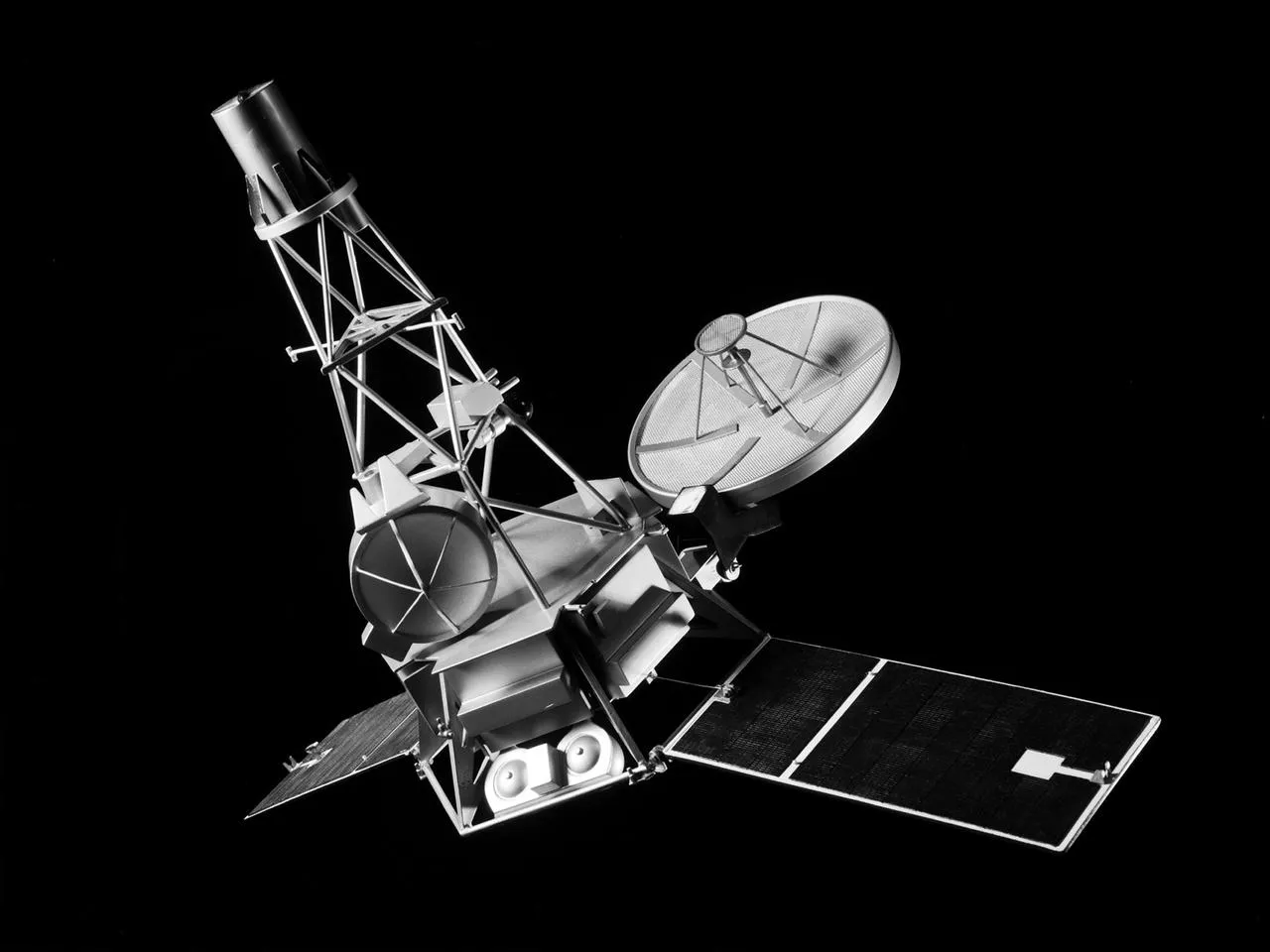
Mariner was NASA's first attempt to do that — a family of small, lightweight interplanetary probes, built fast and flown often, aimed at Venus, Mars, and eventually Mercury. Several failed; the program pressed on. Between 1962 and 1975 the Mariners carried out the first reconnaissance of the inner solar system, and in doing so replaced imagination with photographs.
Goals
The goal was first contact with the other planets: to fly a spacecraft close enough to Venus and Mars to measure what they were actually made of and, above all, to photograph them. A single close pass returning a handful of pictures and readings would tell humanity more about a planet than a century of telescope work — the difference between a smudge and a surface.
The later goal grew more ambitious: not just to fly past, but to stay. Mariner 9 was built to carry enough fuel to brake into orbit around Mars and study the whole planet over months — the step from a glimpse to a survey — while Mariner 10 aimed to reach Mercury by a route no one had flown, stealing speed from Venus's gravity along the way.
Outcome
The Mariners rewrote the inner solar system one flyby at a time. Mariner 2 reached Venus in 1962 — the first spacecraft ever to reach another planet — and found not a tropical twin but a furnace, its surface hundreds of degrees hot beneath crushing clouds. Three years later Mariner 4 flew past Mars and sent back the first photographs ever taken of another planet from close range: a cratered, moon-like desert that quietly killed the old dreams of canals and civilisations.
Mariner 9 went further and stayed. In 1971 it became the first spacecraft to orbit another planet, arriving at Mars in the middle of a global dust storm that hid the surface for weeks. When the dust cleared it mapped the entire planet — and revealed a Mars far grander than Mariner 4's craters had suggested: the largest volcano in the solar system, a canyon system stretching a continent's width, and, most provocatively, the dry channels of what had once been running water.
Mariner 10 closed the program with two firsts. In 1974 it became the first spacecraft to reach Mercury, photographing a scorched, cratered world — and it got there by flying past Venus and using the planet's gravity to bend its path inward toward Mercury, the first use of an interplanetary gravity-assist slingshot that every deep-space mission since has depended on.
The story
The story of Mariner is first contact — the moment each planet stopped being an idea and became a place. Every world the program reached had, until then, been known only by inference; Mariner returned the first hard data and the first real pictures, and in each case the reality was different from the dream. Venus was not a twin but a hell. Mars was not canal-laced but cratered — and then, on closer inspection, carved by ancient water after all. The program's gift was to replace centuries of guessing with the plain evidence of a camera.
It is also the story of how planetary exploration learned its basic moves. Mariner 4 proved you could fly across the solar system and photograph a planet; Mariner 9 proved you could stop and survey one; Mariner 10 proved you could use a planet's gravity to reach another for free. Those three capabilities — the flyby, the orbiter, and the gravity assist — are the grammar of every mission that followed, and the Mariners are where each was first written.
And it set up everything after it. Mariner 9's global map of Mars, with its hints of vanished water, is what sent Viking to search for life there a few years later. The Mariner design lineage, extended for the outer planets, became the Voyagers. The program was the first draft of American planetary science — the one that established both what the inner planets were and how, from then on, they would be explored.
What it gave back
Mariner's first legacy is the inner solar system as we now know it: Venus revealed as a furnace, Mars mapped from craters to canyons, Mercury photographed for the first time. The program returned the first ground truth about the neighbouring planets, and the modern picture of each begins with a Mariner.
Its second is the toolkit. The flyby, the planetary orbiter, and the interplanetary gravity-assist slingshot were all first accomplished by Mariners, and all three remain fundamental to how spacecraft explore. Later missions fly farther and carry more, but they still use the moves Mariner invented.
Its third is everything it made possible. Mariner 9's Mars set the target for Viking; the Mariner lineage grew into Voyager; and the whole idea that the planets could be visited and understood, not just observed, was established by these small probes. They were the first chapter, and the rest of planetary exploration is written in their grammar.
What we can learn
The lesson of Mariner is that a single close look can overturn a century of assumption. Telescopes had studied Venus and Mars for generations and got the essentials wrong — a warm twin, a canal-laced world of life. A few hours of flyby data corrected both. When the real evidence is finally gathered, it often bears little resemblance to the careful theories built in its absence; the first direct measurement is worth more than any amount of inference.
The deeper lesson is that capabilities compound. Mariner did not set out to invent the gravity assist or the planetary orbiter as ends in themselves — it solved the problem in front of it, and each solution became a permanent tool the next mission could assume. Progress on hard frontiers is often less about single triumphs than about building a grammar of moves that everyone who comes after gets to use for free.
Missions
- 1962 Mariner 2 reaches Venus in December 1962 Mariner 2 became the first spacecraft to reach another planet, finding Venus not a tropical twin of Earth but a furnace hundreds of degrees hot
- 1974 Mariner 10 at Mercury the first spacecraft to visit Mercury, and the first to use one planet's gravity to reach another — the slingshot trick every deep-space mission has used since