NASA · USA · 1972–2003

Pioneer
Before Voyager could tour the outer planets, someone had to prove the road was survivable. Two small probes went first — through the asteroid belt, past Jupiter, and out.
Robotic campaign COMPLETED
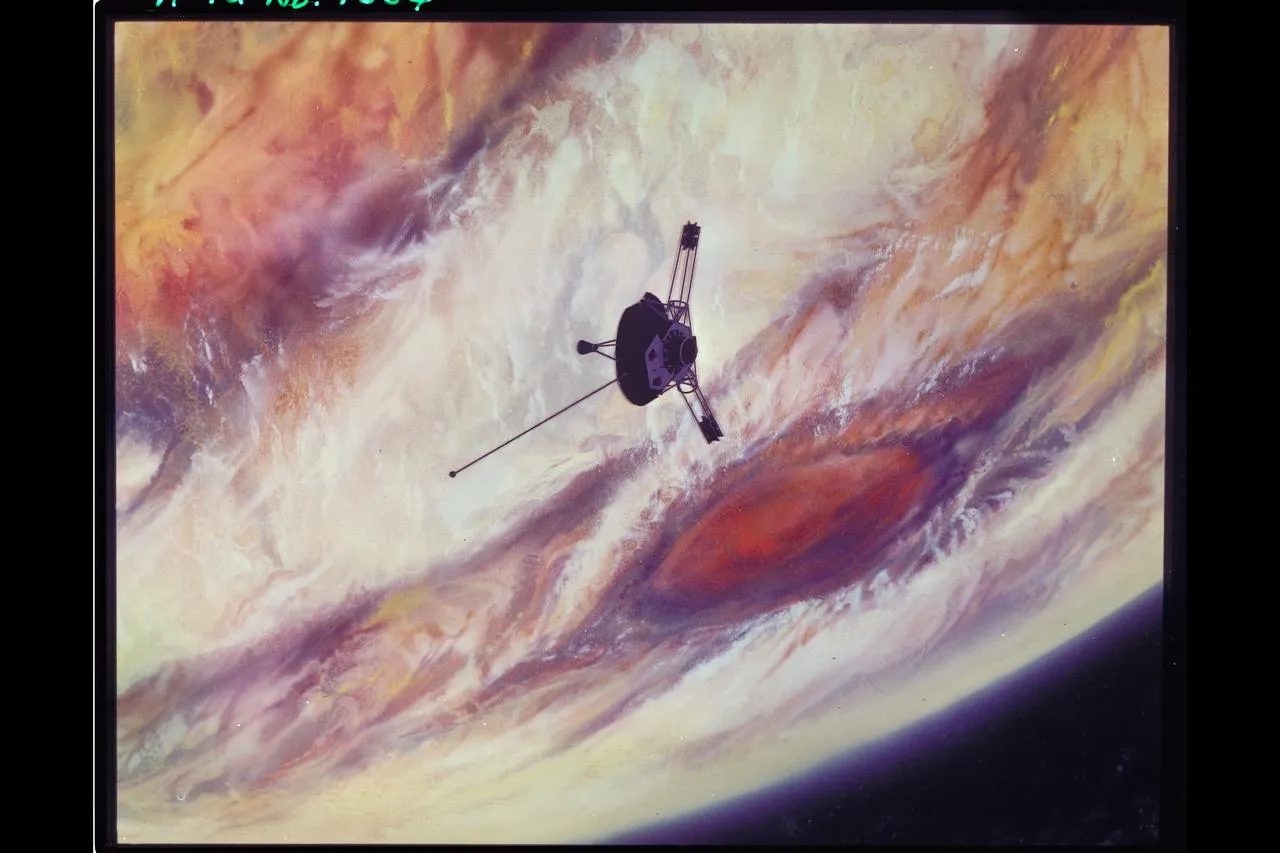
The land
In the early 1970s the outer solar system was not just unexplored; it was thought to be dangerous to reach. Between Mars and Jupiter lay the asteroid belt, and no one knew whether a spacecraft could cross it without being destroyed by debris. Beyond it, Jupiter's radiation belts were understood to be lethal to electronics. The giant planets were worth visiting, but the path to them ran through two hazards no machine had ever faced.
The Pioneers were the scouts sent to find out. Small, spin-stabilised, and comparatively simple, Pioneer 10 and 11 were built to go first — to test whether the belt could be crossed and whether a probe could survive a close pass by Jupiter — so that the far more expensive Voyagers, already being planned, would know what they were flying into.
Goals
The goal was reconnaissance in the most literal sense: prove the route. Cross the asteroid belt and measure how much of a threat it really was. Fly close to Jupiter and see whether a spacecraft could take the radiation and return useful data. The science — first close looks at Jupiter, and then, for Pioneer 11, the first visit to Saturn — was real, but the deeper purpose was to clear the way.
Each also carried a small gold plaque — designed by Carl Sagan and Frank Drake — engraved with a man, a woman, and a map to the Sun. It was a modest afterthought compared with Voyager's later Golden Record, but it was the first: the first object humanity deliberately inscribed with a message and threw toward the stars.
Outcome
Both fears proved unfounded, which was the point. Pioneer 10 crossed the asteroid belt without harm — the belt, it turned out, was mostly empty space — and in December 1973 became the first spacecraft to reach Jupiter, surviving the radiation and returning the first close images of the giant planet. It then became the first human-made object placed on a trajectory to leave the solar system entirely.
Pioneer 11 went further. After its own Jupiter flyby it used the planet's gravity to cross the solar system and reach Saturn in 1979 — the first spacecraft ever to do so — flying through the ring plane to test whether the region was safe, and finding the gap that the Voyagers would use in the years that followed. The scouts had mapped the hazards; the tour could proceed.
The Pioneers kept transmitting for decades as they receded. Pioneer 10's last faint signal was received in 2003, from more than twelve billion kilometres away. Both are still out there, silent now, coasting toward the stars — Pioneer 10 in the direction of the star Aldebaran, a journey it will take some two million years to complete.
The story
The story of Pioneer is the unglamorous, essential work of going first. The Voyagers are remembered for the Grand Tour; the Pioneers are the reason the Grand Tour could be attempted at all. They took the risks that turned unknown dangers into measured ones — proving the asteroid belt was crossable and Jupiter's radiation survivable — so that the missions behind them could be designed with confidence instead of fear. Someone always has to test the road, and it is rarely the one that gets the credit.
It is also a story of doing a great deal with a little. The Pioneers were modest craft, simpler and cheaper than the Voyagers that followed, and they still achieved a run of genuine firsts — first through the belt, first to Jupiter, first to Saturn, first out of the solar system. They are proof that a well-aimed small mission can open a frontier that the flagship then walks through.
And they carried the first message. The Pioneer plaque was a quieter gesture than the Golden Record — a single engraved sheet rather than a library of sounds — but it came first, and it framed the idea that a spacecraft leaving forever ought to say something about who sent it. Every message humanity has since aimed at deep space descends from that small gold plate bolted to a scout.
What it gave back
Pioneer's first legacy is the road it opened. By proving the asteroid belt crossable and Jupiter's radiation survivable, it converted the outer solar system from a theoretical hazard into a reachable destination — the direct enabler of Voyager, Galileo, Cassini, and every mission to the giant planets since.
Its second is a set of permanent firsts: first through the belt, first to Jupiter, first to Saturn, first object on an escape trajectory out of the solar system. Those entries in the record do not expire, and they all belong to two small, cheap probes.
Its third is the plaque — the first deliberate message from Earth to the cosmos, and the template for the Golden Records that followed. Pioneer established that a craft leaving forever should carry some account of its makers, and that idea has outlived the missions themselves.
What we can learn
The lesson of Pioneer is the value of the scout. The most important thing the Pioneers did was reduce uncertainty for the missions behind them — turning guesses about the asteroid belt and Jupiter's radiation into hard numbers a designer could build against. On any real frontier, a cheap probe sent to measure the danger is worth far more than its cost, because it lets the expensive follow-on be built for the world as it is rather than as it was feared to be.
The deeper lesson is that going first rarely brings the glory, and matters anyway. The Pioneers are less famous than the Voyagers they made possible, but without them the Grand Tour would have been a leap into the unknown rather than a calculated flight. Some of the most important work is the reconnaissance nobody remembers — and it is worth doing well precisely because everything after it depends on it.
Missions
- 1972
 the first spacecraft to cross the asteroid belt and reach Jupiter, and the first put on a course to leave the solar system entirely
 - 1972 The Pioneer plaque a small gold-anodised plaque on each craft showing a man, a woman, and the Earth's location — the first physical message from humanity aimed at the stars
- 1973
 flew Jupiter, then became the first spacecraft to reach Saturn — scouting the path and the ring hazards the Voyagers would follow
 - 1978 Pioneer Venus a separate pair of Pioneers reached Venus in 1978 — an orbiter that radar-mapped the planet through its clouds, and probes that plunged into its crushing atmosphere