CMSA · China · 1999–now

Shenzhou
The capsule that made China the third nation to launch its own people — built slowly, tested exhaustively, and never once lost a crew.
Crewed campaign ACTIVE
The land
For forty years, only two countries had ever launched a human being into space on their own rocket: the Soviet Union and the United States. In October 2003 a third joined them, quietly and without a race to win. Yang Liwei rode a Shenzhou capsule to orbit, circled the Earth fourteen times, and came home — and China became a human spacefaring nation on its own terms, using its own vehicle, its own launcher, and its own astronaut corps. There had been no competitor to beat. There was only a capability to build, and China had spent a decade building it.
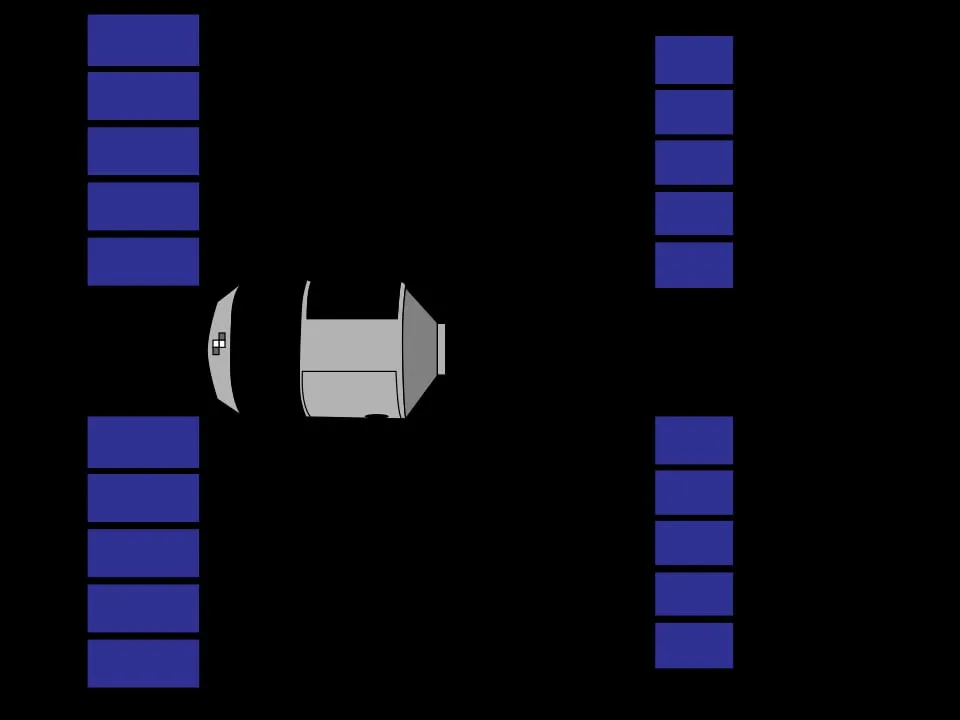
Shenzhou — "Divine Vessel" — looks, at a glance, like a Soyuz: the same three-part layout of orbital module, descent capsule, and service module, the legacy of a 1990s technology relationship with Russia. But it is larger, entirely Chinese-built, and improved in a telling way — its orbital module carries its own solar panels and can keep flying as a free satellite after the crew comes home. It is Soyuz's architecture taken to school and handed back with better marks.
Goals
The goal was never a stunt flight; it was a permanent, independent human spaceflight capability. That meant building not just a capsule but the entire apparatus around it — a rated launch vehicle, a mission-control network, a recovery force, a training program, and a corps of astronauts drawn from the air force. Shenzhou was the vehicle at the center of a national capability, and the program refused to fly a crew until every piece of that capability had been proven.
Over the longer arc, the goal was to feed a station. Every capability Shenzhou proved — orbital flight, spacewalks, rendezvous, long-duration stays — was a prerequisite for the Tiangong stations that followed. The crewed program and the station program were designed as two halves of one plan: build the vehicle and the people first, then give them somewhere to go.
Outcome
By any measure of reliability, Shenzhou has been a quiet triumph. Since the first uncrewed test in 1999 it has flown crews to orbit, conducted China's first spacewalk (Shenzhou 7, 2008), performed the country's first crewed docking (Shenzhou 9, 2012), and delivered every resident crew to the Chinese Space Station since 2021 — without ever losing an astronaut. In a domain where both of its predecessors paid for their firsts in lives, China reached the same milestones and brought everyone home.
The program also built something less visible but just as durable: a deep bench. China now flies experienced commanders alongside rookies, has put women in orbit and on spacewalks, and rotates crews through the station on a regular cadence. Shenzhou is no longer a demonstration that China can fly people — it is the routine, dependable bus that keeps its station staffed.
The story
The story of Shenzhou is the story of a country that decided the milestones mattered less than the method. Yang Liwei's 2003 flight arrived four decades after Gagarin's; China gained nothing by being early because it was never trying to be. It was trying to be certain. Each Shenzhou flight retired one specific risk and cleared the way for the next, and the program's willingness to wait — to fly uncrewed tests until the vehicle had earned trust — is precisely why its human record is unblemished.
There is a human texture to it too. The astronauts are national figures, drawn largely from military pilots, trained for years for flights that are planned far in advance and executed almost exactly as scheduled. Where the early Soviet and American programs were improvisational and often terrifying, China's is procedural to the point of seeming unglamorous — and that lack of drama is the whole point. A program that produces no near-death stories is a program that is working.
And it is inseparable from independence. Shenzhou exists because China wanted to fly its own people without asking anyone's permission or borrowing anyone's seat — the same impulse that, when China was excluded from the ISS, produced the Tiangong stations. The capsule is the vehicle; the deeper cargo it carries is autonomy.
What it gave back
Shenzhou's first legacy is the plain fact of the third seat at the table. Human spaceflight is no longer a two-power capability frozen in the Cold War; it is a living, expanding one, and China's uninterrupted safety record gives its program a credibility that firsts alone never could.
Its second legacy is a proven ladder for everything that comes next. The same step-by-step, prove-it-first method that carried Shenzhou from uncrewed test to station ferry is now being pointed at the Moon — a new deep-space crew capsule, a heavy lunar lander, and a stated goal of landing astronauts by 2030. Shenzhou is the rehearsal; the Moon is the performance.
And it is a standing offer. China has begun inviting astronauts from other nations to train for and fly aboard its station on Shenzhou-delivered crews — making the vehicle not just a national bus but a potential ride for countries that have none of their own.
What we can learn
The lesson of Shenzhou is that in human spaceflight, patience is a safety system. By refusing to rush a crew onto an unproven vehicle, China achieved every major milestone its predecessors did without paying their price in lives. Being decades late cost it nothing that mattered; being careful bought it everything.
The deeper lesson is about what independence is worth. A borrowed seat can be taken away; a capability you built yourself cannot. Shenzhou is the vehicle that guarantees China never has to ask — and that guarantee, more than any single flight, is the thing the program was really built to deliver.
Missions
- 1999 first uncrewed test flight — the capsule flies and returns before anyone rides it
- 2003 Shenzhou 5 Yang Liwei orbits Earth 14 times — the first Chinese astronaut in space, and China becomes the third nation to launch a human on its own rocket, 42 years after Gagarin
- 2008 Shenzhou 7 Zhai Zhigang performs China's first spacewalk — the third country ever to conduct an EVA
- 2012 Shenzhou 9 first crewed docking, with Tiangong-1; Liu Yang becomes the first Chinese woman in space
- 2016 Shenzhou 11 a 30-day stay aboard Tiangong-2 — China's longest crewed mission to that point, proving month-scale habitation
- 2021 Shenzhou 12 the first crew to board the permanent Chinese Space Station; Shenzhou-14 (2022) begins continuous occupation
Hardware
- Shenzhou crew spacecraft
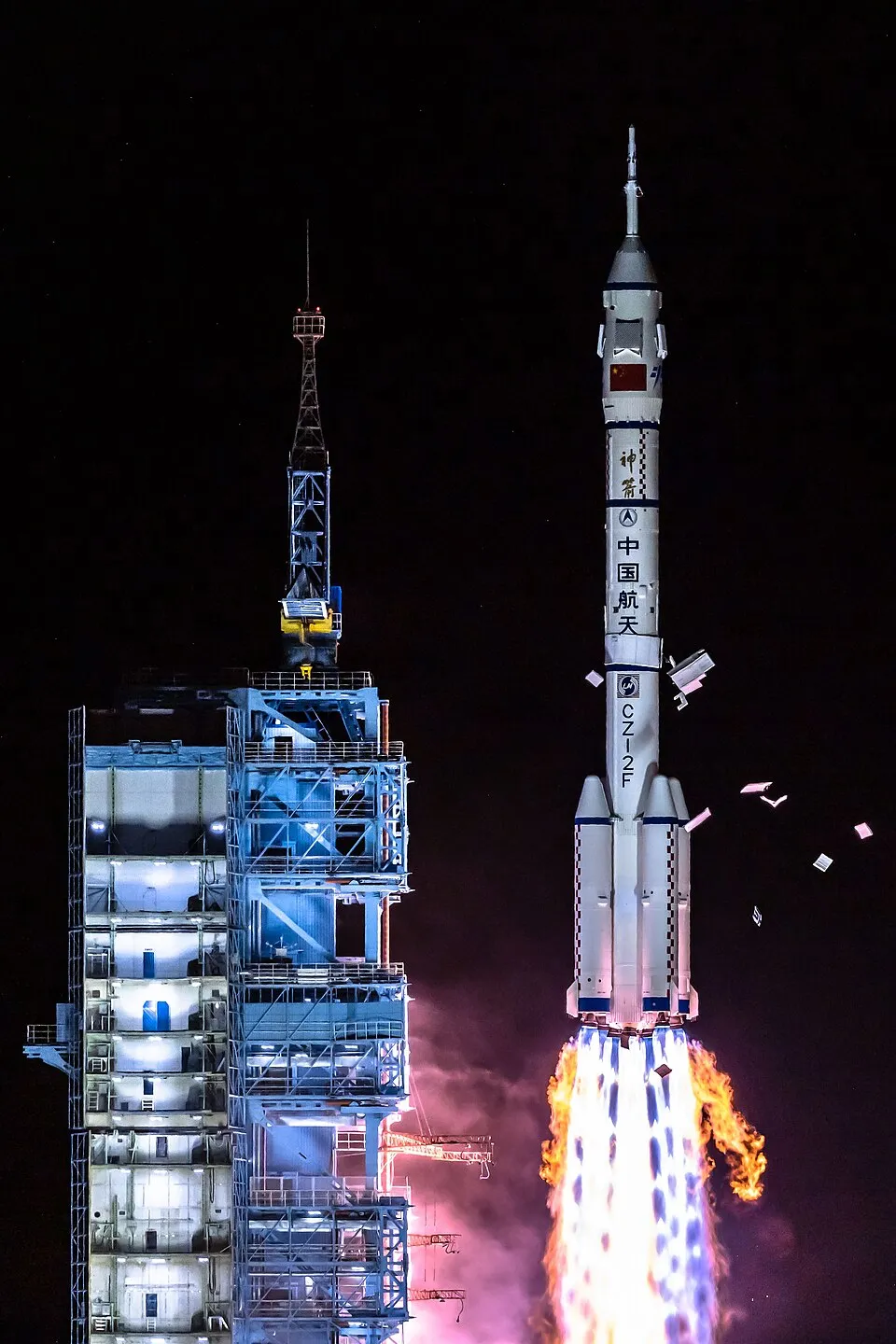
- Long March 2f crew launcher
- Shenzhou Iva launch/entry suit