SpaceX · USA · 2019–now

Starship
The biggest rocket ever built, designed to be fully and rapidly reusable — the vehicle SpaceX means to carry people to Mars.
Crewed campaign ACTIVE
The land
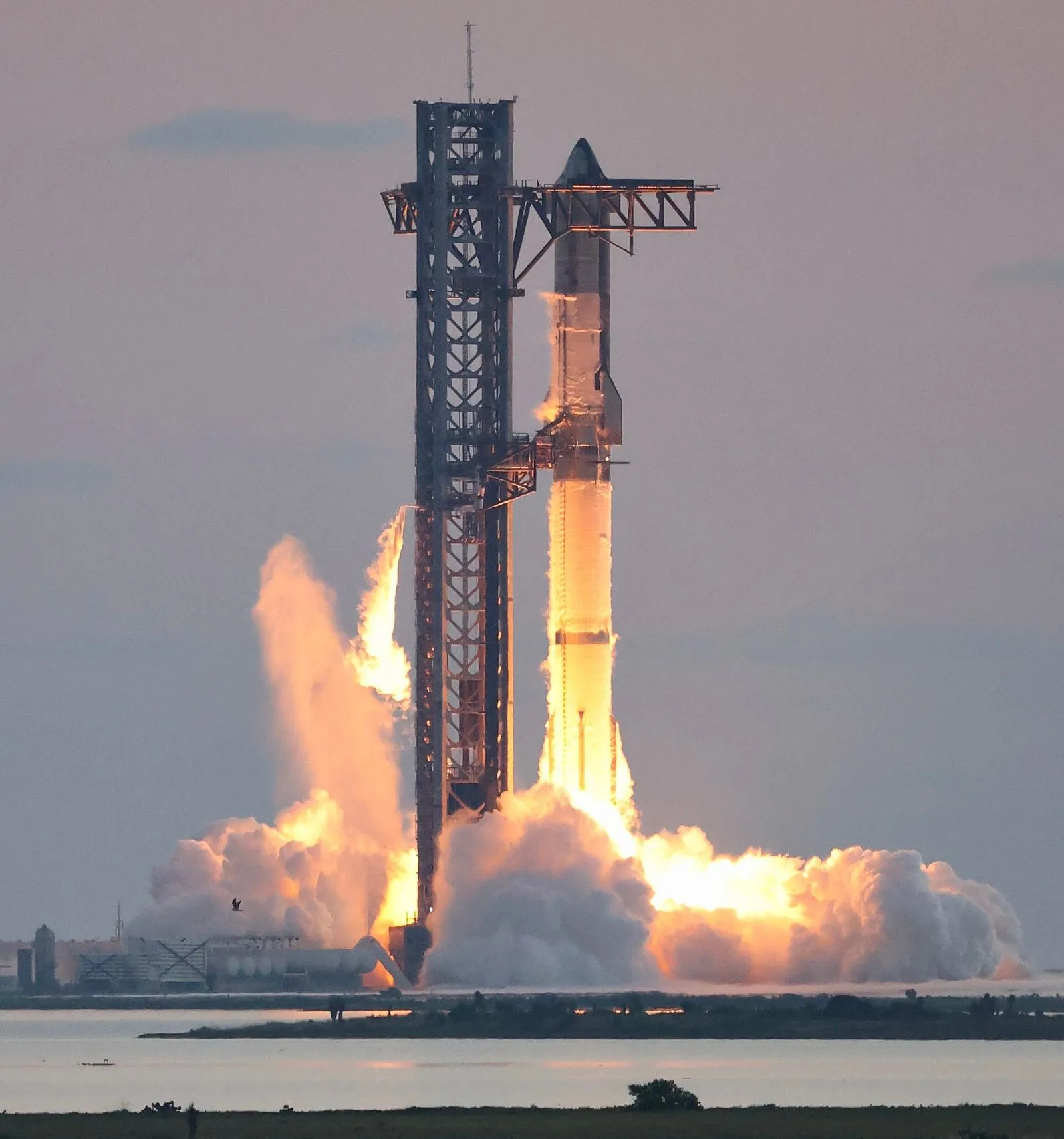
Every rocket that has ever launched people has thrown most of itself away. Even Falcon 9, which recovers its first stage, discards the upper stage on every flight. Starship is an attempt to end that entirely — a launch system where both stages fly back, land, and are refuelled and reflown, like an aircraft rather than an artillery shell. It is also simply enormous: taller than the Saturn V, with more thrust than any rocket in history, built not to fly a mission or two but to fly constantly, cheaply, for decades.
The reason for the size and the reuse is a single destination. SpaceX's stated purpose since its founding has been to make humanity multiplanetary, and the arithmetic of Mars is brutal: sending enough people and cargo to build a settlement there requires lifting more mass, more often, and far more cheaply than any expendable rocket could ever manage. Starship is the answer worked backwards from that goal — the vehicle you would need if you were serious about not just visiting Mars but living there.
Goals
The immediate goal is full and rapid reusability: a booster and a ship that both return, land, and fly again with minimal refurbishment, driving the cost per kilogram to orbit down by another order of magnitude beyond what Falcon 9 achieved. Reuse of the first stage made space cheaper; reuse of everything, flown often, is meant to make it cheap enough to change what is possible.
The nearer-term goals are concrete missions that need it. NASA has selected Starship as one of two Human Landing Systems that will put Artemis astronauts on the Moon — the other being Blue Origin's Blue Moon — the first crewed lunar landers since Apollo. Starship is also meant to launch the larger next-generation Starlink satellites, and eventually to carry cargo and crews to Mars. The Moon is the proving ground; Mars is the point.
And there is a goal that underpins all of it: refuelling in orbit. A Starship bound for the Moon or Mars launches nearly empty of the propellant it needs for the journey, and is filled up by a series of tanker Starships rendezvousing with it in Earth orbit. This orbital-refuelling architecture is unproven at scale and is the single hardest thing the program must demonstrate — the linchpin the whole deep-space plan hangs on.
Outcome
As of the mid-2020s, Starship is a program in the middle of its story, not the end. It has flown: a single-engine test article hopped and landed in 2019, an upper stage flew high and landed intact in 2021, the full stack has launched repeatedly since 2023, and in 2024 the Super Heavy booster was caught out of the air by the launch tower's arms — a genuinely new achievement. But it has not yet flown people, reached orbit with a payload routinely, or demonstrated orbital refuelling. The hardest milestones are still ahead.
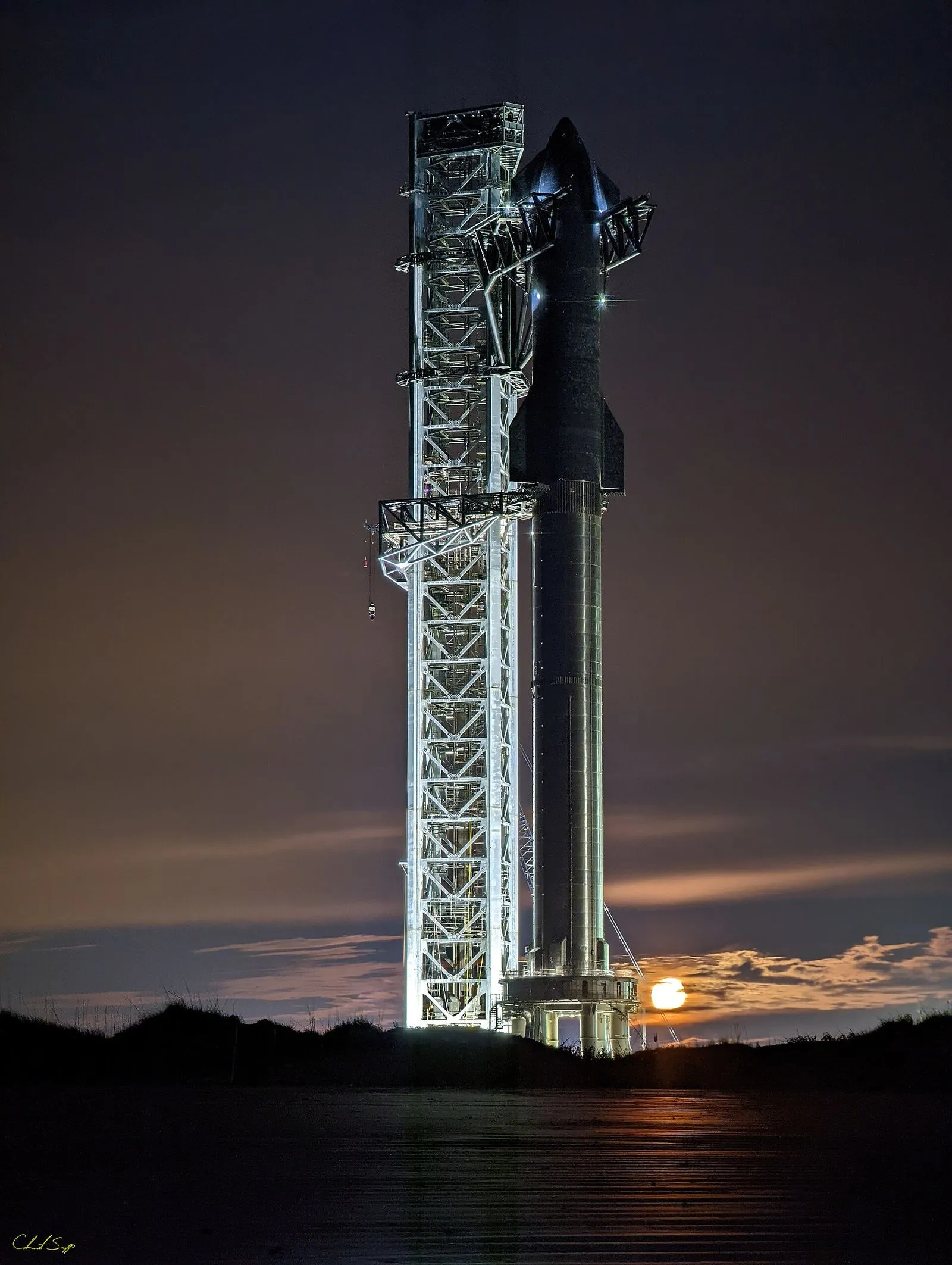
The development style is deliberately, spectacularly public. Where traditional programs test on the ground for years to avoid a single failure, Starship flies early prototypes expecting them to explode, treating each loss as data bought cheaply. That approach has produced dramatic footage and rapid progress — and also real friction, over environmental impact around the launch site, over debris, and over whether move-fast iteration is appropriate for a vehicle meant to eventually carry humans.
The story
Starship is Falcon 9's method scaled to its logical extreme. The company that learned to land a booster by crashing dozens is now learning to fly a fully-reusable super-heavy rocket the same way — building prototypes fast, flying them before they are perfect, and improving on a cadence no traditional program attempts. The explosions are not setbacks in this framing; they are the cost of information, and the willingness to pay that cost in public is the whole competitive advantage.
It is also the most ambitious single machine in spaceflight, and the most uncertain. Nothing about it is guaranteed: orbital refuelling has never been done at scale, rapid reuse of a heat-shielded upper stage is unproven, and the leap from landing test articles to safely flying crews to another planet is vast. Starship might compress the timeline to the Moon and Mars dramatically, or it might spend a decade proving harder than expected. Both outcomes are live, and the program is honest that the hardest parts remain unproven.
Underneath the engineering is a wager about purpose. Apollo went to the Moon to win a race and then stopped, because the goal was the arrival, not the staying. Starship is built on the opposite premise — that the point is not to plant a flag but to move enough mass, often enough, to build something permanent off Earth. Whether or not it succeeds, it represents a different reason to go: not to prove a nation's superiority, but to make the human presence in space large enough to last.
What it gave back
Starship's legacy is still being written, but its influence is already real. By making full reusability and orbital refuelling the assumed architecture of the future, it has reset what a serious deep-space program is expected to look like — and its selection as one of the Artemis lunar landers ties America's return to the Moon directly to whether this vehicle works.
If it succeeds, the legacy is a step-change in access to deep space: cheap, high-cadence lift measured in hundreds of tonnes, enough to make lunar bases and Mars missions logistically possible rather than merely conceivable. If it struggles, the legacy is still a demonstration of how far the fly-fail-fix method can be pushed — and where it meets its limits.
Either way, Starship has already changed the conversation. The question in human spaceflight is no longer whether reusability works — Falcon settled that — but how far it scales, and whether it can carry people beyond Earth. Starship is the biggest bet anyone has placed on the answer being 'all the way'.
What we can learn
The lesson Starship is testing is whether the method that made small rockets cheap can make enormous ones cheap too. Iteration through visible failure worked for Falcon; Starship is the experiment in whether it scales to the largest, most complex vehicle ever built — and whether it can cross the line into human spaceflight, where failure is far less acceptable. The answer is not yet in.
The deeper lesson is about designing backwards from a goal. Starship makes no sense as an incremental improvement to existing rockets; it only makes sense if the real objective is settling another planet, and every strange choice — the size, the full reuse, the orbital refuelling — follows from that. Whether or not Mars is reached, the vehicle is a lesson in what it looks like to engineer for an end state most of the industry considers a fantasy.
Missions
- 2019 Starhopper a single-engine test article hops 150 metres and lands — the first flight of the program, proving the basic control
- 2021 SN15 lands after a run of spectacular explosions, a Starship upper stage flies high and lands intact — the fly-fail-fix method applied to the biggest rocket ever built
- 2023 First integrated flight the full stack — Super Heavy booster and Starship — launches together for the first time; it clears the pad and is lost minutes later, and the data feeds the next attempt
- 2023 the uncrewed demonstration flights on the road to orbit, the Moon, and Mars
- 2024 Booster catch the Super Heavy booster flies back and is caught out of the air by the launch tower's arms — a landing method no one had ever attempted at this scale
- the intended end state — crewed Starships carrying people to the surface of Mars
Hardware
- Starship fully-reusable launch system