SpaceX · USA · 2019–now

Starlink
The first megaconstellation — thousands of satellites that brought the internet to the whole planet, and remade low Earth orbit in the process.
Infrastructure ACTIVE

The land
For sixty years, satellites were rare and precious things — a few hundred expensive spacecraft, each in its own orbit, most of them large and far away. Starlink broke that model completely. Instead of a handful of big satellites in high orbit, it flies thousands of small ones close to Earth, flat-packed and launched sixty at a time, forming a mesh that blankets the planet. By the mid-2020s more than half of all active satellites in orbit were Starlinks — a single company's constellation outnumbering everything humanity had ever launched before it, combined.
The reason to fly so many, so low, is physics. Internet from the traditional communications satellites in geostationary orbit is slow, because the signal has to travel 36,000 kilometres each way. Starlink's satellites orbit at around 550 kilometres, close enough that the round-trip delay feels like ground-based broadband — but staying that low means each satellite covers only a small patch of ground for a few minutes at a time, so you need a swarm of them, constantly handing you off from one to the next, to cover anywhere at all.
Goals
The stated goal is global broadband: fast internet anywhere on Earth, including the places fibre optic cable and cell towers have never reached — rural farms, ships at sea, aircraft, disaster zones, and remote communities that the economics of ground infrastructure had written off. A dish the size of a pizza box, pointed at the sky, connects to whichever satellites are passing overhead.
The unstated goal is money to build something else. Starlink is SpaceX's revenue engine — a consumer service billing millions of subscribers, funding the far more expensive and speculative work of Starship and Mars. The constellation is both a product in its own right and the financial foundation under the company's deeper ambition; the internet business pays for the interplanetary one.
Outcome
It works, at a scale nothing else approaches. Starlink went from its first operational launch in 2019 to millions of subscribers across dozens of countries within a few years, delivering usable broadband to places that had none. It has kept ships, airlines, and remote towns online, and in 2022 it kept an entire country connected through a war — demonstrating, alarmingly to some, that a single private constellation had become critical infrastructure and a factor in national security.
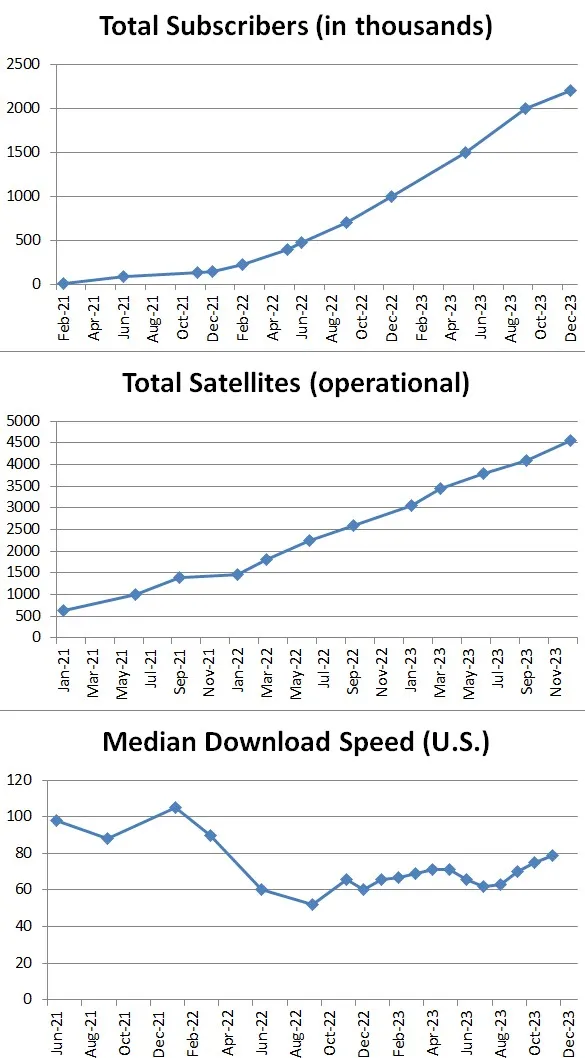
But the outcome has a second face. Astronomers watched their images fill with satellite streaks and their radio bands crowd with downlink noise; the sheer number of objects sharpened every worry about collisions and orbital debris; and the concentration of so much capability in one private company's hands unsettled governments used to controlling their own communications. Starlink solved a real problem and created new ones the world is still working out how to manage.
The story
Starlink is what reusability was for. Falcon 9's cheap, frequent, recoverable launches are the only reason a constellation of this size is affordable to build and continually replace — and Starlink, in turn, is the payload that keeps those Falcons flying at a cadence no one else can match. The two are a closed loop: the rocket makes the constellation possible, and the constellation gives the rocket something to launch, over and over, paying for itself each time.
It is also the moment low Earth orbit stopped being empty. For the whole space age, orbit was vast and sparsely occupied; a few thousand satellites had room to spare. Starlink, with tens of thousands planned and rivals racing to match it, turns near-Earth space into a shared, crowded, actively-managed commons — one where satellites must constantly dodge each other, where a single collision could cascade, and where the rules for who may fly what, and how many, are being written after the fact.
And it is a case study in a private actor moving faster than the institutions meant to govern it. Starlink deployed thousands of satellites before regulators, astronomers, or competitors had fully reckoned with the consequences — brightness, debris, spectrum, geopolitics. The constellation is a genuine public good and an unaccountable concentration of power at the same time, and both things are true because it was built by one company at a speed the old system was not designed to check.
What it gave back
Starlink's first legacy is proof that satellite internet, long a graveyard of bankrupt ventures, can actually work at planetary scale — which is why a crowd of rivals, from Amazon's Kuiper to national and European constellations, is now racing to build their own. The megaconstellation is no longer a gamble; it is the new shape of the communications industry in orbit.
Its second legacy is the crowding of low orbit itself — a permanent change to the environment of near-Earth space. The debates Starlink forced open, about brightness, debris, spectrum, and who governs a shared orbit, will define the next decades of spaceflight far beyond any one company's satellites.
And its third is financial: a working revenue engine that funds deep-space ambition. Starlink is the model for how a launch company pays for the missions that will never pay for themselves — the internet business underwriting the road to Mars.
What we can learn
The lesson of Starlink is that scale changes the nature of a thing. A hundred satellites is a communications network; ten thousand is an alteration of the sky and a new commons to be governed. Quantity, past a threshold, becomes a qualitative change — and the megaconstellation crossed that threshold before anyone had agreed on the rules for what lies on the other side.
The deeper lesson is that infrastructure built faster than it can be governed delivers real good and real risk at once. Starlink genuinely connected the unconnected — and simultaneously concentrated critical capability in private hands, crowded a shared orbit, and streaked the astronomers' sky. The task it leaves is not to undo it but to catch up to it: to build the governance a technology this powerful should have had before it flew.
Missions
- 2019 First 60 satellites a single Falcon 9 deploys 60 flat-packed satellites at once — the operational constellation begins, and the night sky gets its first Starlink 'train'
- 2021 Service goes live public beta opens; a constellation becomes a consumer internet service reaching places fibre and cell towers never did
- 2022 Ukraine Starlink terminals keep a country online through a war — and make one company's constellation a factor in national security overnight
- 2024 Direct to cell satellites begin connecting ordinary phones directly, with no terminal — the constellation starts to become a global cell tower