Amazon · USA · 2023–now

Amazon Leo (Project Kuiper)
Amazon's answer to Starlink — rebranded Amazon Leo in 2025, backed by the deepest pockets in retail and a deliberate refusal to depend on a rival's rocket.
Infrastructure ACTIVE
The land
Once Starlink proved that a megaconstellation could actually work — that thousands of small satellites in low orbit could deliver real internet to real customers — the question stopped being whether anyone would build a second one and became who. The answer with the most money behind it is Amazon. Launched as Project Kuiper and rebranded Amazon Leo in late 2025, the program is a planned constellation of thousands of satellites aimed at the same prize: global broadband from low Earth orbit, sold to consumers, businesses, and governments who cannot get it any other way.
Kuiper is the challenger, and it arrives late on purpose and by circumstance. Starlink had a years-long head start and a captive, cheap ride to orbit in its parent company's own Falcon rockets. Kuiper has neither — but it has Amazon: a company with vast capital, a global logistics and cloud business to plug the service into, and enough leverage to buy launches wholesale. The contest between them is the first real competition of the megaconstellation era.
Goals
The goal is a full commercial broadband constellation — thousands of satellites providing low-latency internet worldwide, integrated with Amazon's Web Services cloud so that connectivity and computing are sold together. The strategic aim is not just to sell internet but to extend Amazon's reach to every corner of the planet not yet wired, and to keep a competitor from owning that market unopposed.
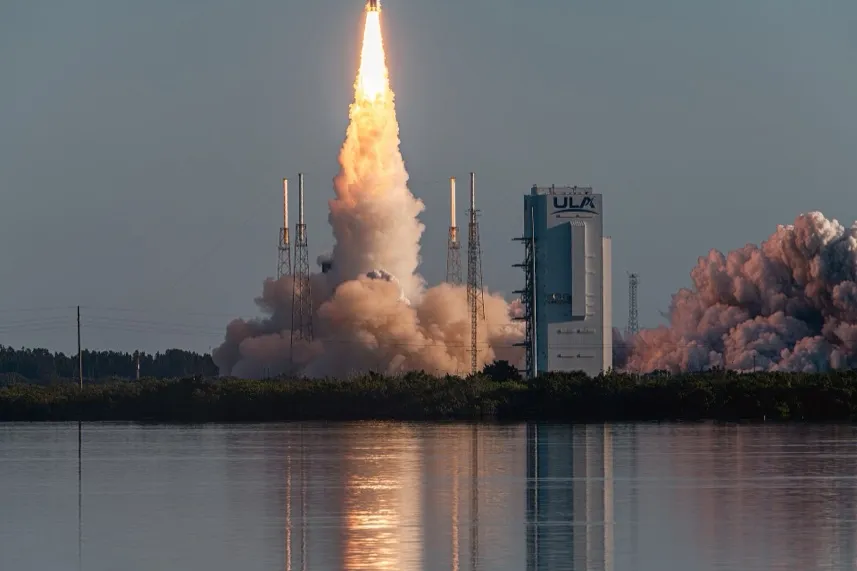
A defining goal is launch independence from SpaceX. Because Kuiper competes directly with Starlink, buying rides on Falcon 9 would mean funding and depending on its rival — so Amazon deliberately spread its enormous launch contracts across many providers: United Launch Alliance's Atlas V and Vulcan, Arianespace's Ariane 6, and Blue Origin's New Glenn. It is one of the largest launch-procurement deals in history, structured specifically to avoid the one rocket that would have been easiest to buy.
Outcome
Kuiper is early in its deployment. Two prototype satellites reached orbit in 2023 and validated the design; production satellites began launching in the mid-2020s, years behind Starlink. An FCC deadline that had required half the constellation to be deployed by mid-2026 to secure spectrum rights was waived in June 2026, easing the pace pressure — though the competitive urgency of catching Starlink remains. The outcome — whether Kuiper becomes a genuine second force or a costly latecomer — is still being decided in orbit.
What is already clear is that the megaconstellation is no longer a one-company phenomenon. Kuiper's arrival, alongside European and national constellations, confirms that low Earth orbit is being built out by multiple competing operators at once — multiplying the benefits of connectivity and multiplying, in exact proportion, the problems of a crowded orbit: more objects to track, more collision risk, more streaks across the astronomers' sky, from more owners answering to more governments.
Kuiper also stress-tests the launch market itself. Its multi-provider strategy is a lifeline for rockets that need payloads — Vulcan, Ariane 6, and New Glenn all benefit from having a customer this large — and a bet that a constellation can be built without vertical integration, buying its rides rather than flying its own. Whether that is competitive against a rival that launches itself is one of the open questions the program will answer.
The story
The story of Kuiper is the story of the fast-follower. Starlink took the technical and financial risk of proving the megaconstellation; Kuiper's task is to prove that a well-capitalized second mover can catch a first mover with a head start and its own rockets. Amazon's advantages are real — money, cloud infrastructure, a consumer brand, logistics — but so is the disadvantage of starting the race after the leader has already lapped the field once.
It is also a study in the strategic weight of launch. Kuiper's most distinctive decision — to buy rides everywhere except from SpaceX — is a reminder that in the constellation era, access to orbit is not a neutral utility but a competitive weapon. When your rival owns the cheapest rocket, refusing to use it is expensive; Amazon judged that dependence on a competitor was more expensive still. The launch manifest is, in effect, part of the business strategy.
And it deepens the governance problem Starlink opened. Two rival megaconstellations, then several, filling the same shells of low orbit, raise the stakes on every unresolved question — coordination between operators, collision avoidance across companies that do not share data, spectrum sharing, and the brightness that astronomers have to live with. Competition is good for customers and hard for the commons; Kuiper makes both truer.
What it gave back
Kuiper's legacy, still forming, is the confirmation that satellite internet is a real market with room for more than one giant. Its very existence changed Starlink from a monopoly-in-waiting into one competitor among several, and validated the megaconstellation as the settled future of orbital communications rather than one company's gamble.
Its second legacy is to the launch industry. By spreading the largest commercial launch contract in history across Atlas V, Vulcan, Ariane 6, and New Glenn, Amazon underwrote the business case for a whole generation of rockets — proof that a constellation can be a customer that keeps multiple launch vehicles alive.
And it adds a second major operator to the crowding of low orbit, making the governance of a shared, congested near-Earth space not a Starlink problem but an industry one — the environment that every future satellite, crewed spacecraft, and telescope will have to fly through.
What we can learn
The lesson of Kuiper is that proving something is possible invites competition to build it better or cheaper — and that the second mover's problem is entirely different from the first's. Starlink had to prove the megaconstellation could work at all; Kuiper has to prove a latecomer can catch a leader who owns the road to orbit. Money helps; a head start and your own rockets may help more.
The deeper lesson is that in a networked capability, control of the supply chain is strategy. Kuiper's launch choices — deliberately routed around its rival — show that when access to orbit is scarce and partly owned by a competitor, who you buy your rides from is not a procurement detail but a decision about independence, and worth paying a premium to get right.
Missions
- 2023 KuiperSat prototypes two test satellites reach orbit to validate the design before mass production begins
- 2025 Production launches the operational constellation begins deploying — years behind Starlink, and racing a regulatory clock to keep its spectrum
- 2025 Multi-rocket by design Kuiper buys launches across many providers — Atlas V, Vulcan, Ariane 6, New Glenn — rather than depending on a rival's rocket the way it would on Falcon
Hardware
- Kuiper constellation